Nasiri R, Akbarpour S, Zali A R, Khodakarami N, Boochani M H, Noory A R, Soori H
Department of Environmental Health Engineering, School of Public Health and Safety, Shahid Beheshti University of Medical Sciences, Tehran, Iran.
Department of Epidemiology and Biostatistics, School of Public Health, Tehran University of Medical Sciences, Tehran, Iran.
GeoJournal. 2022;87(4):3291-3305. doi: 10.1007/s10708-021-10438-x. Epub 2021 May 12.
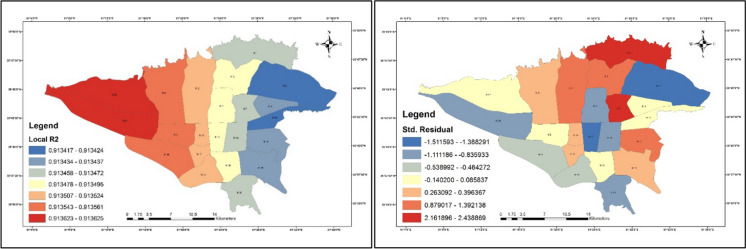
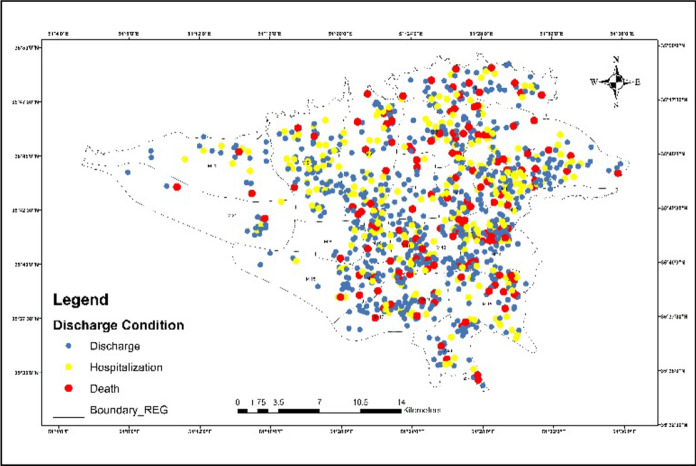
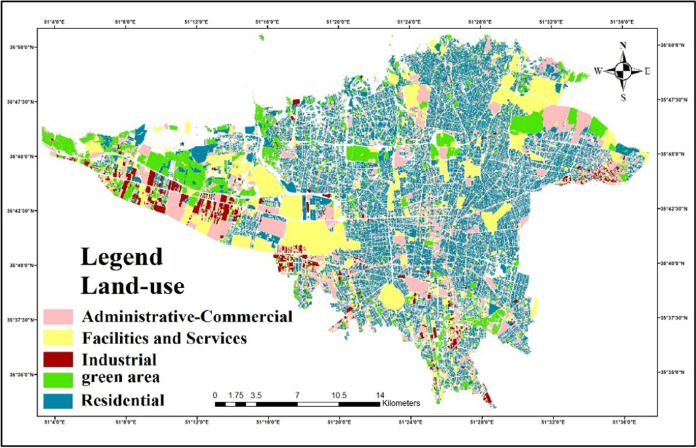
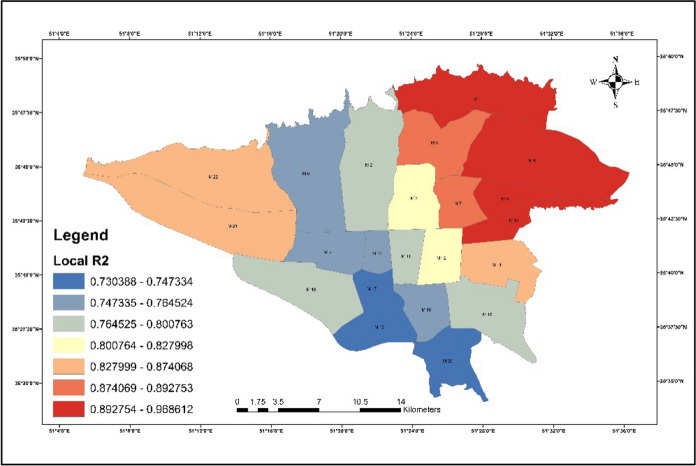
COVID-19 has been distinguished as a zoonotic coronavirus, like SARS coronavirus and MERS coronavirus. Tehran metropolis, as the capital of Iran, has a high density of residents that experienced a high incidence and mortality rates which daily increase the number of death and cases. In this study, the IDW (Inverse Distance Weight), Hotspots, and GWR (Geography Weighted Regression) Model are used as methods for analyzing big data COVID-19 in Tehran. The results showed that the majority of patients and deaths were men, but the death rate was higher in women than in men; also was observed a direct relationship between the area of the houses, and the infected rate, to COVID-19. Also, the results showed a disproportionate distribution of patients in Tehran, although in the eastern regions the number of infected people is higher than in other districts; the eastern areas have a high population density as well as residential land use, and there is a high relationship between population density in residential districts and administrative-commercial and the number of COVID-19 cases in all regions. The outputs of local R were interesting among patients and underlying disorders; the local R between hypertension and neurological diseases was 0.91 and 0.79, respectively, which was higher than other disorders. The highest rates of local R for diabetes and heart disease were 0.67 and 0.55, respectively. From this study, it can be concluded the restrictions must be considered especially, in areas densely populated for all people.
新型冠状病毒肺炎(COVID-19)已被确认为一种人畜共患的冠状病毒,与严重急性呼吸综合征冠状病毒和中东呼吸综合征冠状病毒类似。德黑兰作为伊朗首都,居民密度高,经历了高发病率和死亡率,每日死亡人数和病例数不断增加。在本研究中,反距离加权法(IDW)、热点分析和地理加权回归(GWR)模型被用作分析德黑兰COVID-19大数据的方法。结果表明,大多数患者和死亡者为男性,但女性死亡率高于男性;还观察到房屋面积与COVID-19感染率之间存在直接关系。此外,结果显示德黑兰患者分布不均衡,尽管东部地区的感染人数高于其他地区;东部地区人口密度高,住宅用地多,居民区人口密度与行政商业区以及所有地区的COVID-19病例数之间存在高度相关性。在患者和潜在疾病中,局部R的结果很有趣;高血压与神经系统疾病之间的局部R分别为0.91和0.79,高于其他疾病。糖尿病和心脏病的局部R最高值分别为0.67和0.55。从这项研究可以得出结论,必须特别考虑在人口密集地区对所有人实施限制措施。