Zhang Jiping, Huang Jianhao
The Office of Psychological Counselor, College of Foreign Languages, Ningbo University, Ningbo, China.
Department of Education Management, China-Asean International College, Dhurakij Pundit University, Bangkok, Thailand.
Front Psychol. 2021 Apr 28;12:643184. doi: 10.3389/fpsyg.2021.643184. eCollection 2021.
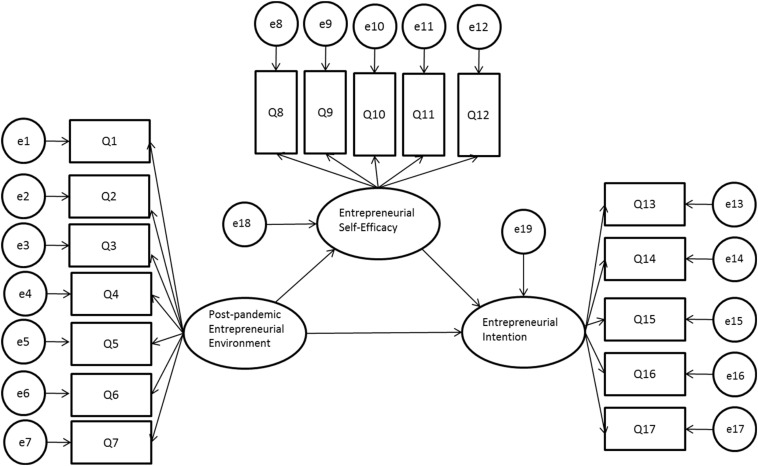
The mechanism of how the COVID-19 global pandemic has affected the entrepreneurial intentions of college students remains unknown. To investigate the impact of the entrepreneurial environment on entrepreneurial self-efficacy and entrepreneurial intentions in the post-pandemic era, 913 college students were invited to complete a questionnaire. The data were analyzed with structural equation models. The conclusions revealed by the questionnaire are as followed: college students have retained some entrepreneurial intention in the post-pandemic era; the factors influencing the entrepreneurial intention include sex, family entrepreneurial history, major, and education background; and entrepreneurial self-efficacy can play a major role to mediate the impact caused by the post-pandemic entrepreneurial environment on entrepreneurial intentions. The research conclusions provide important insights to improve college students' entrepreneurial intentions in the post-pandemic environment.
新冠疫情全球大流行如何影响大学生创业意向的机制尚不清楚。为了调查后疫情时代创业环境对创业自我效能感和创业意向的影响,邀请了913名大学生完成一份问卷。采用结构方程模型对数据进行分析。问卷得出的结论如下:后疫情时代大学生仍保留一定的创业意向;影响创业意向的因素包括性别、家族创业史、专业和教育背景;创业自我效能感在调解后疫情时代创业环境对创业意向的影响方面可发挥主要作用。研究结论为改善后疫情环境下大学生的创业意向提供了重要见解。