Epilepsy Unit, University of Glasgow, Glasgow, United Kingdom.
Epilepsy and Migraine Treatment Center, Krakow, Poland.
Cannabis Cannabinoid Res. 2021 Dec;6(6):528-536. doi: 10.1089/can.2020.0075. Epub 2021 Feb 15.
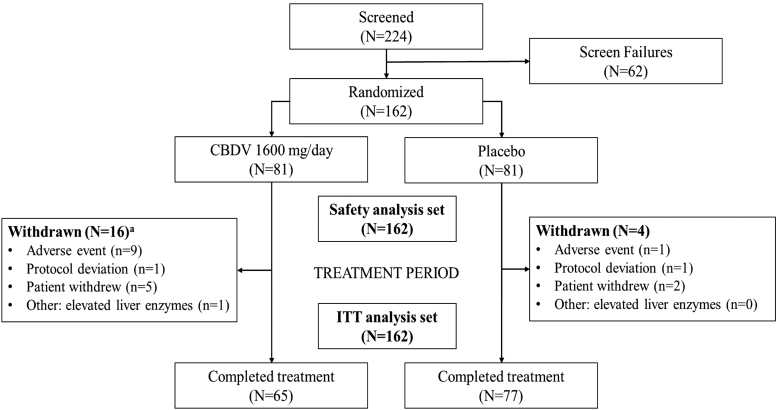
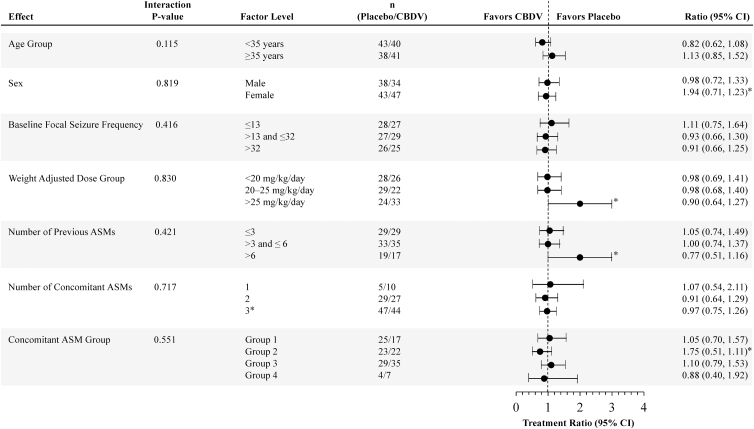
We assessed the efficacy, safety, and tolerability of cannabidivarin (CBDV) as add-on therapy in adults with inadequately controlled focal seizures. One hundred and sixty-two participants (CBDV =81; placebo =81) were enrolled. After a 4-week baseline, participants titrated from 400 to 800 mg CBDV twice daily (b.i.d.) (or placebo) over 2 weeks, followed by 6 weeks stable dosing (at 800 mg b.i.d.) and a 12-day taper period. The primary endpoint was the change from baseline in focal seizure frequency during the 8-week treatment period. Secondary endpoints included additional efficacy measures relating to seizures, physician- and participant-reported outcomes, change in the use of rescue medication, cognitive assessments, and safety. Median baseline focal seizure frequencies were 17-18 per 28 days in both groups, and similar reductions in frequency were observed in the CBDV (40.5%) and placebo (37.7%) groups during the treatment period (treatment ratio [% reduction] CBDV/placebo: 0.95 [4.6]; confidence interval: 0.78-1.17 [-16.7 to 21.9]; =0.648). There were no differences between the CBDV and placebo groups for any seizure subtype. There were no significant treatment differences between CBDV and placebo groups for any of the secondary efficacy outcome measures. Overall, 59 (72.8%) of participants in the CBDV group and 39 (48.1%) in the placebo group had ≥1 treatment-emergent adverse event (AE); the 3 most common were diarrhea, nausea, and somnolence. The incidence of serious AEs was low (3.7% in the CBDV group vs. 1.2% in the placebo group). There was little or no effect of CBDV on vital signs, physical examination, or electrocardiogram findings. Elevations in serum transaminases (alanine aminotransferase or aspartate aminotransferase) to levels >3×upper limit of normal occurred in three participants taking CBDV (two discontinued as a result) and one taking placebo; however, none met the criteria for potential Hy's Law cases. It is likely the 40.5% seizure reduction with CBDV represents an appropriate pharmacological response in this population with focal seizures. The placebo response was, however, high, which may reflect the participants' expectations of CBDV, and a treatment difference from placebo was not observed. CBDV was generally well tolerated. Clinical Trial Registration number: NCT02365610.
我们评估了大麻二酚(CBDV)作为附加疗法在未充分控制的局灶性癫痫发作成人患者中的疗效、安全性和耐受性。162 名参与者(CBDV=81;安慰剂=81)入组。在 4 周基线期后,参与者在 2 周内从 400 至 800mg CBDV 每日两次(b.i.d.)(或安慰剂)滴定,随后进行 6 周稳定剂量(800mg b.i.d.)和 12 天的减量期。主要终点是 8 周治疗期间基线时局灶性癫痫发作频率的变化。次要终点包括与癫痫发作相关的其他疗效指标、医生和参与者报告的结果、急救药物使用的变化、认知评估和安全性。两组基线期局灶性癫痫发作频率均为 17-18 次/28 天,CBDV 组(40.5%)和安慰剂组(37.7%)在治疗期间频率均有类似降低(治疗比值[降低百分比]CBDV/安慰剂:0.95[4.6];置信区间:0.78-1.17[-16.7 至 21.9];=0.648)。CBDV 组和安慰剂组任何癫痫发作亚型均无差异。CBDV 组和安慰剂组任何次要疗效终点均无显著治疗差异。总体而言,CBDV 组 59(72.8%)名参与者和安慰剂组 39(48.1%)名参与者出现≥1 次治疗出现的不良事件(AE);最常见的是腹泻、恶心和嗜睡。严重 AE 的发生率较低(CBDV 组 3.7%,安慰剂组 1.2%)。CBDV 对生命体征、体格检查或心电图检查结果几乎没有影响。三名服用 CBDV 的参与者(两名因此停药)和一名服用安慰剂的参与者的血清转氨酶(丙氨酸氨基转移酶或天冬氨酸氨基转移酶)升高至正常值上限的 3 倍以上;然而,均不符合潜在 Hy's 法则病例的标准。CBDV 导致的 40.5%癫痫发作减少可能代表该人群局灶性癫痫发作的适当药理反应。然而,安慰剂的反应很高,这可能反映了参与者对 CBDV 的期望,并且未观察到与安慰剂的治疗差异。CBDV 总体耐受性良好。临床试验注册号:NCT02365610。