Yu Han, Yu Jingbo, Li Linlin, Zhang Yujia, Xin Shuquan, Ni Xiuzhen, Sun Yuan, Song Kai
School of Life Sciences, Changchun Normal University, Changchun, China.
Center of Pharmaceutical Engineering and Technology, Harbin University of Commerce, Harbin, China.
Front Chem. 2021 May 3;9:677876. doi: 10.3389/fchem.2021.677876. eCollection 2021.
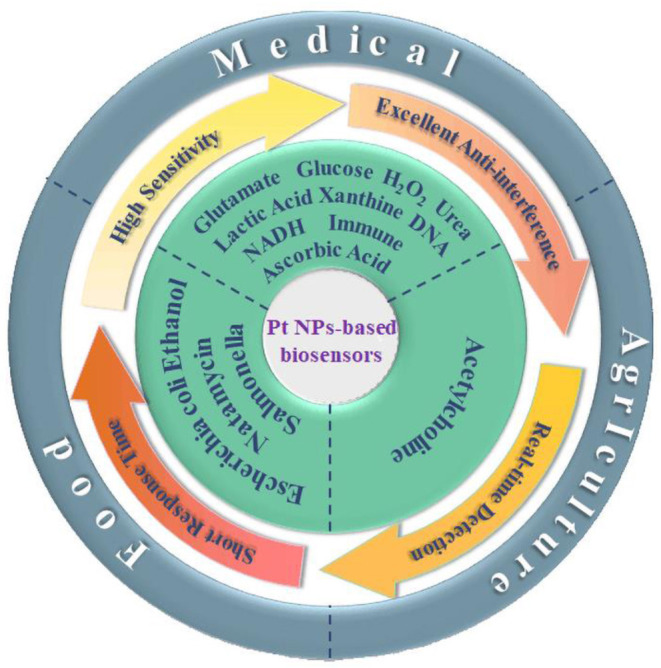
The detection of biomolecules using various biosensors with excellent sensitivity, selectivity, stability, and reproducibility, is of great significance in the analytical and biomedical fields toward achieving their practical applications. Noble metal nanoparticles are favorable candidates due to their unique optical, surface electrical effect, and catalytic properties. Among these noble metal nanoparticles, platinum nanoparticles (Pt NPs) have been widely employed for the detection of bioactive substances such as glucose, glutamic acid, and hormones. However, there is still a long way to go before the potential challenges in the practical applications of biomolecules are fully overcome. Bearing this in mind, combined with our research experience, we summarized the recent progress of the Pt NP-based biosensors and highlighted the current problems that exist in their practical applications. The current review would provide fundamental guidance for future applications using the Pt NP-based biosensors in food, agricultural, and medical fields.
利用各种具有出色灵敏度、选择性、稳定性和可重复性的生物传感器来检测生物分子,在分析和生物医学领域实现其实际应用方面具有重要意义。贵金属纳米粒子因其独特的光学、表面电学效应和催化特性而成为理想的候选材料。在这些贵金属纳米粒子中,铂纳米粒子(Pt NPs)已被广泛用于检测葡萄糖、谷氨酸和激素等生物活性物质。然而,在生物分子实际应用中的潜在挑战得到完全克服之前,仍有很长的路要走。考虑到这一点,结合我们的研究经验,我们总结了基于铂纳米粒子的生物传感器的最新进展,并突出了其实际应用中存在的当前问题。本综述将为未来基于铂纳米粒子的生物传感器在食品、农业和医学领域的应用提供基础指导。