Szklarz Zbigniew, Kołczyk-Siedlecka Karolina, Vereshchagina Elizaveta, Herbjørnrød Aina, Wittendorp Paul, Jain Shruti, Wójcik Pawel Jerzy
Department of Microfluidic Electrochemistry, Redoxme AB, 30-059 Kraków, Poland.
Faculty of Foundry Engineering, Department of Chemistry and Corrosion of Metals, AGH University Krakow, al. A. Mickiewicza 30, 30-059 Kraków, Poland.
Materials (Basel). 2024 Mar 15;17(6):1352. doi: 10.3390/ma17061352.
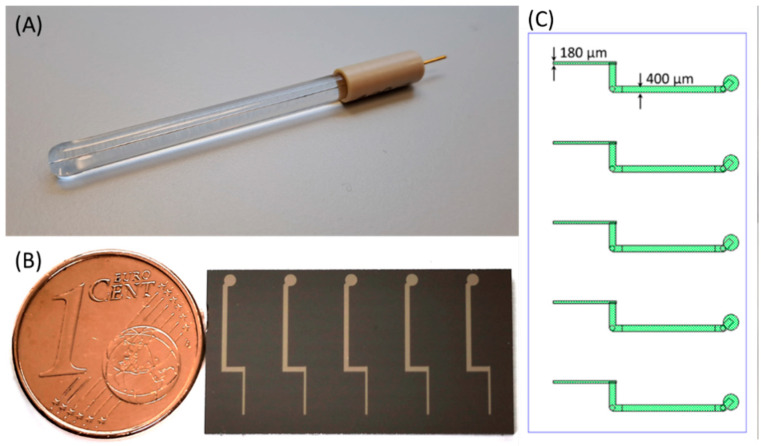
This paper discusses the electrochemical properties of thin-film, planar, titanium-platinum (Ti-Pt) microelectrodes fabricated using glass or silicon substrates and compares their performance to the classic platinum (Pt) microelectrodes embedded in glass. To analyze the possible differences coming both from the size of the tested electrodes as well as from the substrate, short- and long-term electrochemical tests were performed on selected water electrolytes (KCl, HCl, KOH). To study the electrochemical response of the electrodes, the cyclic voltammetry (CV) measurements were carried out at different scanning rates (from 5 to 200 mV/s). Long-term tests were also conducted, including one thousand cycles with a 100 mV/s scan rate to investigate the stability of the tested electrodes. Before and after electrochemical measurements, the film morphology was analyzed using a scanning electron microscope (SEM). The good quality of the thin-film Pt electrodes and the high repeatability in electrochemical response have been shown. There are minor differences in standard deviation values taken from electrochemical measurements, comparing thin-film and wire-based electrodes. Damages or any changes on the electrodes' surfaces were revealed by SEM observations after long-term electrochemical tests.
本文讨论了使用玻璃或硅基体制备的薄膜平面钛铂(Ti-Pt)微电极的电化学性质,并将其性能与嵌入玻璃中的经典铂(Pt)微电极进行了比较。为了分析来自测试电极尺寸以及基底的可能差异,在选定的水电解质(KCl、HCl、KOH)上进行了短期和长期电化学测试。为了研究电极的电化学响应,在不同扫描速率(5至200 mV/s)下进行循环伏安法(CV)测量。还进行了长期测试,包括以100 mV/s扫描速率进行一千次循环,以研究测试电极的稳定性。在电化学测量前后,使用扫描电子显微镜(SEM)分析薄膜形态。已证明薄膜铂电极质量良好且电化学响应具有高重复性。比较薄膜电极和线状电极,电化学测量的标准偏差值存在微小差异。长期电化学测试后,SEM观察揭示了电极表面的损伤或任何变化。