Department of Ophthalmology, Bascom Palmer Eye Institute, University of Miami Miller School of Medicine, Miami, Florida, USA.
Wilmer Eye Institute, Johns Hopkins University School of Medicine, Baltimore, Maryland, USA.
Am J Ophthalmol. 2021 Oct;230:151-155. doi: 10.1016/j.ajo.2021.05.008. Epub 2021 May 19.
The purpose of this study was to determine whether severe acute respiratory syndrome coronavirus 2 (SARS-CoV-2) is detectable in the aqueous of asymptomatic individuals presenting for ophthalmic surgery.
Prospective cross-sectional study.
Setting and participants: all patients undergoing anterior segment surgery at an ambulatory surgical center (ASC) belonging to a tertiary academic center in South Florida during a 102-day period between June and September 2020 received nasal swab testing for SARS-CoV-2 and underwent a relevant review of symptoms prior to surgery, with negative results required for both in order to proceed with surgery. Main outcomes and measurements: a small sample of aqueous humor (approximately 0.2 cc) was acquired at the beginning of anterior segment surgery from all participants. Aqueous humor was analyzed for SARS-CoV-2 viral ribonucleic acid (RNA) using real-time reverse transcriptase polymerase chain reaction. Demographic information was acquired from participants for secondary analyses.
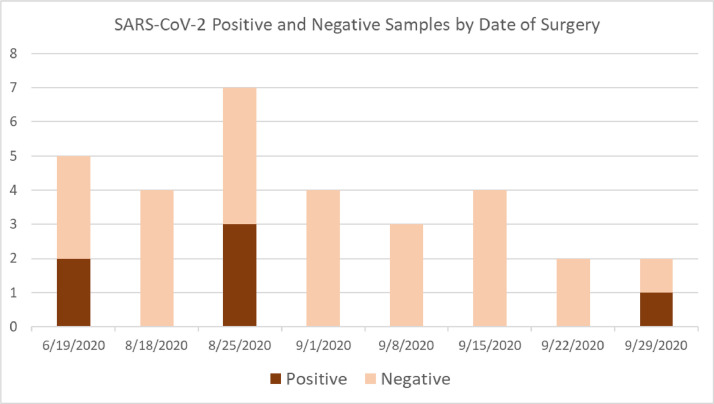
A total of 70 samples were acquired. Of those, 39 samples were excluded due to insufficient material or inconclusive results. Of 31 samples that were successfully analyzed, 6 (19.4%) demonstrated detectable SARS-CoV-2 RNA. None of the 6 individuals (0%) with detectable viral RNA in aqueous humor reported symptoms during the year, compared to 2 of 25 individuals (8%) with negative samples (P = 1). Positive samples were distributed throughout the study period, including both the first and the last days of enrollment.
The presence of SARS-CoV-2 viral RNA in aqueous despite negative nasal swab testing confirmed its presence beyond the blood-ocular barrier in asymptomatic individuals and raises the possibility that the virus may persist in immunoprivileged spaces despite an absence of symptoms.
本研究旨在确定无症状个体在接受眼科手术时,其眼房水中是否可检测到严重急性呼吸综合征冠状病毒 2(SARS-CoV-2)。
前瞻性横断面研究。
研究场所和参与者:2020 年 6 月至 9 月期间,在佛罗里达州南部的一家三级学术中心的门诊手术中心(ASC),对所有接受眼前段手术的患者进行鼻拭子 SARS-CoV-2 检测,并在手术前对相关症状进行了回顾,只有在鼻拭子和症状均为阴性的情况下,才能进行手术。主要观察指标:所有参与者在眼前段手术开始时,均采集少量房水(约 0.2cc)。使用实时逆转录聚合酶链反应(RT-PCR)分析房水中的 SARS-CoV-2 病毒核糖核酸(RNA)。对参与者的人口统计学信息进行二次分析。
共采集 70 个样本。其中 39 个样本因材料不足或结果不确定而被排除。在成功分析的 31 个样本中,有 6 个(19.4%)检测到 SARS-CoV-2 RNA。在 6 个检测到病毒 RNA 的患者中(0%),无人在过去 1 年中出现症状,而在 25 个阴性样本患者中,有 2 人(8%)出现症状(P = 1)。阳性样本分布在整个研究期间,包括入组的第一天和最后一天。
尽管鼻拭子检测结果为阴性,但在无症状个体的房水中仍可检测到 SARS-CoV-2 病毒 RNA,证实了其在血眼屏障之外的存在,并提示该病毒可能存在于免疫特权部位,尽管无症状。