Department of Pediatrics, University of California San Francisco (AL Beck, JC Huang, and L Lendzion).
Department of Pediatrics, University of California San Francisco (AL Beck, JC Huang, and L Lendzion).
Acad Pediatr. 2021 Nov-Dec;21(8):1434-1440. doi: 10.1016/j.acap.2021.05.015. Epub 2021 May 21.
To understand the impact of the coronavirus disease 2019 (COVID-19) pandemic on parental perceptions of health behaviors and food insecurity among children with overweight and obesity living in San Francisco and to assess the relationship between food insecurity and dietary intake during the pandemic.
Parents of children ages 4 to 12 in San Francisco with body mass index ≥85th percentile measured at a clinic visit at a Federally Qualified Health Center or academic practice from January 1st to March 15th, 2020 were eligible to participate. Parents completed a survey reporting on child health behaviors and household food insecurity prior to and since the start of the pandemic. Survey items were abstracted from validated surveys with adaptations. Regression models evaluated associations between food insecurity and dietary intake variables.
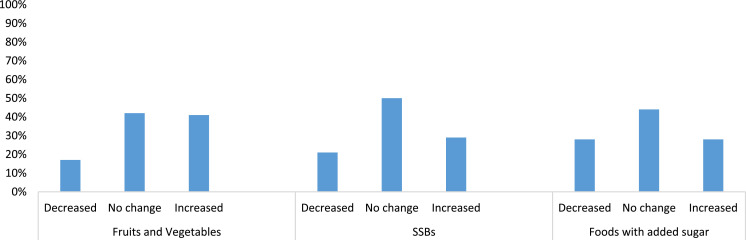
Most participants (n = 145) were publicly insured (90%), Latino (77%), and spoke Spanish at home (70%). Parents perceived that child mean daily nonacademic screen time was higher during the pandemic compared to before (3.8 hours vs 1.6 hours). Mean daily physical activity was reported to be lower compared to prior to the pandemic (1 hour vs 1.8 hours). On average, reported bedtime shifted 1.6 hours later. Food insecurity increased significantly but was not associated with intake of fruits, vegetables, sugar-sweetened beverages, or foods with added sugar during the pandemic.
Parents of children with overweight or obesity in San Francisco perceive increased child screen time, decreased physical activity and later bedtimes during the COVID-19 pandemic. Findings suggest a need for policies that support healthy lifestyle behaviors among low-income children during the pandemic.
了解 2019 年冠状病毒病(COVID-19)大流行对旧金山超重和肥胖儿童父母对健康行为和儿童食物不安全认知的影响,并评估大流行期间食物不安全与饮食摄入之间的关系。
在联邦合格健康中心或学术实践中的诊所就诊时,对孩子的体重指数(BMI)≥第 85 百分位数的 4 至 12 岁的旧金山父母进行了调查。父母在大流行之前和之后完成了一份报告儿童健康行为和家庭食物不安全的调查。调查项目从经过验证的调查中提取,并进行了改编。回归模型评估了食物不安全与饮食摄入变量之间的关系。
大多数参与者(n=145)具有公共保险(90%),拉丁裔(77%),在家说西班牙语(70%)。父母认为孩子在大流行期间的非学术性日常屏幕时间比以前高(3.8 小时对 1.6 小时)。与大流行前相比,日常体育活动的平均报告时间较低(1 小时对 1.8 小时)。平均而言,报告的就寝时间推迟了 1.6 小时。食物不安全显著增加,但与大流行期间水果、蔬菜、含糖饮料或添加糖的食物摄入量无关。
旧金山超重或肥胖儿童的父母认为孩子在 COVID-19 大流行期间的屏幕时间增加、体力活动减少和就寝时间延迟。调查结果表明,在大流行期间需要制定政策,以支持低收入儿童的健康生活方式行为。