Briot Kellen, Pizano Adrien, Bouvard Manuel, Amestoy Anouck
Medical Sciences Department, University of Bordeaux, Bordeaux, France.
Pôle Universitaire de Psychiatrie de l'Enfant et de l'Adolescent, Centre Hospitalier Charles-Perrens, Bordeaux, France.
Front Psychiatry. 2021 May 5;12:634756. doi: 10.3389/fpsyt.2021.634756. eCollection 2021.
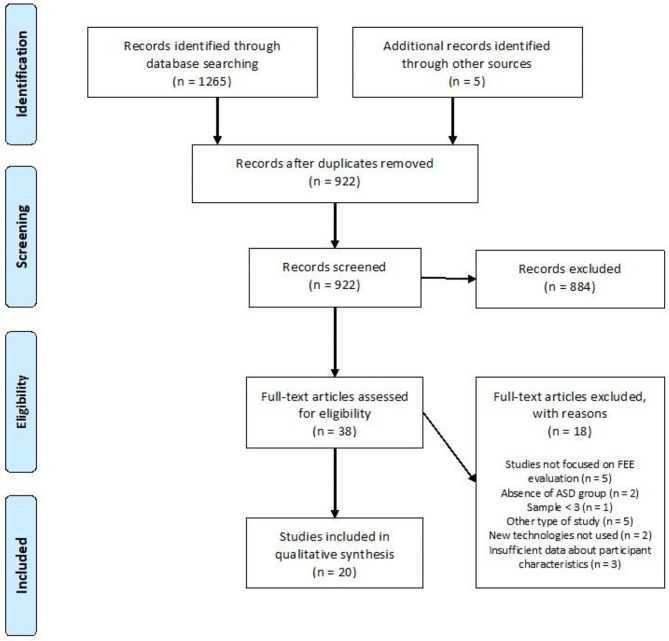
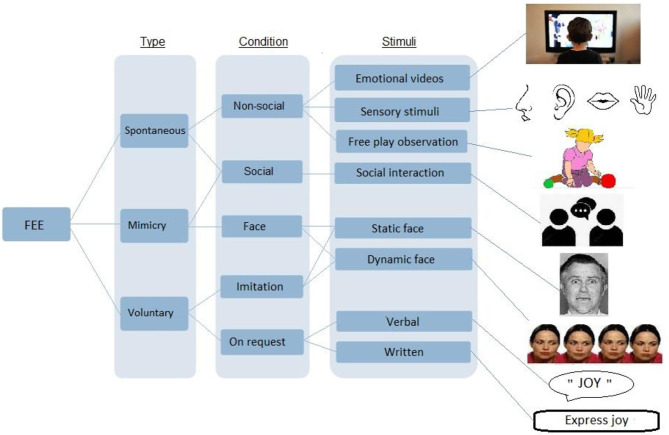
The ability to recognize and express emotions from facial expressions are essential for successful social interactions. Facial Emotion Recognition (FER) and Facial Emotion Expressions (FEEs), both of which seem to be impaired in Autism Spectrum Disorders (ASD) and contribute to socio-communicative difficulties, participate in the diagnostic criteria for ASD. Only a few studies have focused on FEEs processing and the rare behavioral studies of FEEs in ASD have yielded mixed results. Here, we review studies comparing the production of FEEs between participants with ASD and non-ASD control subjects, with a particular focus on the use of automatic facial expression analysis software. A systematic literature search in accordance with the PRISMA statement identified 20 reports published up to August 2020 concerning the use of new technologies to evaluate both spontaneous and voluntary FEEs in participants with ASD. Overall, the results highlight the importance of considering socio-demographic factors and psychiatric co-morbidities which may explain the previous inconsistent findings, particularly regarding quantitative data on spontaneous facial expressions. There is also reported evidence for an inadequacy of FEEs in individuals with ASD in relation to expected emotion, with a lower quality and coordination of facial muscular movements. Spatial and kinematic approaches to characterizing the synchrony, symmetry and complexity of facial muscle movements thus offer clues to identifying and exploring promising new diagnostic targets. These findings have allowed hypothesizing that there may be mismatches between mental representations and the production of FEEs themselves in ASD. Such considerations are in line with the Facial Feedback Hypothesis deficit in ASD as part of the Broken Mirror Theory, with the results suggesting impairments of neural sensory-motor systems involved in processing emotional information and ensuring embodied representations of emotions, which are the basis of human empathy. In conclusion, new technologies are promising tools for evaluating the production of FEEs in individuals with ASD, and controlled studies involving larger samples of patients and where possible confounding factors are considered, should be conducted in order to better understand and counter the difficulties in global emotional processing in ASD.
从面部表情识别和表达情绪的能力对于成功的社交互动至关重要。面部情绪识别(FER)和面部情绪表达(FEEs)在自闭症谱系障碍(ASD)中似乎均受损,并导致社会交流困难,二者均参与了ASD的诊断标准。仅有少数研究关注FEEs加工,且关于ASD中FEEs的罕见行为学研究结果不一。在此,我们综述了比较ASD患者与非ASD对照受试者之间FEEs产生情况的研究,特别关注自动面部表情分析软件的使用。根据PRISMA声明进行的系统文献检索确定了截至2020年8月发表的20篇报告,这些报告涉及使用新技术评估ASD患者的自发和自愿FEEs。总体而言,结果凸显了考虑社会人口统计学因素和精神共病的重要性,这些因素可能解释了先前不一致的发现,尤其是关于自发面部表情的定量数据。也有报道称,ASD个体的FEEs在与预期情绪相关方面存在不足,面部肌肉运动的质量和协调性较低。描述面部肌肉运动同步性、对称性和复杂性的空间和运动学方法因此为识别和探索有前景的新诊断靶点提供了线索。这些发现使人们推测,在ASD中,心理表征与FEEs本身的产生之间可能存在不匹配。这些考虑与作为破镜理论一部分的ASD中面部反馈假说缺陷一致,结果表明参与处理情绪信息和确保情绪具身表征的神经感觉运动系统受损,而情绪具身表征是人类同理心的基础。总之,新技术是评估ASD个体FEEs产生情况的有前景的工具,应该开展涉及更大患者样本且尽可能考虑混杂因素的对照研究,以便更好地理解和应对ASD中整体情绪加工的困难。