Pereira Hugo Vieira, Palmeira Antnio Labisa, Encantado Jorge, Marques Marta Moreira, Santos Ins, Carraa Eliana Veiga, Teixeira Pedro J
Centro Interdisciplinar Para o Estudo da Performance Humana (CIPER), Faculdade de Motricidade Humana, University of Lisbon, Lisbon, Portugal.
Centro de Investigao em Desporto, Educao Fsica, Exerccio e Sade (CIDEFES), Faculdade de Educao Fsica e Desporto, Universidade Lusfona, Lisbon, Portugal.
Front Psychol. 2021 May 7;12:624783. doi: 10.3389/fpsyg.2021.624783. eCollection 2021.
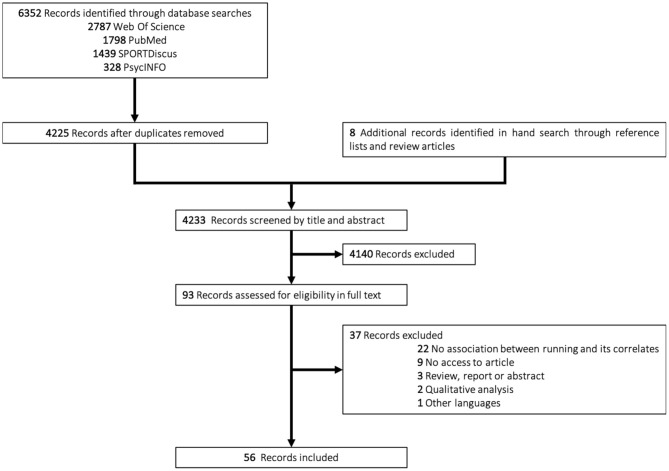
The aim of this review was to systematically synthesize the published literature describing the psychological and behavioral correlates of recreational running in adults, defined as running for leisure, with or without a competitive component. Quantitative research published in peer-reviewed journals until January 2021 were included. Studies were identified through MEDLINE, PsycINFO, SPORTDiscus, and Web of Science and were included in this review if they (1) were aimed at recreational running, (2) included general adult samples (18 years or older, without a diagnosed medical condition or metabolic disorder), and (3) assessed psychological or behavioral correlates of recreational running. Fifty-six articles reporting 58 studies met the eligibility criteria and were included. There were 27 cross-sectional studies, 12 longitudinal studies, and 19 trials (8 non-controlled trials, 5 controlled trials, and 6 randomized controlled trials) ( = 37,501, 1877 years old, 43% women). Twenty-eight studies assessed antecedents of running behavior, and 25 studies used running behavior as treatment or predictor of a given effect or outcome. Four studies examined both predictors and outcomes of running. Thirty-one studies showed poor quality, while 20 had fair and 7 good quality. Motives were the most frequently studied antecedent of running behavior ( = 19), and results suggest that the highest-ranked or more prevalent motives were physical health, psychological motives, and personal achievement. Additionally, perceived control, attitude toward running, intention and subjective norms, self-efficacy, and social support may have also played a role in the adoption of recreational running. Moreover, improvements in mood ( = 10) and well-being ( = 10) were the most frequently reported positive outcomes of running. Reductions in depression, anxiety, and stress were also reported in included studies. To our knowledge, this is the first systematic review on this topic. The identification of behavioral and psychological correlates of recreational running across populations can contribute to inform and guide a public policy agenda, focused on helping people sustain regular physical activity, through a modality they have chosen and appear to enjoy. https://www.crd.york.ac.uk/prospero/display_record.php?RecordID=68954, identifier: CRD42017068954.
本综述的目的是系统地综合已发表的文献,这些文献描述了成年人休闲跑步(定义为以休闲为目的跑步,有无竞争成分均可)的心理和行为关联。纳入了截至2021年1月在同行评审期刊上发表的定量研究。通过MEDLINE、PsycINFO、SPORTDiscus和科学网检索研究,如果研究(1)针对休闲跑步,(2)纳入一般成人样本(18岁及以上,无确诊疾病或代谢紊乱),(3)评估休闲跑步的心理或行为关联,则纳入本综述。56篇报告58项研究的文章符合纳入标准并被纳入。其中有27项横断面研究、12项纵向研究和19项试验(8项非对照试验、5项对照试验和6项随机对照试验)(n = 37501,年龄1877岁,43%为女性)。28项研究评估了跑步行为的前因,25项研究将跑步行为用作给定效应或结果的治疗方法或预测因素。4项研究同时考察了跑步的预测因素和结果。31项研究质量较差,20项质量一般,7项质量良好。动机是跑步行为最常被研究的前因(n = 19),结果表明排名最高或最普遍的动机是身体健康、心理动机和个人成就。此外,感知控制、对跑步的态度、意图和主观规范、自我效能感和社会支持在休闲跑步的养成中可能也起到了作用。此外,情绪改善(n = 10)和幸福感提升(n = 10)是跑步最常被报告的积极结果。纳入的研究中也报告了抑郁、焦虑和压力的减轻。据我们所知,这是关于该主题的首次系统综述。确定不同人群中休闲跑步的行为和心理关联有助于为公共政策议程提供信息并加以指导,该议程侧重于通过人们选择并似乎喜欢的方式帮助他们维持定期体育活动。https://www.crd.york.ac.uk/prospero/display_record.php?RecordID=68954,标识符:CRD42017068954。