Department of Psychiatry (UPK), University of Basel, Basel, Switzerland.
Department of Mathematics and Computer Science, University of Basel, Basel, Switzerland.
Transl Psychiatry. 2021 May 24;11(1):312. doi: 10.1038/s41398-021-01409-4.
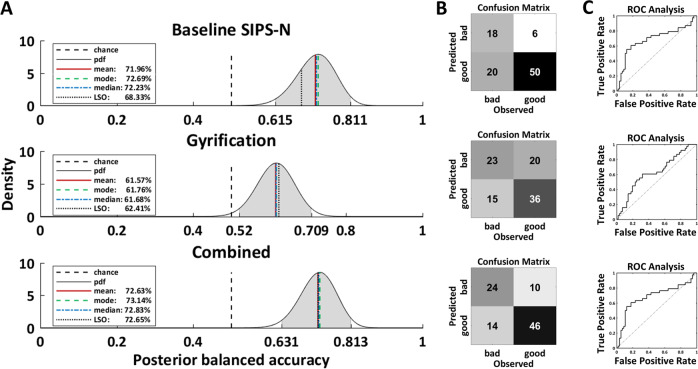
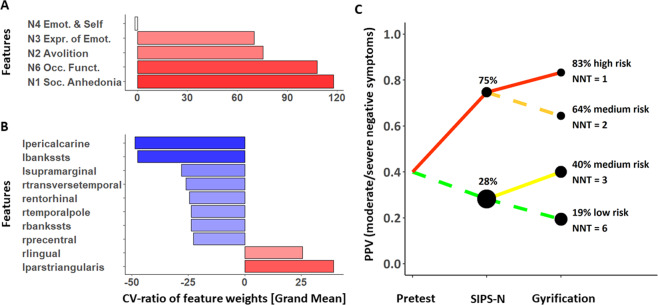
Negative symptoms occur frequently in individuals at clinical high risk (CHR) for psychosis and contribute to functional impairments. The aim of this study was to predict negative symptom severity in CHR after 9 months. Predictive models either included baseline negative symptoms measured with the Structured Interview for Psychosis-Risk Syndromes (SIPS-N), whole-brain gyrification, or both to forecast negative symptoms of at least moderate severity in 94 CHR. We also conducted sequential risk stratification to stratify CHR into different risk groups based on the SIPS-N and gyrification model. Additionally, we assessed the models' ability to predict functional outcomes in CHR and their transdiagnostic generalizability to predict negative symptoms in 96 patients with recent-onset psychosis (ROP) and 97 patients with recent-onset depression (ROD). Baseline SIPS-N and gyrification predicted moderate/severe negative symptoms with significant balanced accuracies of 68 and 62%, while the combined model achieved 73% accuracy. Sequential risk stratification stratified CHR into a high (83%), medium (40-64%), and low (19%) risk group regarding their risk of having moderate/severe negative symptoms at 9 months follow-up. The baseline SIPS-N model was also able to predict social (61%), but not role functioning (59%) at above-chance accuracies, whereas the gyrification model achieved significant accuracies in predicting both social (76%) and role (74%) functioning in CHR. Finally, only the baseline SIPS-N model showed transdiagnostic generalization to ROP (63%). This study delivers a multimodal prognostic model to identify those CHR with a clinically relevant negative symptom severity and functional impairments, potentially requiring further therapeutic consideration.
阴性症状在处于精神病高危(CHR)状态的个体中经常出现,并导致功能障碍。本研究的目的是预测 9 个月后 CHR 的阴性症状严重程度。预测模型要么包括使用精神病风险综合征结构化访谈(SIPS-N)测量的基线阴性症状,要么包括全脑脑回,以预测 94 名 CHR 中至少中度严重的阴性症状。我们还进行了连续风险分层,根据 SIPS-N 和脑回模型将 CHR 分为不同的风险组。此外,我们评估了这些模型预测 CHR 中功能结果的能力及其对预测 96 名首发精神病(ROP)和 97 名首发抑郁症(ROD)患者阴性症状的跨诊断通用性。基线 SIPS-N 和脑回预测中度/重度阴性症状,平衡准确率分别为 68%和 62%,而联合模型的准确率为 73%。连续风险分层将 CHR 分为高(83%)、中(40-64%)和低(19%)风险组,以预测他们在 9 个月随访时出现中度/重度阴性症状的风险。基线 SIPS-N 模型也能够预测社会(61%),但不能预测角色功能(59%),达到高于机会的准确率,而脑回模型在预测 CHR 中的社会(76%)和角色(74%)功能方面均达到显著的准确率。最后,只有基线 SIPS-N 模型显示对 ROP 的跨诊断通用性(63%)。本研究提供了一种多模态预后模型,以识别那些具有临床相关阴性症状严重程度和功能障碍的 CHR,可能需要进一步的治疗考虑。