Messiah Sarah E, Uppuluri Maduri, Xie Luyu, Schellinger Jeffrey N, Mathew M Sunil, Ofori Ashley, Kukreja Sachin, Schneider Benjamin, Dunn Samuel H, Tavakkoli Anna, Almandoz Jaime P
School of Public Health, University of Texas Health Science Center, Dallas, TX, USA.
Center for Pediatric Population Health, Children's Health System of Texas and UT Health School of Public Health, Dallas, TX, USA.
Obes Surg. 2021 Aug;31(8):3738-3748. doi: 10.1007/s11695-021-05488-6. Epub 2021 May 27.
The impact of the COVID-19 pandemic on behavioral issues among those who have completed bariatric surgery (BS) is not well described in ethnically diverse populations. The aim of this study was to compare the impact of COVID-19 lockdown orders and after lockdown orders were lifted on substance use, mental health, and weight-related behaviors among a sample of post-BS adults.
A retrospective medical chart review identified BS patients from one university-based obesity medicine clinic and two BS practices. An online non-anonymous survey was implemented in two phases: during lockdown (April 1-May 31, 2020) and after lockdown orders were lifted (June 1, 2020-September 30, 2020) to obtain information about the COVID-19 pandemic's impact on BS patients.
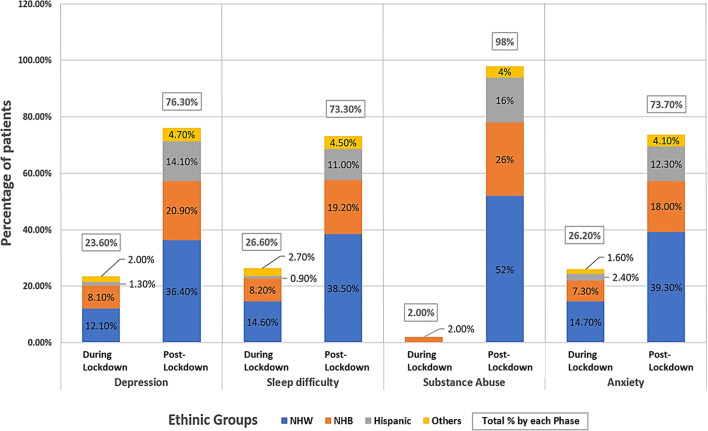
A total of 189 (during lockdown=39, post-lockdown=150) participants (90.4% female, mean age 52.4 years, SD 11.1, 49.8% non-Hispanic White, 30.6% non-Hispanic Black, 16.1% Hispanic) participated. Lockdown participants were more likely to have sleep problems (74.3% vs. 56.1%, P=.039) and feel anxious (82.0% vs. 63.0%, P=.024) versus post-lockdown participants. A majority (83.4%) reported depression in both lockdown/post-lockdown. Post-lockdown participants were more than 20 times more likely to report substance use compared those in lockdown (aOR 20.56, 95% CI 2.66-158.4).
The COVID-19 pandemic is having a substantial negative impact on substance use, mental health, and weight-related health behaviors in diverse BS patients. These findings have important implications for post-BS patient care teams and may suggest the integration of screening tools to identify those at high risk for behavioral health issues.
在不同种族人群中,2019年冠状病毒病(COVID-19)大流行对接受减肥手术(BS)者行为问题的影响尚未得到充分描述。本研究的目的是比较COVID-19封锁令期间及解除封锁令后,减肥手术后成年样本中药物使用、心理健康和体重相关行为所受的影响。
通过回顾性病历审查,从一家大学肥胖医学诊所和两家减肥手术机构中确定减肥手术患者。在线非匿名调查分两个阶段进行:封锁期间(2020年4月1日至5月31日)和解除封锁令后(2020年6月1日至9月30日),以获取COVID-19大流行对减肥手术患者影响的信息。
共有189名参与者(封锁期间=39名,封锁后=150名)(90.4%为女性,平均年龄52.4岁,标准差11.1,49.8%为非西班牙裔白人,30.6%为非西班牙裔黑人,16.1%为西班牙裔)参与。与封锁后参与者相比,封锁期间参与者更易出现睡眠问题(74.3%对56.1%,P=0.039)和焦虑情绪(82.0%对63.0%,P=0.024)。大多数(83.4%)在封锁期间/封锁后均报告有抑郁症状。与封锁期间相比,封锁后参与者报告药物使用的可能性高出20倍以上(调整后比值比20.56,95%置信区间2.66-158.4)。
COVID-19大流行对不同减肥手术患者的药物使用、心理健康和体重相关健康行为产生了重大负面影响。这些发现对减肥手术后患者护理团队具有重要意义,可能意味着需要整合筛查工具以识别行为健康问题高危人群。