Fernandes Nayanna L S, Juliellen L da Cunha, Andressa F B de Oliveira, D'Alpino H P Paulo, Sampaio C Fábio
Programa de Pós-Graduação Stricto sensu em Odontologia, Universidade Federal da Paraíba, PB, Brazil.
Department of Morphology, Federal University of Paraíba, Centro de Ciências da Saúde, Brazil.
Eur J Dent. 2021 Jul;15(3):433-439. doi: 10.1055/s-0041-1725576. Epub 2021 May 26.
This study aimed to characterize the superficial and subsurface morphology of dental enamel treated with fluoridated gels containing different biomimetic compounds after erosive challenge.
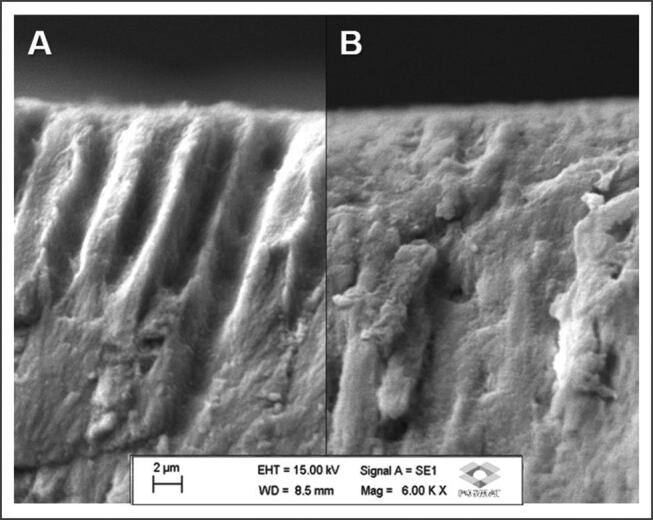
Bovine incisor teeth were sectioned to obtain enamel blocks (4 mm × 4 mm × 6 mm; = 5) that were demineralized to create an artificial caries lesion and treated by pH cycling interspersed with exposure to fluoridated toothpaste slurries under agitation. During pH cycling (demineralization and remineralization for 2 and 22 hours, respectively) for 6 days, the enamel blocks were exposed to toothpaste slurries under agitation with one of the dental gels: Regenerate Enamel Science (NR-5 technology), Daily Regenerator Dental Clean (REFIX technology), and Sensodyne Repair & Protect (Novamin technology). The enamel blocks were subjected to an erosive challenge, immersed in 50% citric acid for 2 minutes, and then washed with plenty of distilled water. The surface and cross-sectional micromorphology were assessed using scanning electron microscope (SEM). The elemental analyses (weight percentage) were determined with an energy-dispersive X-ray spectroscopy (EDS).
Enamel treated with the product containing REFIX technology presented a smoother surface morphology compared to the other treatments. The higher resistance to the erosive challenge can be attributed to a silicon-enriched mineral layer formed on the enamel induced by the REFIX-based toothpaste. This was not observed in the specimens treated with the other technology-containing toothpastes.
The REFIX technology seemed to be the most promising compared to the Novamin and NR-5 technologies. In addition to forming a surface mineralized layer, the enamel treated with REFIX technology associated with the pH cycling resisted a subsequent erosive challenge.
本研究旨在表征在受到侵蚀性挑战后,用含有不同仿生化合物的含氟凝胶处理过的牙釉质的表面和亚表面形态。
将牛切牙切片以获得牙釉质块(4毫米×4毫米×6毫米;n = 5),对其进行脱矿以制造人工龋损,并通过在搅拌下穿插接触含氟牙膏糊剂进行pH循环处理。在为期6天的pH循环(脱矿和再矿化分别为2小时和22小时)过程中,将牙釉质块在搅拌下与以下一种牙科凝胶接触含氟牙膏糊剂:Regenerate Enamel Science(NR-5技术)、Daily Regenerator Dental Clean(REFIX技术)和Sensodyne Repair & Protect(诺华敏技术)。对牙釉质块进行侵蚀性挑战,将其浸入50%的柠檬酸中2分钟,然后用大量蒸馏水冲洗。使用扫描电子显微镜(SEM)评估表面和横截面微观形态。用能量色散X射线光谱仪(EDS)进行元素分析(重量百分比)。
与其他处理方法相比,用含REFIX技术的产品处理过的牙釉质呈现出更光滑的表面形态。对侵蚀性挑战具有更高的抵抗力可归因于基于REFIX的牙膏在牙釉质上诱导形成的富含硅的矿化层。在用其他含技术的牙膏处理的标本中未观察到这种情况。
与诺华敏和NR-5技术相比,REFIX技术似乎最有前景。除了形成表面矿化层外,用与pH循环相关的REFIX技术处理过的牙釉质能够抵抗随后的侵蚀性挑战。