• 文献检索
  • 文档翻译
  • 深度研究
  • 学术资讯
  • Suppr Zotero 插件Zotero 插件
  • 邀请有礼
  • 套餐&价格
  • 历史记录
应用&插件
Suppr Zotero 插件Zotero 插件浏览器插件Mac 客户端Windows 客户端微信小程序
定价
高级版会员购买积分包购买API积分包
服务
文献检索文档翻译深度研究API 文档MCP 服务
关于我们
关于 Suppr公司介绍联系我们用户协议隐私条款
关注我们

Suppr 超能文献

核心技术专利:CN118964589B侵权必究
粤ICP备2023148730 号-1Suppr @ 2026

文献检索

告别复杂PubMed语法,用中文像聊天一样搜索,搜遍4000万医学文献。AI智能推荐,让科研检索更轻松。

立即免费搜索

文件翻译

保留排版,准确专业,支持PDF/Word/PPT等文件格式,支持 12+语言互译。

免费翻译文档

深度研究

AI帮你快速写综述,25分钟生成高质量综述,智能提取关键信息,辅助科研写作。

立即免费体验

使用可解释的深度学习对癌症依赖性进行建模。

Using interpretable deep learning to model cancer dependencies.

作者信息

Lin Chih-Hsu, Lichtarge Olivier

机构信息

Department of Molecular and Human Genetics.

Department of Biochemistry and Molecular Biology.

出版信息

Bioinformatics. 2021 Sep 9;37(17):2675-2681. doi: 10.1093/bioinformatics/btab137.

DOI:10.1093/bioinformatics/btab137
PMID:34042953
原文链接:https://pmc.ncbi.nlm.nih.gov/articles/PMC8428607/
Abstract

MOTIVATION

Cancer dependencies provide potential drug targets. Unfortunately, dependencies differ among cancers and even individuals. To this end, visible neural networks (VNNs) are promising due to robust performance and the interpretability required for the biomedical field.

RESULTS

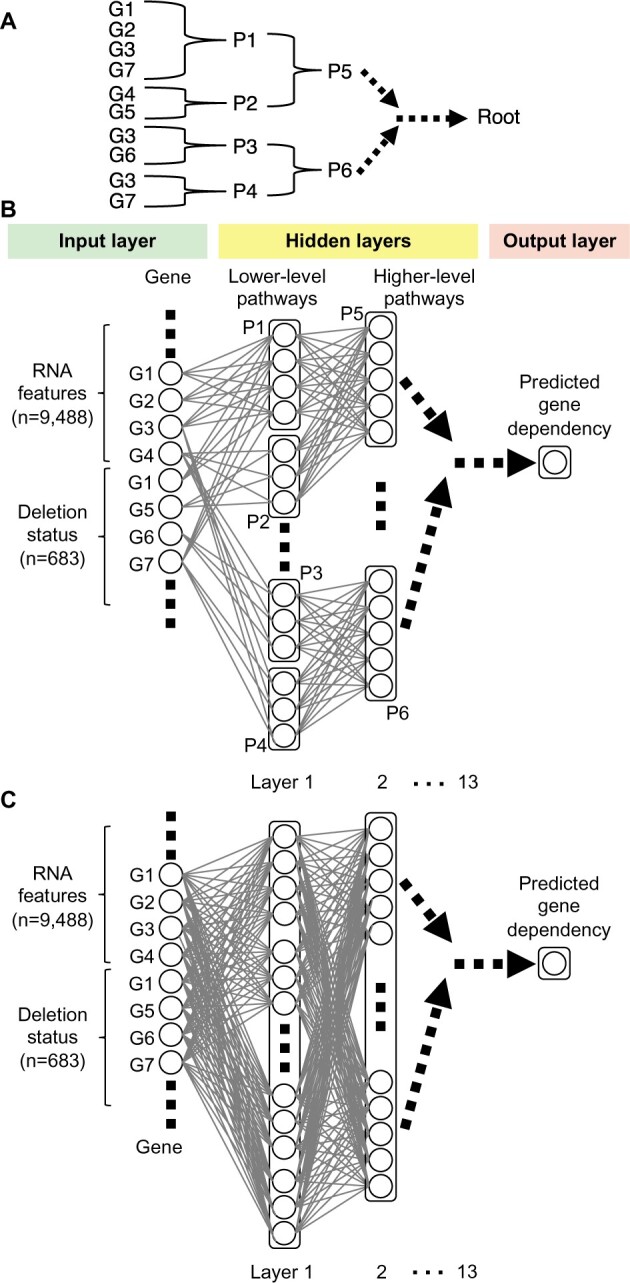
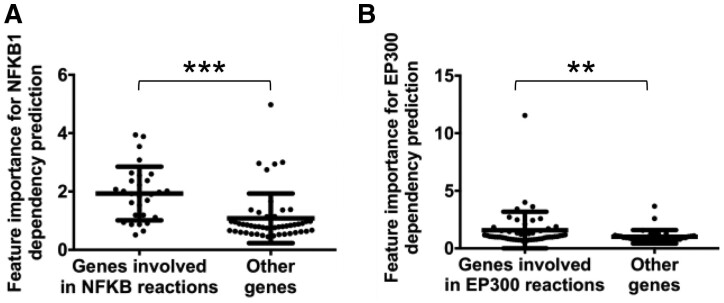
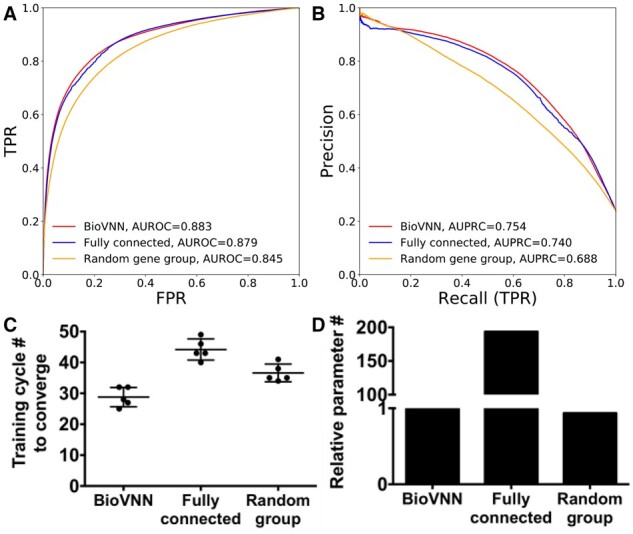
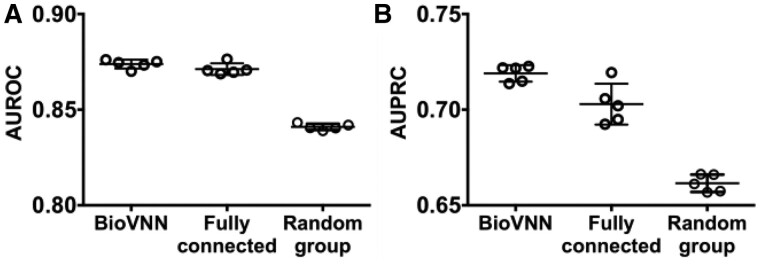
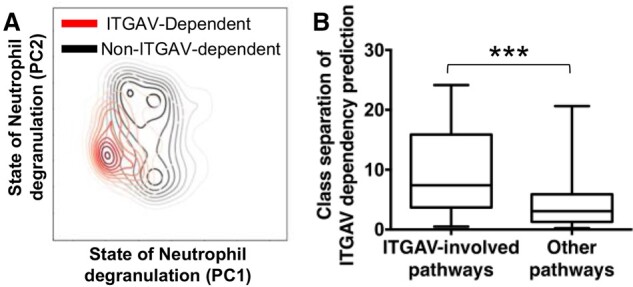
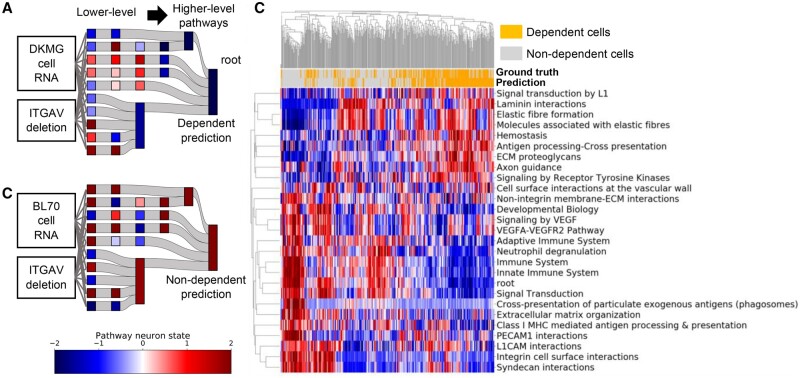
We design Biological visible neural network (BioVNN) using pathway knowledge to predict cancer dependencies. Despite having fewer parameters, BioVNN marginally outperforms traditional neural networks (NNs) and converges faster. BioVNN also outperforms an NN based on randomized pathways. More importantly, dependency predictions can be explained by correlating with the neuron output states of relevant pathways, which suggest dependency mechanisms. In feature importance analysis, BioVNN recapitulates known reaction partners and proposes new ones. Such robust and interpretable VNNs may facilitate the understanding of cancer dependency and the development of targeted therapies.

AVAILABILITY AND IMPLEMENTATION

Code and data are available at https://github.com/LichtargeLab/BioVNN.

SUPPLEMENTARY INFORMATION

Supplementary data are available at Bioinformatics online.

摘要

动机

癌症依赖性提供了潜在的药物靶点。不幸的是,不同癌症甚至个体之间的依赖性存在差异。为此,可见神经网络(VNN)因其强大的性能和生物医学领域所需的可解释性而颇具前景。

结果

我们利用通路知识设计了生物可见神经网络(BioVNN)来预测癌症依赖性。尽管参数较少,但BioVNN的性能略优于传统神经网络(NN),且收敛速度更快。BioVNN也优于基于随机通路的神经网络。更重要的是,通过与相关通路的神经元输出状态相关联,可以解释依赖性预测,这揭示了依赖性机制。在特征重要性分析中,BioVNN重现了已知的反应伙伴并提出了新的伙伴。这种强大且可解释的VNN可能有助于理解癌症依赖性并推动靶向治疗的发展。

可用性与实现

代码和数据可在https://github.com/LichtargeLab/BioVNN获取。

补充信息

补充数据可在《生物信息学》在线获取。

https://cdn.ncbi.nlm.nih.gov/pmc/blobs/0e91/8428607/225171c3a6ae/btab137f6.jpg
https://cdn.ncbi.nlm.nih.gov/pmc/blobs/0e91/8428607/eb99e89abb2d/btab137f1.jpg
https://cdn.ncbi.nlm.nih.gov/pmc/blobs/0e91/8428607/9ced3d85b2f3/btab137f2.jpg
https://cdn.ncbi.nlm.nih.gov/pmc/blobs/0e91/8428607/773313b5acec/btab137f3.jpg
https://cdn.ncbi.nlm.nih.gov/pmc/blobs/0e91/8428607/cf122bbc3eb7/btab137f4.jpg
https://cdn.ncbi.nlm.nih.gov/pmc/blobs/0e91/8428607/1d3117980c46/btab137f5.jpg
https://cdn.ncbi.nlm.nih.gov/pmc/blobs/0e91/8428607/225171c3a6ae/btab137f6.jpg
https://cdn.ncbi.nlm.nih.gov/pmc/blobs/0e91/8428607/eb99e89abb2d/btab137f1.jpg
https://cdn.ncbi.nlm.nih.gov/pmc/blobs/0e91/8428607/9ced3d85b2f3/btab137f2.jpg
https://cdn.ncbi.nlm.nih.gov/pmc/blobs/0e91/8428607/773313b5acec/btab137f3.jpg
https://cdn.ncbi.nlm.nih.gov/pmc/blobs/0e91/8428607/cf122bbc3eb7/btab137f4.jpg
https://cdn.ncbi.nlm.nih.gov/pmc/blobs/0e91/8428607/1d3117980c46/btab137f5.jpg
https://cdn.ncbi.nlm.nih.gov/pmc/blobs/0e91/8428607/225171c3a6ae/btab137f6.jpg

相似文献

1
Using interpretable deep learning to model cancer dependencies.使用可解释的深度学习对癌症依赖性进行建模。
Bioinformatics. 2021 Sep 9;37(17):2675-2681. doi: 10.1093/bioinformatics/btab137.
2
MPVNN: Mutated Pathway Visible Neural Network architecture for interpretable prediction of cancer-specific survival risk.MPVNN:用于癌症特异性生存风险可解释预测的突变途径可见神经网络架构。
Bioinformatics. 2022 Nov 15;38(22):5026-5032. doi: 10.1093/bioinformatics/btac636.
3
Pre-training graph neural networks for link prediction in biomedical networks.用于生物医学网络中链接预测的预训练图神经网络。
Bioinformatics. 2022 Apr 12;38(8):2254-2262. doi: 10.1093/bioinformatics/btac100.
4
MonoNet: enhancing interpretability in neural networks via monotonic features.MonoNet:通过单调特征增强神经网络的可解释性。
Bioinform Adv. 2023 Feb 23;3(1):vbad016. doi: 10.1093/bioadv/vbad016. eCollection 2023.
5
GraphPath: a graph attention model for molecular stratification with interpretability based on the pathway-pathway interaction network.GraphPath:一种基于通路-通路相互作用网络的可解释性图注意力模型,用于分子分层。
Bioinformatics. 2024 Mar 29;40(4). doi: 10.1093/bioinformatics/btae165.
6
XMR: an explainable multimodal neural network for drug response prediction.XMR:一种用于药物反应预测的可解释多模态神经网络。
Front Bioinform. 2023 Aug 2;3:1164482. doi: 10.3389/fbinf.2023.1164482. eCollection 2023.
7
ParsVNN: parsimony visible neural networks for uncovering cancer-specific and drug-sensitive genes and pathways.ParsVNN:用于揭示癌症特异性和药物敏感基因及通路的简约可见神经网络。
NAR Genom Bioinform. 2021 Oct 27;3(4):lqab097. doi: 10.1093/nargab/lqab097. eCollection 2021 Dec.
8
Predicting protein-peptide binding residues via interpretable deep learning.通过可解释的深度学习预测蛋白质-肽结合残基
Bioinformatics. 2022 Jun 27;38(13):3351-3360. doi: 10.1093/bioinformatics/btac352.
9
PathCNN: interpretable convolutional neural networks for survival prediction and pathway analysis applied to glioblastoma.PathCNN:适用于胶质母细胞瘤的可解释卷积神经网络的生存预测和途径分析。
Bioinformatics. 2021 Jul 12;37(Suppl_1):i443-i450. doi: 10.1093/bioinformatics/btab285.
10
TranSynergy: Mechanism-driven interpretable deep neural network for the synergistic prediction and pathway deconvolution of drug combinations.TranSynergy:用于药物组合协同预测和途径解卷积的基于机制的可解释深度神经网络。
PLoS Comput Biol. 2021 Feb 12;17(2):e1008653. doi: 10.1371/journal.pcbi.1008653. eCollection 2021 Feb.

引用本文的文献

1
Strategies to include prior knowledge in omics analysis with deep neural networks.在组学分析中利用深度神经网络纳入先验知识的策略。
Patterns (N Y). 2025 Mar 14;6(3):101203. doi: 10.1016/j.patter.2025.101203.
2
SL-scan identifies synthetic lethal interactions in cancer using metabolic networks.SL 扫描技术利用代谢网络鉴定癌症中的合成致死相互作用。
Sci Rep. 2023 Sep 22;13(1):15763. doi: 10.1038/s41598-023-42992-4.
3
Knowledge graph aids comprehensive explanation of drug and chemical toxicity.知识图谱辅助药物和化学毒性的全面阐释。
CPT Pharmacometrics Syst Pharmacol. 2023 Aug;12(8):1072-1079. doi: 10.1002/psp4.12975. Epub 2023 Jul 20.
4
Network Biology-Inspired Machine Learning Features Predict Cancer Gene Targets and Reveal Target Coordinating Mechanisms.受网络生物学启发的机器学习特征可预测癌症基因靶点并揭示靶点协调机制。
Pharmaceuticals (Basel). 2023 May 16;16(5):752. doi: 10.3390/ph16050752.
5
Predicting genetic interactions, cell line dependencies and drug sensitivities with variational graph auto-encoder.使用变分图自动编码器预测基因相互作用、细胞系依赖性和药物敏感性。
Front Bioinform. 2022 Dec 2;2:1025783. doi: 10.3389/fbinf.2022.1025783. eCollection 2022.
6
Opportunities and challenges in interpretable deep learning for drug sensitivity prediction of cancer cells.用于癌细胞药物敏感性预测的可解释深度学习中的机遇与挑战。
Front Bioinform. 2022 Nov 17;2:1036963. doi: 10.3389/fbinf.2022.1036963. eCollection 2022.
7
Knowledge-guided deep learning models of drug toxicity improve interpretation.药物毒性的知识引导深度学习模型可改善解释效果。
Patterns (N Y). 2022 Aug 24;3(9):100565. doi: 10.1016/j.patter.2022.100565. eCollection 2022 Sep 9.