SimulaMet, Oslo, Norway.
University of Oslo, Oslo, Norway.
Sci Data. 2021 May 27;8(1):142. doi: 10.1038/s41597-021-00920-z.
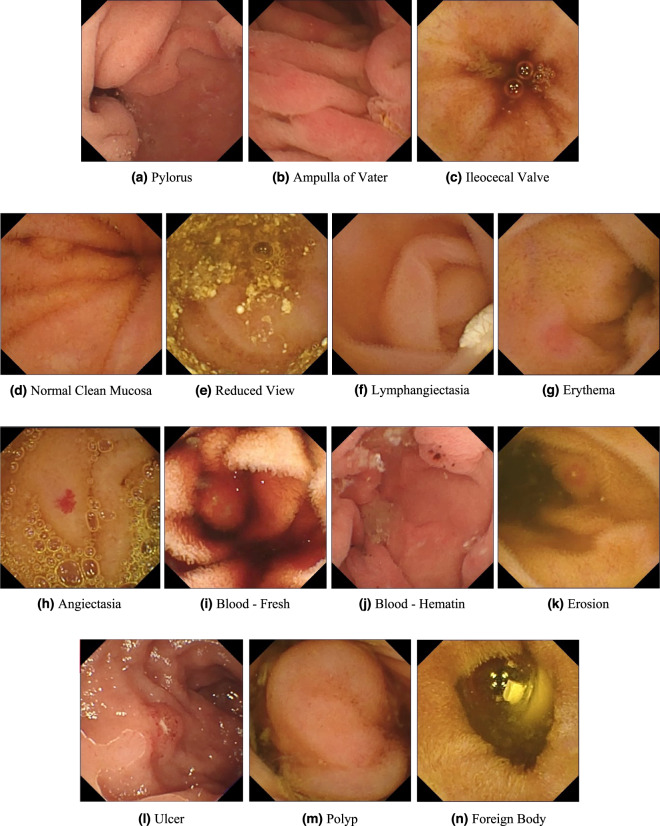
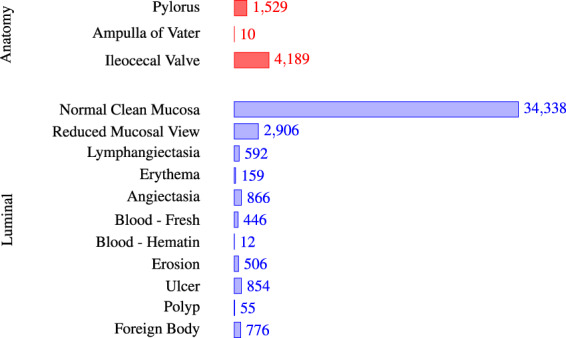
Artificial intelligence (AI) is predicted to have profound effects on the future of video capsule endoscopy (VCE) technology. The potential lies in improving anomaly detection while reducing manual labour. Existing work demonstrates the promising benefits of AI-based computer-assisted diagnosis systems for VCE. They also show great potential for improvements to achieve even better results. Also, medical data is often sparse and unavailable to the research community, and qualified medical personnel rarely have time for the tedious labelling work. We present Kvasir-Capsule, a large VCE dataset collected from examinations at a Norwegian Hospital. Kvasir-Capsule consists of 117 videos which can be used to extract a total of 4,741,504 image frames. We have labelled and medically verified 47,238 frames with a bounding box around findings from 14 different classes. In addition to these labelled images, there are 4,694,266 unlabelled frames included in the dataset. The Kvasir-Capsule dataset can play a valuable role in developing better algorithms in order to reach true potential of VCE technology.
人工智能(AI)预计将对视频胶囊内镜(VCE)技术的未来产生深远影响。其潜力在于提高异常检测能力,同时减少人工劳动。现有的工作表明,基于人工智能的计算机辅助诊断系统对 VCE 具有很大的优势。它们也有很大的改进空间,可以实现更好的效果。此外,医疗数据通常是稀疏的,研究界无法获得,合格的医务人员很少有时间进行繁琐的标记工作。我们提出了 Kvasir-Capsule,这是一个从挪威一家医院的检查中收集的大型 VCE 数据集。Kvasir-Capsule 包含 117 个视频,可从中提取总共 4,741,504 个图像帧。我们已经对 47,238 个带有边界框的帧进行了标记和医学验证,这些边界框围绕着 14 个不同类别的发现。除了这些标记的图像外,该数据集中还包含 4,694,266 个未标记的帧。Kvasir-Capsule 数据集可以在开发更好的算法方面发挥重要作用,以充分发挥 VCE 技术的潜力。