Leenhardt Romain, Li Cynthia, Le Mouel Jean-Philippe, Rahmi Gabriel, Saurin Jean Christophe, Cholet Franck, Boureille Arnaud, Amiot Xavier, Delvaux Michel, Duburque Clotilde, Leandri Chloé, Gérard Romain, Lecleire Stéphane, Mesli Farida, Nion-Larmurier Isabelle, Romain Olivier, Sacher-Huvelin Sylvie, Simon-Shane Camille, Vanbiervliet Geoffroy, Marteau Philippe, Histace Aymeric, Dray Xavier
Sorbonne University, Endoscopy Unit.
Drexel University, College of Arts & Sciences, Philadelphia, Pennsylvania, United States.
Endosc Int Open. 2020 Mar;8(3):E415-E420. doi: 10.1055/a-1035-9088. Epub 2020 Feb 21.
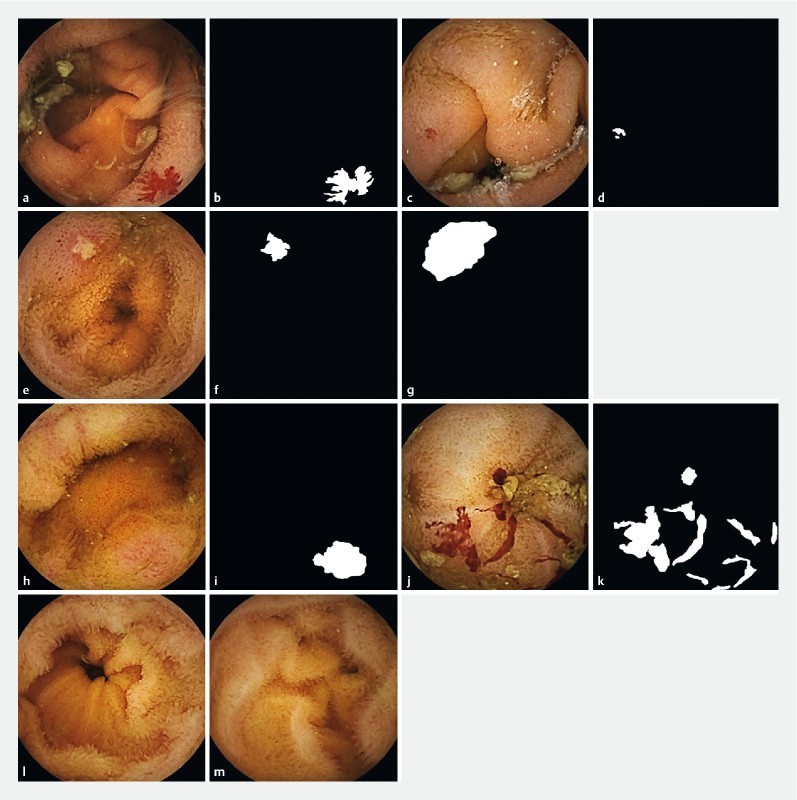
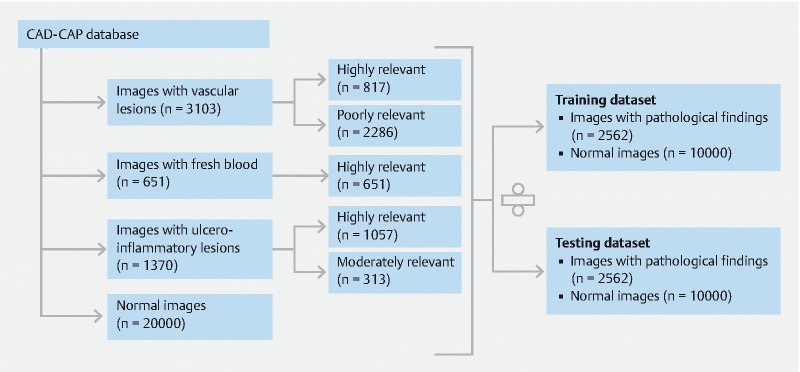
Capsule endoscopy (CE) is the preferred method for small bowel (SB) exploration. With a mean number of 50,000 SB frames per video, SBCE reading is time-consuming and tedious (30 to 60 minutes per video). We describe a large, multicenter database named CAD-CAP (Computer-Assisted Diagnosis for CAPsule Endoscopy, CAD-CAP). This database aims to serve the development of CAD tools for CE reading. Twelve French endoscopy centers were involved. All available third-generation SB-CE videos (Pillcam, Medtronic) were retrospectively selected from these centers and deidentified. Any pathological frame was extracted and included in the database. Manual segmentation of findings within these frames was performed by two pre-med students trained and supervised by an expert reader. All frames were then classified by type and clinical relevance by a panel of three expert readers. An automated extraction process was also developed to create a dataset of normal, proofread, control images from normal, complete, SB-CE videos. Four-thousand-one-hundred-and-seventy-four SB-CE were included. Of them, 1,480 videos (35 %) containing at least one pathological finding were selected. Findings from 5,184 frames (with their short video sequences) were extracted and delimited: 718 frames with fresh blood, 3,097 frames with vascular lesions, and 1,369 frames with inflammatory and ulcerative lesions. Twenty-thousand normal frames were extracted from 206 SB-CE normal videos. CAD-CAP has already been used for development of automated tools for angiectasia detection and also for two international challenges on medical computerized analysis.
胶囊内镜检查(CE)是小肠(SB)探查的首选方法。每个视频平均有50,000个小肠帧,小肠胶囊内镜检查(SBCE)的阅片既耗时又乏味(每个视频需要30至60分钟)。我们描述了一个名为CAD-CAP(胶囊内镜计算机辅助诊断)的大型多中心数据库。该数据库旨在为CE阅片的计算机辅助诊断工具的开发提供服务。 有12个法国内镜中心参与其中。从这些中心回顾性选取了所有可用的第三代小肠胶囊内镜视频(MediTronics公司的Pillcam),并对其进行了去识别处理。提取了所有病理帧并纳入数据库。由一名专家阅片者培训并监督的两名医学预科学生对这些帧内的发现进行了手动分割。然后由三名专家阅片者组成的小组按类型和临床相关性对所有帧进行分类。还开发了一种自动提取程序,以从正常、完整的小肠胶囊内镜视频中创建一个正常、经校对的对照图像数据集。 共纳入了4174例小肠胶囊内镜检查。其中,选取了1480个视频(35%),这些视频至少包含一项病理发现。提取并界定了5184帧(及其短视频序列)的发现:718帧有新鲜血液,3097帧有血管病变,1369帧有炎症和溃疡性病变。从206个小肠胶囊内镜正常视频中提取了20000帧正常帧。CAD-CAP已被用于开发血管扩张检测的自动化工具,也被用于两项医学计算机分析的国际挑战赛。