Department of Developmental Psychology, Utrecht University, Utrecht, The Netherlands.
Research Institute of Child Development and Education, University of Amsterdam, Amsterdam, The Netherlands.
Clin Psychol Psychother. 2021 May;28(3):489-499. doi: 10.1002/cpp.2620. Epub 2021 Jun 17.
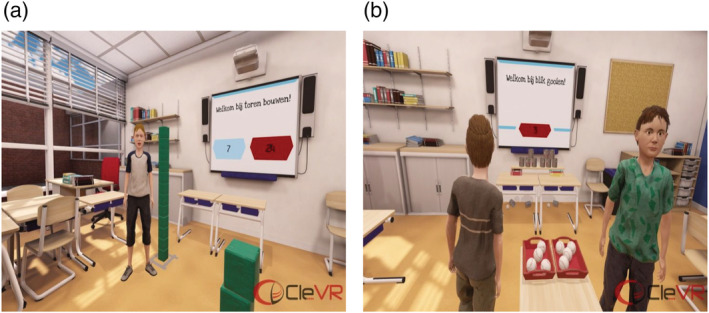
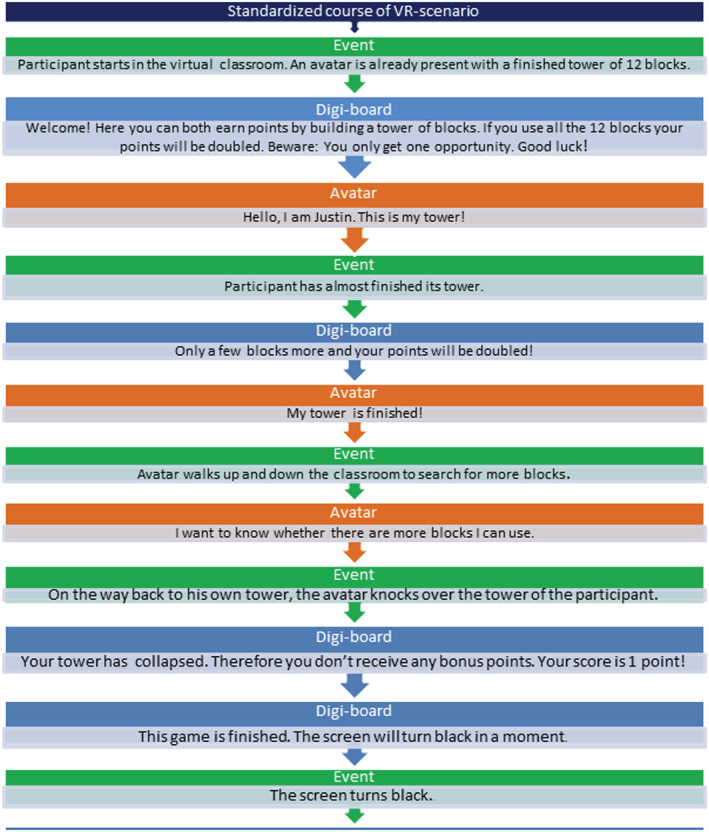
Children's aggressive behaviour is partly determined by how they process social information (e.g., making hostile interpretations or aiming to seek revenge). Such aggressive social information processing (SIP) may be most evident if children are emotionally engaged in actual social interactions. Current methods to assess aggressive SIP, however, often ask children to reflect on hypothetical vignettes. This pilot study therefore examined a new method that actually involves children in emotionally engaging social interactions: interactive virtual reality (VR). We developed a virtual classroom where children could play games with virtual peers. A sample of boys (N = 32; ages 8-13) from regular and special education reported on their SIP in distinct VR contexts (i.e., neutral, instrumental gain and provocation). They also completed a standard vignette-based assessment of SIP. Results demonstrated good convergent validity of interactive VR assessment of SIP, as indicated by significant moderate to large correlations of VR-assessed SIP with vignette-assessed SIP for all SIP variables except anger. Interactive VR showed improved measurement sensitivity (i.e., larger variances in SIP compared to vignettes) for aggressive responding, but not for other SIP variables. Discriminant validity (i.e., distinct SIP patterns across contexts) of interactive VR was supported for provocation contexts, but not for instrumental gain contexts. Last, children were more enthusiastic about the VR assessment compared to the vignette-based assessment. These findings suggest that interactive VR may be a promising tool, allowing for the assessment of children's aggressive SIP in standardized yet emotionally engaging social interactions.
儿童的攻击行为部分取决于他们如何处理社会信息(例如,进行敌对解释或意图寻求报复)。如果儿童在实际的社会互动中情绪投入,那么这种具有攻击性的社会信息处理(SIP)可能最为明显。然而,目前评估攻击 SIP 的方法通常要求儿童对假设的情景进行反思。因此,这项初步研究考察了一种新的方法,该方法实际上使儿童参与到情感投入的社会互动中:互动虚拟现实(VR)。我们开发了一个虚拟教室,孩子们可以在其中与虚拟同伴玩游戏。来自普通教育和特殊教育的一组男孩(N=32;年龄 8-13 岁)在不同的 VR 情境(即中性、工具性收益和挑衅)下报告了他们的 SIP。他们还完成了基于情景的 SIP 标准评估。结果表明,互动 VR 对 SIP 的评估具有良好的收敛效度,因为 VR 评估的 SIP 与基于情景的 SIP 在所有 SIP 变量(除了愤怒)之间存在显著的中等至较大相关性。与基于情景的评估相比,互动 VR 对攻击性反应的测量灵敏度(即 SIP 的方差较大)有所提高,但对其他 SIP 变量则不然。互动 VR 的判别效度(即不同情境下的 SIP 模式)得到了挑衅情境的支持,但在工具性收益情境中则不然。最后,与基于情景的评估相比,儿童对 VR 评估更感兴趣。这些发现表明,互动 VR 可能是一种很有前途的工具,可用于评估儿童在标准化但情感投入的社会互动中的攻击性 SIP。