Department of General Psychology, University of Padova, Via Venezia 8, 35131 Padova, Italy.
Digital Health Lab, Centre for Health and Wellbeing, Fondazione Bruno Kessler, Via Sommarive 18, 38123 Trento, Italy.
Int J Environ Res Public Health. 2022 Jun 13;19(12):7237. doi: 10.3390/ijerph19127237.
Virtual Reality Environments (VREs) are widely deployed in mental health treatments, often associated with relaxation techniques. The personalization of natural VR-based scenarios is a key element that can further facilitate users' sense of presence and relaxation. This study explored the role of VREs' personalization in the user experience with an environment supporting relaxation, by deploying mixed methods.
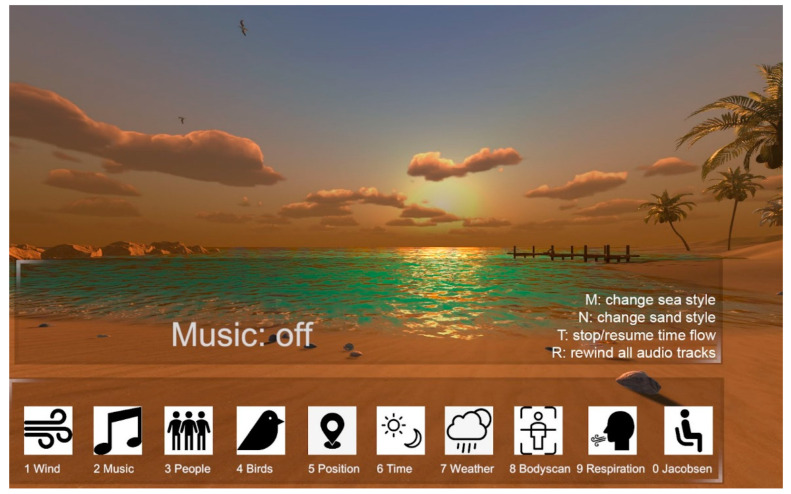
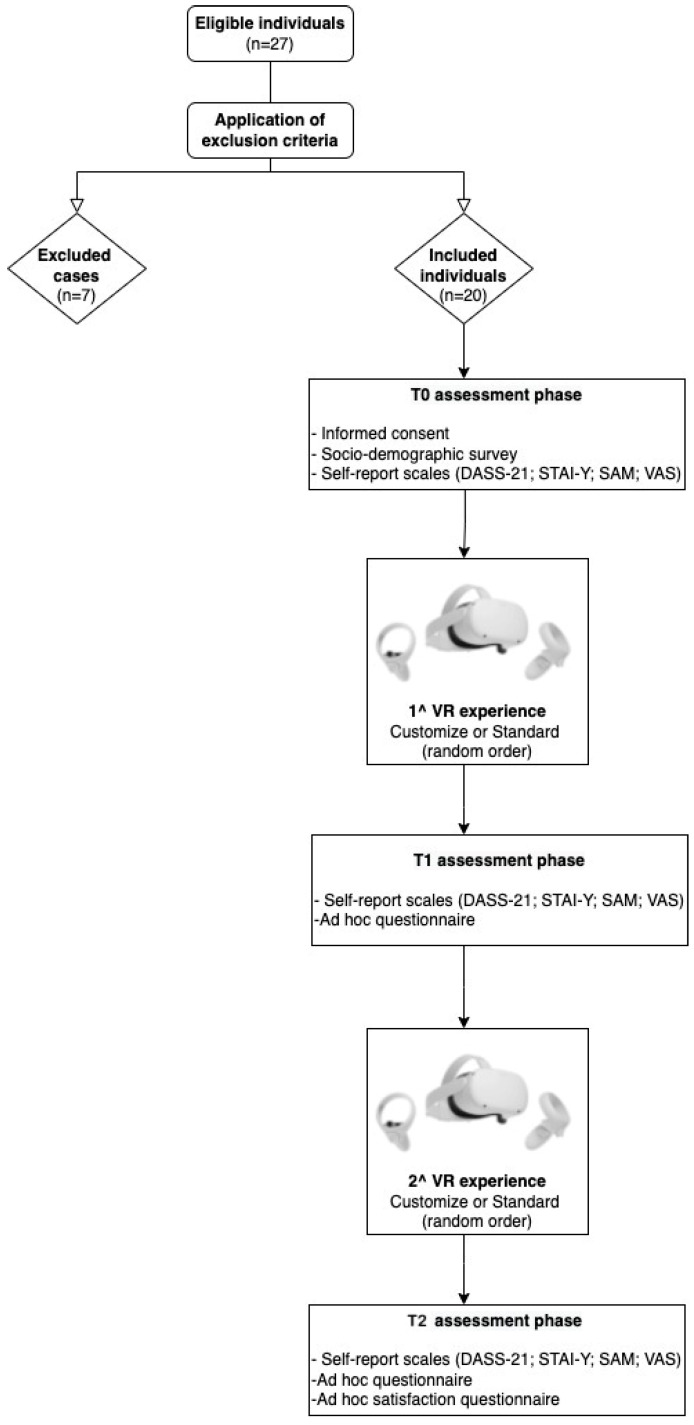
A non-clinical sample of 20 individuals participated in exposure to a supportive body-scan-guided relaxation VRE. In the personalized conditions, the participants had the option of choosing the context (e.g., sea, mountain, or countryside) and including in the scenario different types of sounds, visual elements, and changing the time of day and weather. In the standard conditions, individuals were exposed to a relaxing VRE, but they could choose neither the context nor the auditory and visual elements. The order of presentation of the personalized vs non-personalized environments was randomized. Measures regarding relaxation, state-anxiety perceived levels, VRE-related symptoms, the usability of the Virtual Reality (VR) setting, sense of presence, pleasure, activation, engagement, and level of immersion experienced were collected before and after exposure to the VR environments.
Findings showed that personalized VREs were preferred by users. Participants generally preferred to experience a greater immersivity, pleasure, engagement, and relaxation in the personalized virtual settings.
The study further confirms the role of personalization as a component positively contributing to relaxation and engagement. Future research may further assess this effect in the context of large-scale controlled studies involving clinical and non-clinical populations.
虚拟现实环境(VREs)广泛应用于心理健康治疗中,通常与放松技术相关联。基于自然的 VR 场景的个性化是进一步促进用户存在感和放松感的关键要素。本研究通过混合方法探索了个性化 VR 环境在支持放松的环境中的用户体验中的作用。
一个非临床的 20 人样本参与了支持身体扫描引导放松的 VRE 的暴露。在个性化条件下,参与者可以选择环境的背景(如海洋、山脉或乡村),并在场景中包含不同类型的声音、视觉元素,并更改白天和天气的时间。在标准条件下,个人会暴露在一个放松的 VRE 中,但他们既不能选择环境,也不能选择听觉和视觉元素。个性化与非个性化环境的呈现顺序是随机的。在暴露于 VR 环境之前和之后,收集了关于放松、感知到的状态焦虑水平、与 VRE 相关的症状、虚拟现实(VR)设置的可用性、存在感、愉悦感、激活、参与度和沉浸水平的测量结果。
研究结果表明,用户更喜欢个性化的 VRE。参与者通常更喜欢在个性化的虚拟环境中体验更高的沉浸感、愉悦感、参与度和放松感。
该研究进一步证实了个性化作为一个积极促进放松和参与的组成部分的作用。未来的研究可能会在涉及临床和非临床人群的大规模对照研究中进一步评估这种效果。