Department of Public Health Sciences, the University of North Carolina at Charlotte, 9201 University City Blvd, NC.
Department of Public Health Sciences, the University of North Carolina at Charlotte, 9201 University City Blvd, NC.
Ann Epidemiol. 2021 Oct;62:51-58. doi: 10.1016/j.annepidem.2021.05.006. Epub 2021 May 25.
To determine the association of social factors with Covid-19 mortality and identify high-risk clusters.
Data on Covid-19 deaths across 3,108 contiguous U.S. counties from the Johns Hopkins University and social determinants of health (SDoH) data from the County Health Ranking and the Bureau of Labor Statistics were fitted to Bayesian semi-parametric spatiotemporal Negative Binomial models, and 95% credible intervals (CrI) of incidence rate ratios (IRR) were used to assess the associations. Exceedance probabilities were used for detecting clusters.
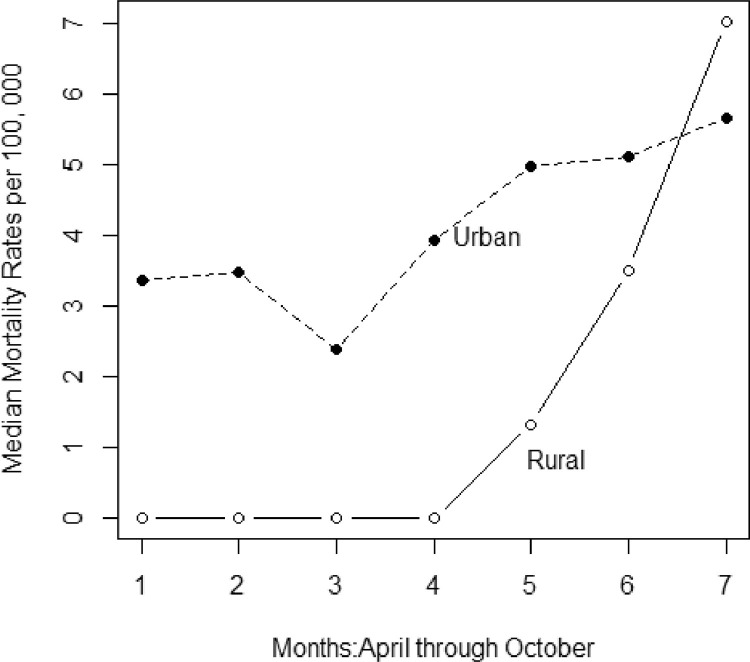
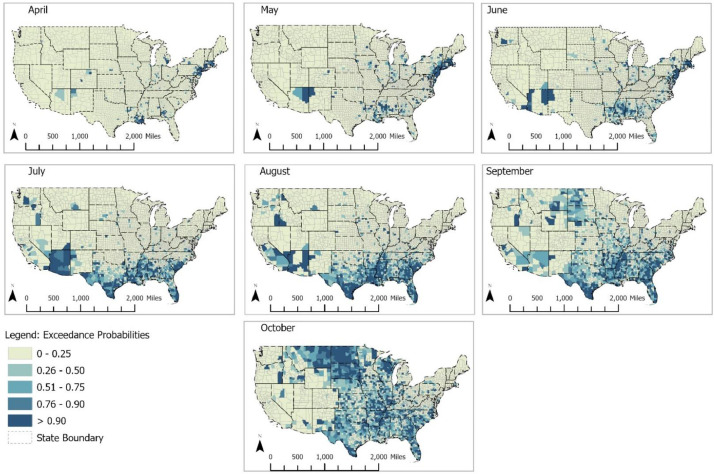
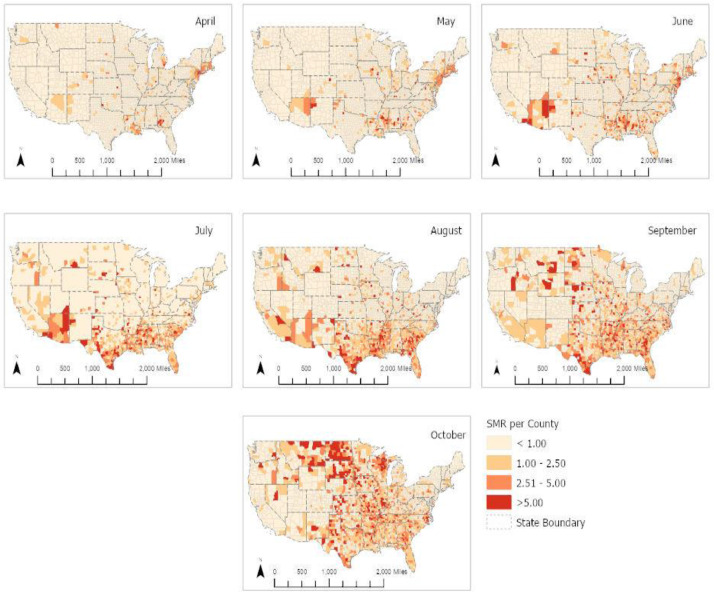
As of October 31, 2020, the median mortality rate was 40.05 per 100, 000. The monthly urban mortality rates increased with unemployment (IRR:1.41, 95% CrI: 1.24, 1.60), percent Black population (IRR:1.05, 95% CrI: 1.04, 1.07), and residential segregation (IRR:1.03, 95% CrI: 1.02, 1.04). The rural monthly mortality rates increased with percent female population (IRR: 1.17, 95% CrI: 1.11, 1.24) and percent Black population (IRR:1.07 95% CrI:1.06, 1.08). Higher college education rates were associated with decreased mortality rates in rural and urban counties. The dynamics of exceedance probabilities detected the shifts of high-risk clusters from the Northeast to Southern and Midwestern counties.
Spatiotemporal analyses enabled the inclusion of unobserved latent risk factors and aid in scientifically grounded decision-making at a granular level.
确定社会因素与新冠死亡率之间的关联,并确定高风险聚集区。
从约翰霍普金斯大学(Johns Hopkins University)获取了美国 3108 个连续县的新冠死亡数据,以及县健康排名(County Health Ranking)和劳工统计局(Bureau of Labor Statistics)的健康决定因素数据,利用贝叶斯半参数时空负二项模型进行拟合,使用发病率比(IRR)的 95%可信区间(CrI)来评估关联。利用超越概率来检测集群。
截至 2020 年 10 月 31 日,死亡率中位数为每 10 万人 40.05 人。城市月死亡率随失业率(IRR:1.41,95%CrI:1.24,1.60)、黑人人口比例(IRR:1.05,95%CrI:1.04,1.07)和居住隔离(IRR:1.03,95%CrI:1.02,1.04)而增加。农村月死亡率随女性人口比例(IRR:1.17,95%CrI:1.11,1.24)和黑人人口比例(IRR:1.07,95%CrI:1.06,1.08)而增加。较高的大学教育率与农村和城市县的死亡率降低有关。超越概率的动态变化检测到高危集群从东北部转移到南部和中西部县。
时空分析能够纳入未观察到的潜在风险因素,并有助于在微观层面上进行基于科学的决策。