State Key Laboratory of Oral Disease, National Clinical Research Center for Oral Disease, West China Hospital of Stomatology, Sichuan University, Chengdu, 610041, Sichuan, China.
Center of Infectious Diseases, West China Hospital of Sichuan University, No. 37 Guoxue Alley, Wuhou District, Chengdu, 610041, China.
Microb Cell Fact. 2021 May 28;20(1):108. doi: 10.1186/s12934-021-01599-y.
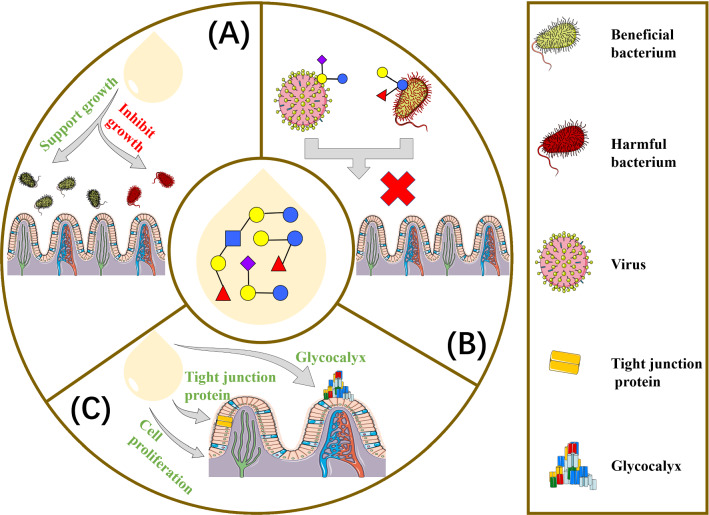
Human milk is the gold standard for nutrition of infant growth, whose nutritional value is mainly attributed to human milk oligosaccharides (HMOs). HMOs, the third most abundant component of human milk after lactose and lipids, are complex sugars with unique structural diversity which are indigestible by the infant. Acting as prebiotics, multiple beneficial functions of HMO are believed to be exerted through interactions with the gut microbiota either directly or indirectly, such as supporting beneficial bacteria growth, anti-pathogenic effects, and modulation of intestinal epithelial cell response. Recent studies have highlighted that HMOs can boost infants health and reduce disease risk, revealing potential of HMOs in food additive and therapeutics. The present paper discusses recent research in respect to the impact of HMO on the infant gut microbiome, with emphasis on the molecular basis of mechanism underlying beneficial effects of HMOs.
人乳是婴儿生长营养的黄金标准,其营养价值主要归因于人乳寡糖(HMOs)。HMOs 是仅次于乳糖和脂肪的人乳中第三大丰富成分,是一种复杂的糖,具有独特的结构多样性,婴儿无法消化。作为益生元,HMO 具有多种有益功能,被认为通过直接或间接与肠道微生物群相互作用来发挥作用,例如支持有益细菌生长、抗病原作用和调节肠道上皮细胞反应。最近的研究强调 HMO 可以促进婴儿的健康并降低疾病风险,揭示了 HMO 在食品添加剂和治疗中的潜力。本文讨论了 HMO 对婴儿肠道微生物组的影响的最新研究,重点介绍了 HMO 有益作用的机制的分子基础。