Infectious Diseases Group, Department of Internal Medicine, Hospital Universitario Infanta Sofia, FIIB HUIS HHEN, Madrid, Spain.
Universidad Europea de Madrid, Madrid, Spain.
BMC Womens Health. 2021 May 28;21(1):223. doi: 10.1186/s12905-021-01370-w.
To estimate the prevalence and severity of menopausal symptoms and anxiety/depression and to assess the differences according to menopausal status among women living with HIV aged 45-60 years from the cohort of Spanish HIV/AIDS Research Network (CoRIS).
Women were interviewed by phone between September 2017 and December 2018 to determine whether they had experienced menopausal symptoms and anxiety/depression. The Menopause Rating Scale was used to evaluate the prevalence and severity of symptoms related to menopause in three subscales: somatic, psychologic and urogenital; and the 4-item Patient Health Questionnaire was used for anxiety/depression. Logistic regression models were used to estimate odds ratios (ORs) of association between menopausal status, and other potential risk factors, the presence and severity of somatic, psychological and urogenital symptoms and of anxiety/depression.
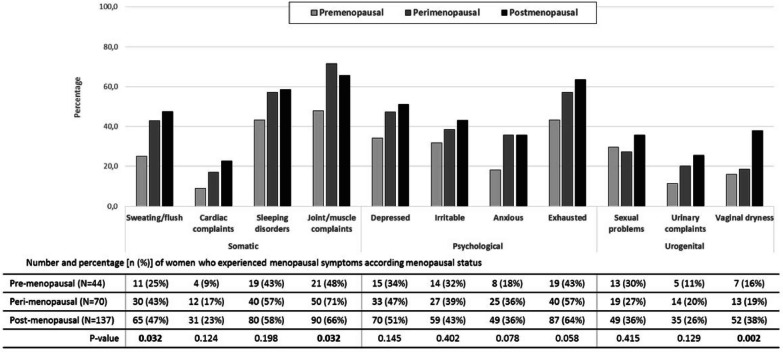
Of 251 women included, 137 (54.6%) were post-, 70 (27.9%) peri- and 44 (17.5%) pre-menopausal, respectively. Median age of onset menopause was 48 years (IQR 45-50). The proportions of pre-, peri- and post-menopausal women who had experienced any menopausal symptoms were 45.5%, 60.0% and 66.4%, respectively. Both peri- and post-menopause were associated with a higher likelihood of having somatic symptoms (aOR 3.01; 95% CI 1.38-6.55 and 2.63; 1.44-4.81, respectively), while post-menopause increased the likelihood of having psychological (2.16; 1.13-4.14) and urogenital symptoms (2.54; 1.42-4.85). By other hand, post-menopausal women had a statistically significant five-fold increase in the likelihood of presenting severe urogenital symptoms than pre-menopausal women (4.90; 1.74-13.84). No significant differences by menopausal status were found for anxiety/depression. Joint/muscle problems, exhaustion and sleeping disorders were the most commonly reported symptoms among all women. Differences in the prevalences of vaginal dryness (p = 0.002), joint/muscle complaints (p = 0.032), and sweating/flush (p = 0.032) were found among the three groups.
Women living with HIV experienced a wide variety of menopausal symptoms, some of them initiated before women had any menstrual irregularity. We found a higher likelihood of somatic symptoms in peri- and post-menopausal women, while a higher likelihood of psychological and urogenital symptoms was found in post-menopausal women. Most somatic symptoms were of low or moderate severity, probably due to the good clinical and immunological situation of these women.
为了评估年龄在 45-60 岁之间的感染 HIV 的西班牙妇女中,根据绝经期状态,估计绝经期症状和焦虑/抑郁的发生率和严重程度,来自西班牙艾滋病毒/艾滋病研究网络(CoRIS)的队列。
2017 年 9 月至 2018 年 12 月期间,通过电话对女性进行访谈,以确定她们是否经历过绝经期症状和焦虑/抑郁。使用绝经评定量表(MRS)评估绝经相关症状的三个子量表(躯体、心理和泌尿生殖)的发生率和严重程度;使用 4 项患者健康问卷(PHQ-4)评估焦虑/抑郁。使用逻辑回归模型估计绝经状态与躯体、心理和泌尿生殖症状以及焦虑/抑郁的发生和严重程度之间的比值比(OR)。
251 名女性中,137 名(54.6%)处于绝经后期,70 名(27.9%)处于围绝经期,44 名(17.5%)处于绝经前期。绝经的中位年龄为 48 岁(IQR 45-50)。有任何绝经期症状的绝经前期、围绝经期和绝经后期女性的比例分别为 45.5%、60.0%和 66.4%。围绝经期和绝经后期发生躯体症状的可能性更高(aOR 3.01;95%CI 1.38-6.55 和 2.63;1.44-4.81),而绝经后期发生心理症状的可能性更高(2.16;1.13-4.14)和泌尿生殖症状(2.54;1.42-4.85)。另一方面,绝经后期女性出现严重泌尿生殖症状的可能性比绝经前期女性高五倍(4.90;1.74-13.84)。未发现焦虑/抑郁与绝经状态存在统计学差异。关节/肌肉问题、疲惫和睡眠障碍是所有女性最常报告的症状。三组之间存在阴道干燥(p=0.002)、关节/肌肉投诉(p=0.032)和出汗/潮红(p=0.032)的发生率差异。
感染 HIV 的女性经历了各种绝经期症状,其中一些症状在女性出现任何月经不规则之前就已经开始。我们发现围绝经期和绝经后期女性发生躯体症状的可能性更高,而绝经后期女性发生心理和泌尿生殖症状的可能性更高。大多数躯体症状的严重程度较低或为中度,可能是由于这些女性的临床和免疫状况良好。