Grupo de Investigación en Acuicultura (GIA), IU-ECOAQUA, Universidad de Las Palmas de Gran Canaria, Las Palmas, Spain.
Department of Biotechnology and Life Sciences, University of Insubria, Varese, Italy.
Front Immunol. 2021 May 12;12:663106. doi: 10.3389/fimmu.2021.663106. eCollection 2021.
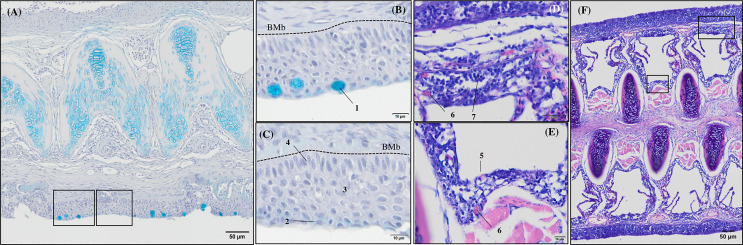
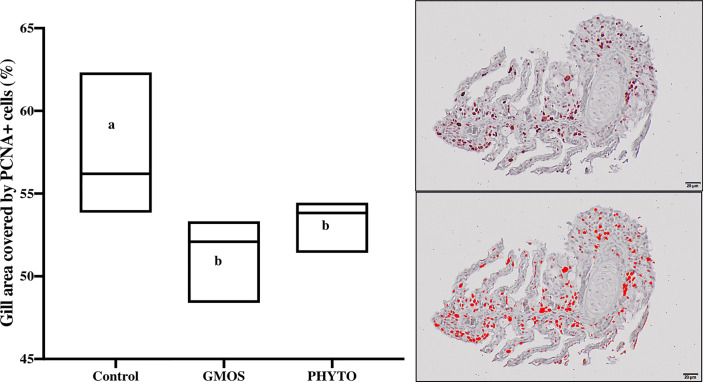
An effective replacement for fish meal (FM) and fish oil (FO) based on plant-based raw materials in the feed of marine fish species is necessary for the sustainability of the aquaculture sector. However, the use of plant-based raw materials to replace FM and FO has been associated with several negative health effects, some of which are related to oxidative stress processes that can induce functional and morphological alterations in mucosal tissues. This study aimed to evaluate the effects of dietary oligosaccharides of plant origin (5,000 ppm; galactomannan oligosaccharides, GMOS) and a phytogenic feed additive (200 ppm; garlic oil and labiatae plant extract mixture, PHYTO) on the oxidative stress status and mucosal health of the gills of juvenile European sea bass (). The experimental diets, low FM and FO diets (10%FM/6%FO) were supplemented with GMOS from plant origin and PHYTO for 63 days. GMOS and PHYTO did not significantly affect feed utilization, fish growth, and survival. GMOS and PHYTO downregulated the expression of , , , , and in the gills of the fish compared with that in fish fed the control diet. The expression of and was upregulated and downregulated, respectively, in the GMOS group compared with that in the control group, whereas the expression of downregulated in the PHYTO group compared with that in the GMOS group. The morphological, histopathological, immunohistochemical, and biochemical parameters of the fish gills were mostly unaffected by GMOS and PHYTO. However, the PHYTO group had lower incidence of lamellar fusion than did the control group after 63 days. Although the tissular distribution of goblet cells was unaffected by GMOS and PHYTO, goblet cell size showed a decreasing trend (-11%) in the GMOS group. GMOS and PHYTO significantly reduced the concentration of PCNA+ in the epithelium of the gills. The above findings indicated that GMOS and PHYTO in low FM/FO-based diets protected the gill epithelia of . from oxidative stress by modulating the expression of oxidative enzyme-related genes and reducing the density of PCNA+ cells in the gills of the fish.
一种有效的替代鱼粉(FM)和鱼油(FO)的基于植物原料的饲料,对于海洋鱼类养殖的可持续性是必要的。然而,使用植物原料替代 FM 和 FO 已经与一些负面的健康影响有关,其中一些与氧化应激过程有关,这些过程会导致粘膜组织的功能和形态改变。本研究旨在评估植物源寡糖(5000ppm;半乳甘露寡糖,GMOS)和植物源饲料添加剂(200ppm;大蒜油和唇形科植物提取物混合物,PHYTO)对幼鱼()鳃部氧化应激状态和粘膜健康的影响。实验饲料为低 FM 和 FO 饲料(10%FM/6%FO),添加植物源 GMOS 和 PHYTO,共 63 天。GMOS 和 PHYTO 对饲料利用率、鱼体生长和成活率没有显著影响。GMOS 和 PHYTO 下调了鱼鳃中 、 、 、 和 基因的表达。与对照组相比,GMOS 组鱼 和 基因的表达分别上调和下调,而 PHYTO 组鱼 基因的表达下调。GMOS 和 PHYTO 对鱼鳃的形态、组织病理学、免疫组织化学和生化参数影响不大。然而,PHYTO 组在 63 天后的鳔裂融合发生率低于对照组。尽管 GMOS 和 PHYTO 对杯状细胞的组织分布没有影响,但 GMOS 组杯状细胞的大小呈下降趋势(-11%)。GMOS 和 PHYTO 显著降低了鳃上皮 PCNA+的浓度。上述结果表明,GMOS 和 PHYTO 在低 FM/FO 基础饲料中通过调节氧化酶相关基因的表达和减少鱼鳃上皮 PCNA+细胞的密度,保护了 的鳃上皮免受氧化应激。