Asgharpour Masoumeh, Khavandegar Armin, Balaei Parastoo, Enayati Noora, Mardi Parham, Alirezaei Amirhesam, Bakhtiyari Mahmood
Department of Nephrology, Rouhani Hospital, Babol University of Medical Sciences, Babol, Iran.
Student Research Committee, Alborz University of Medical Sciences, Karaj, Iran.
Evid Based Complement Alternat Med. 2021 May 17;2021:6667453. doi: 10.1155/2021/6667453. eCollection 2021.
Inflammation plays a prominent role in the deteriorating cardiovascular risk of hemodialysis patients. Utilization of herbal remedies, especially garlic extract, in these patients has resulted in promising improvement in lipid profile, inflammation, and cardiovascular markers.
In this survey, we aimed to determine the effects of oral administration of powder on lipid profile, inflammation, and cardiovascular markers among hemodialysis patients.
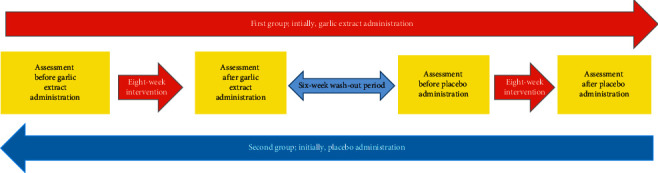
In this interventional double-blinded randomized crossover study, 70 patients were enrolled and assigned in two groups. Each group received 300 mg of garlic powder BID or placebo for eight weeks; after a six-week wash-out period, the agents were switched between two groups so that the group who received garlic powder in the first eight weeks received placebo for the second eight weeks, and vice versa. Venous blood samples were obtained in baseline, wash-out period, and at the end of study. Following obtaining laboratory data, BUN, creatinine, Na, K, Ca, Ph, homocysteine, and lipid profile were compared.
No significant differences were shown at baselines of outcomes between the garlic and placebo group ( value>0.05). However, there was a significant decrease in absolute values of OXLDL (mean placebo = 979.63, mean garlic = 676.54; value<0.001) and HCY (mean placebo = 36.54, mean garlic = 27.78; value<0.001). In addition, significant treatment differences were seen in change values of Ca (placebo = 1.17, garlic = 0.21; value = 0.006), TG (placebo = -6.71, garlic = -24.14; value = 0.014), OXLDL (placebo = -281.30, garlic = -699.78; value<0.001), and HCY (placebo = -0.24, garlic = -6.68; value<0.001).
In this study, powder demonstrated efficacy in lipid profile improvement and renal protective effects among hemodialysis patients.
炎症在血液透析患者心血管风险恶化中起重要作用。在这些患者中使用草药疗法,尤其是大蒜提取物,已在改善血脂、炎症和心血管指标方面取得了有前景的进展。
在本调查中,我们旨在确定口服大蒜粉对血液透析患者血脂、炎症和心血管指标的影响。
在这项干预性双盲随机交叉研究中,招募了70名患者并分为两组。每组接受300毫克大蒜粉,每日两次,或安慰剂,为期八周;在六周的洗脱期后,两组更换用药,即在前八周接受大蒜粉的组在接下来的八周接受安慰剂,反之亦然。在基线、洗脱期和研究结束时采集静脉血样本。获取实验室数据后,比较血尿素氮、肌酐、钠、钾、钙、磷、同型半胱氨酸和血脂情况。
大蒜组和安慰剂组在结局基线时无显著差异(P值>0.05)。然而,氧化型低密度脂蛋白(OXLDL)的绝对值(安慰剂组均值 = 979.63,大蒜组均值 = 676.54;P值<0.001)和同型半胱氨酸(HCY)(安慰剂组均值 = 36.54,大蒜组均值 = 27.78;P值<0.001)有显著下降。此外,在钙(安慰剂组 = 1.17,大蒜组 = 0.21;P值 = 0.006)、甘油三酯(TG)(安慰剂组 = -6.71,大蒜组 = -24.14;P值 = 0.014)、OXLDL(安慰剂组 = -281.30,大蒜组 = -699.78;P值<0.001)和HCY(安慰剂组 = -0.24大蒜组 = -6.68;P值<0.001)的变化值上有显著的治疗差异。
在本研究中,大蒜粉在改善血液透析患者血脂和肾脏保护作用方面显示出疗效。