Department of Public Health and Preventive Medicine, Faculty of Medicine, Udayana University, Denpasar, Indonesia.
Faculty of Medicine, Center for Public Health Innovation, Udayana University, Denpasar, Indonesia.
Front Public Health. 2021 May 13;9:621800. doi: 10.3389/fpubh.2021.621800. eCollection 2021.
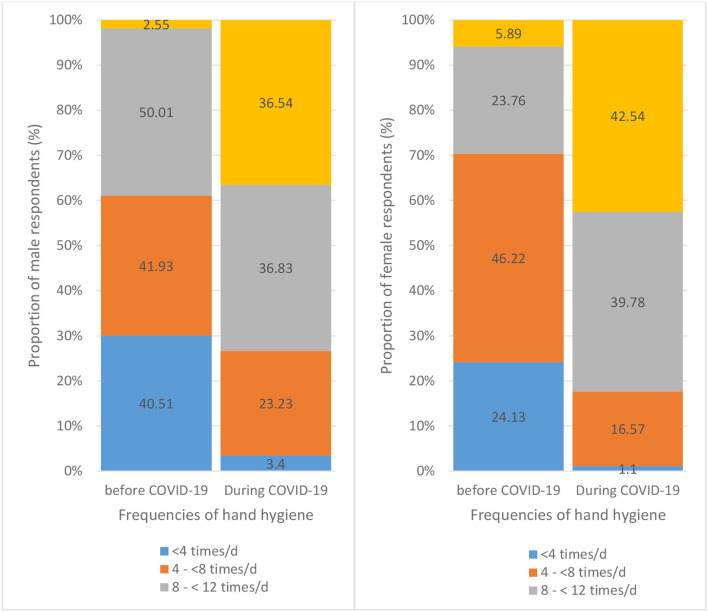
Hand hygiene practices are important not only during the corona virus disease 2019 (COVID-19) pandemic, but also critical to prevent the possible spread of other infectious diseases. This study aims to examine the current hand hygiene behaviors during the COVID-19 pandemic, post pandemic behavior intentions, and the relationship between behavior, psychosocial and contextual factors. A cross-sectional online survey was conducted from 28 May to 12 June 2020, with 896 valid responses obtained from Indonesian citizens over 18 years old. The survey questions included demographic characteristics, individual practices, risk perceptions, attitude, norm factors and ability factors related to hand hygiene during the COVID-19 pandemic. Descriptive analysis, chi square and multiple logistic regression tests were used to analyse the data. The results showed that 82.32% of female respondents and 73.37% male respondents reported handwashing practice 8 times or more per day during COVID-19 pandemic. Participants who perceived themselves at higher risk of contracting SARS-CoV-2 (OR 7.08, 2.26-22.17), had less negative perception toward the practice (OR 1.93, 1.32-2.82), perceived handwashing as an effective preventive measure (OR 1.77, 1.23-2.54), were female (OR 1.71, 1.21-2.41), perceived a more supportive norm (OR 1.68, 1.15-2.44) and noticed more barriers in access to handwashing facilities (OR 1.57, 1.05-2.36) were more likely to engage in hand hygiene practice more frequently during the pandemic. In conclusion, the majority of respondents did increase their frequency of hand hygiene practices during COVID-19 pandemic. In line with previous studies in other pandemic contexts, sex, perceived susceptibility and effectiveness are important predictors of hand hygiene practices, which are similar to findings from previous studies in other pandemic contexts. Addressing social norm related to the perceived hand hygiene practices of friends and important people is a potential health promotion strategy by creating hand hygiene norms in the community.
手卫生习惯不仅在 2019 年冠状病毒病(COVID-19)大流行期间很重要,而且对于预防其他传染病的传播也至关重要。本研究旨在检查 COVID-19 大流行期间的当前手卫生行为、大流行后行为意向以及行为、心理社会和环境因素之间的关系。一项横断面在线调查于 2020 年 5 月 28 日至 6 月 12 日进行,从 18 岁以上的印度尼西亚公民中获得了 896 份有效回复。调查问卷包括人口统计学特征、个人实践、风险认知、态度、与 COVID-19 大流行期间手卫生相关的规范因素和能力因素。使用描述性分析、卡方检验和多逻辑回归检验分析数据。结果显示,82.32%的女性受访者和 73.37%的男性受访者报告在 COVID-19 大流行期间每天洗手 8 次或更多次。认为自己感染 SARS-CoV-2 的风险较高的参与者(OR 7.08,2.26-22.17)、对该实践的负面看法较少(OR 1.93,1.32-2.82)、认为洗手是一种有效的预防措施(OR 1.77,1.23-2.54)、女性(OR 1.71,1.21-2.41)、感知到更支持的规范(OR 1.68,1.15-2.44)和注意到手卫生设施获取方面的更多障碍(OR 1.57,1.05-2.36)更有可能在大流行期间更频繁地进行手卫生实践。总之,大多数受访者确实增加了 COVID-19 大流行期间手卫生的频率。与其他大流行背景下的先前研究一致,性别、感知易感性和有效性是手卫生实践的重要预测因素,这与其他大流行背景下的先前研究结果相似。通过在社区中创造手卫生规范,解决与朋友和重要人物感知的手卫生实践相关的社会规范是一种潜在的健康促进策略。