Feng Xiaojing, Yang Yanyi, Zhuang Siqi, Fang Yiyuan, Dai Yufeng, Fu Yaoyang, Hu Qian, Yuan Qianqin, Tang Haoneng, Tang Lingli
Department of Laboratory Medicine, The Second Xiangya Hospital, Central South University, Changsha, China.
Health Management Center of the Second Xiangya Hospital, Central South University, Changsha, China.
Front Med (Lausanne). 2021 May 12;8:583093. doi: 10.3389/fmed.2021.583093. eCollection 2021.
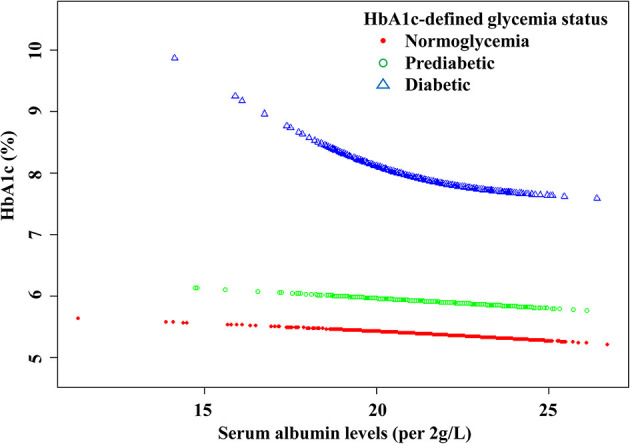
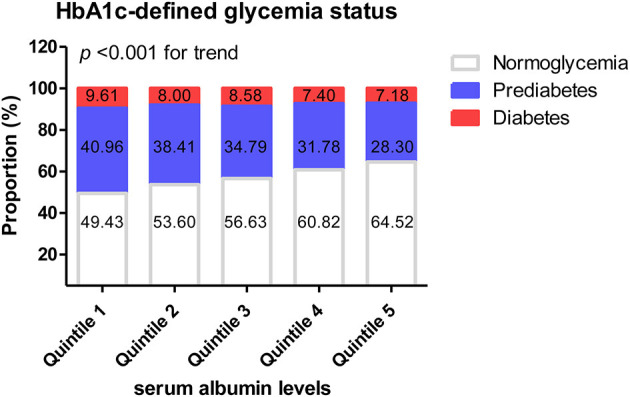
Glycated hemoglobin (HbA1c) is commonly used in the diagnosis and evaluation of glycemic control in diabetes, and it may be influenced by several non-glycemic and glycemic factors, including albumin. This retrospective study investigated the influence of albumin on HbA1c and HbA1c-defined glycemic status. The demographic, hematological, and biochemical data were collected for 11,922 patients undergoing routine physical examination. Univariate and multivariate linear regression analyses, stratified analyses and interaction analyses, and multiple logistic regression were conducted to identify the association between albumin and HbA1c in people with different glycemic status. HbA1c levels were inversely associated with serum albumin level ( < 0.0001) in all participants. Risk factors leading to the association included age > 45 years, high fasting plasma glucose (≥7.0 mmol/L), and anemia. The negative association between HbA1c and albumin was curved ( < 0.0001) and had a threshold effect in the HbA1c-defined diabetic population; the association was significantly stronger when the albumin level fell below 41.4 g/L (β: -0.31, 95% CI: -0.45 to -0.17, < 0.0001). A 2 g/L increase in albumin reduced the odds of HbA1c-defined dysglycemia, diabetes, and poor glycemia control by 12% to 36%, after adjustment for all possible confounders. HbA1c was inversely associated with albumin level in all participants, and the association was significantly stronger in people with diabetes (defined by HbA1c criteria). For diabetic patients with lower albumin level, there was an increased risk of an erroneous HbA1c-based identification and management of glycemic status.
糖化血红蛋白(HbA1c)常用于糖尿病血糖控制的诊断和评估,它可能受到包括白蛋白在内的多种非血糖和血糖因素的影响。这项回顾性研究调查了白蛋白对HbA1c及HbA1c定义的血糖状态的影响。收集了11922例接受常规体检患者的人口统计学、血液学和生化数据。进行单因素和多因素线性回归分析、分层分析和交互分析以及多因素逻辑回归,以确定不同血糖状态人群中白蛋白与HbA1c之间的关联。在所有参与者中,HbA1c水平与血清白蛋白水平呈负相关(<0.0001)。导致这种关联的危险因素包括年龄>45岁、空腹血糖高(≥7.0 mmol/L)和贫血。在HbA1c定义的糖尿病患者群体中,HbA1c与白蛋白之间的负相关呈曲线关系(<0.0001)且具有阈值效应;当白蛋白水平降至41.4 g/L以下时,这种关联显著增强(β:-0.31,95%CI:-0.45至-0.17,<0.0001)。在对所有可能的混杂因素进行校正后,白蛋白每增加2 g/L,HbA1c定义的血糖异常、糖尿病和血糖控制不佳的几率降低12%至36%。在所有参与者中,HbA1c与白蛋白水平呈负相关,在糖尿病患者(根据HbA1c标准定义)中这种关联显著更强。对于白蛋白水平较低的糖尿病患者,基于HbA1c错误识别和管理血糖状态的风险增加。