Department of Mathematics, University of Las Palmas de Gran Canaria, Las Palmas, Spain.
Department of Physical Education and Biomedical and Health Research Universitary Institute, University of Las Palmas de Gran Canaria, Las Palmas, Spain.
Popul Health Metr. 2021 May 31;19(1):27. doi: 10.1186/s12963-021-00259-y.
The number of deaths attributable to COVID-19 in Spain has been highly controversial since it is problematic to tell apart deaths having COVID as the main cause from those provoked by the aggravation by the viral infection of other underlying health problems. In addition, overburdening of health system led to an increase in mortality due to the scarcity of adequate medical care, at the same time confinement measures could have contributed to the decrease in mortality from certain causes. Our aim is to compare the number of deaths observed in 2020 with the projection for the same period obtained from a sequence of previous years. Thus, this computed mortality excess could be considered as the real impact of the COVID-19 on the mortality rates.
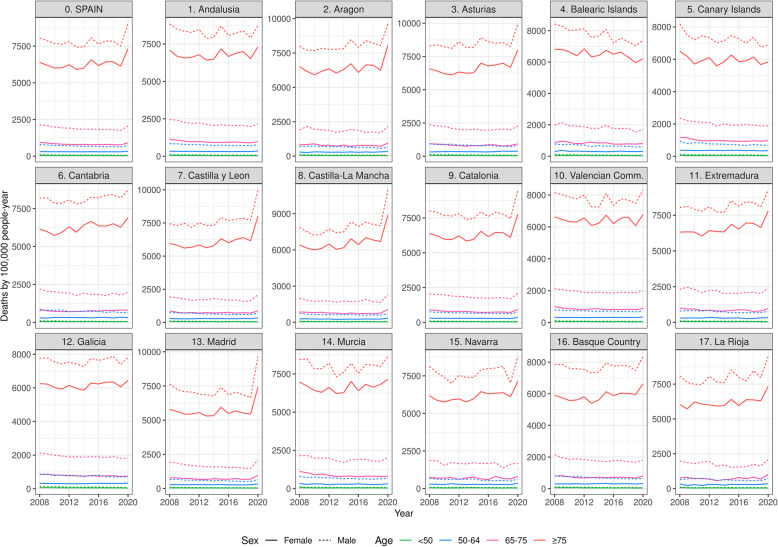
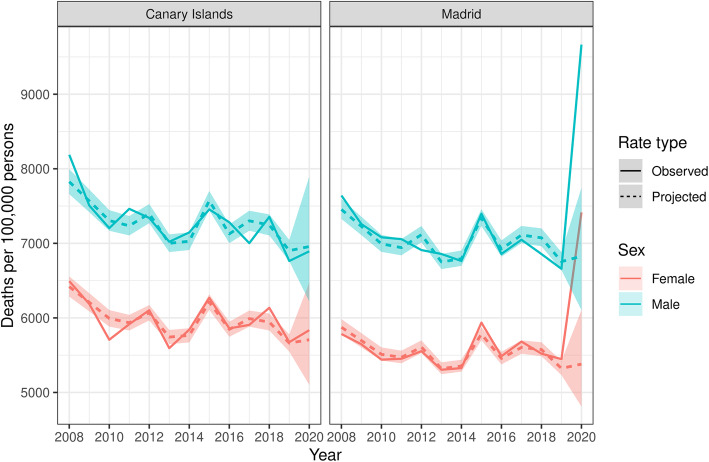
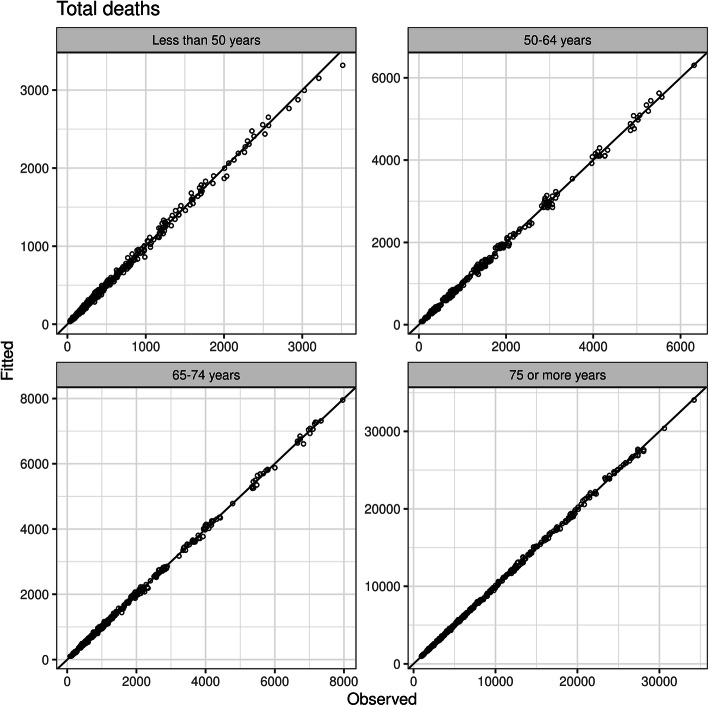
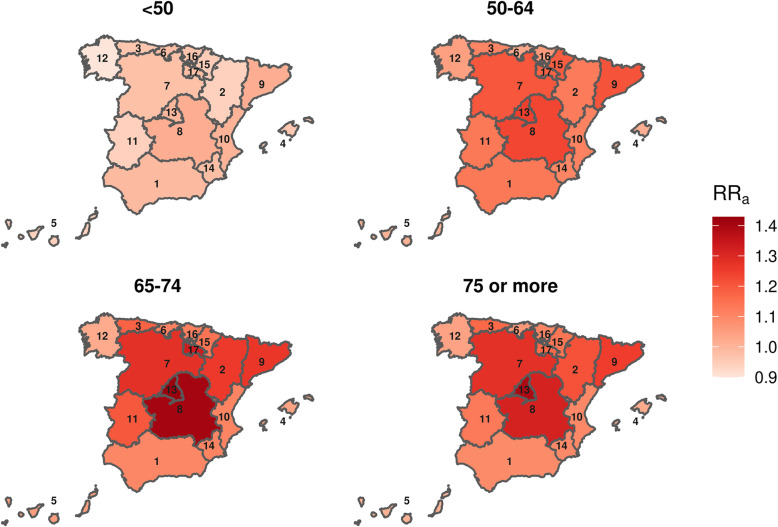
The population was split into four age groups, namely: (< 50; 50-64; 65-74; 75 and over). For each one, a projection of the death numbers for the year 2020, based on the interval 2008-2020, was estimated using a Bayesian spatio-temporal model. In each one, spatial, sex, and year effects were included. In addition, a specific effect of the year 2020 was added ("outbreak"). Finally, the excess deaths in year 2020 were estimated as the count of observed deaths minus those projected.
The projected death number for 2020 was 426,970 people, the actual count being 499,104; thus, the total excess of deaths was 72,134. However, this increase was very unequally distributed over the Spanish regions.
Bayesian spatio-temporal models have proved to be a useful tool for estimating the impact of COVID-19 on mortality in Spain in 2020, making it possible to assess how the disease has affected different age groups accounting for effects of sex, spatial variation between regions and time trend over the last few years.
自新冠疫情爆发以来,西班牙因新冠病毒死亡的人数一直存在争议,因为很难区分因新冠病毒而直接导致的死亡和因新冠病毒恶化而导致的其他潜在健康问题引发的死亡。此外,医疗系统负担过重导致因医疗资源不足而导致的死亡率上升,同时,封锁措施可能导致某些原因导致的死亡率下降。我们的目的是将 2020 年观察到的死亡人数与同年的预测数据进行比较,从而得出新冠疫情对死亡率的实际影响。
将人群分为四个年龄组,分别为:(<50 岁;50-64 岁;65-74 岁;75 岁及以上)。对于每个年龄组,根据 2008-2020 年的时间段,使用贝叶斯时空模型对 2020 年的死亡人数进行预测。在每个模型中,都包括了空间、性别和年份的影响。此外,还添加了 2020 年的特定影响(“疫情爆发”)。最后,通过观察到的死亡人数减去预测的死亡人数来计算 2020 年的超额死亡人数。
2020 年预测的死亡人数为 426970 人,实际死亡人数为 499104 人,因此总死亡人数增加了 72134 人。然而,这种增加在西班牙各地区的分布非常不均衡。
贝叶斯时空模型已被证明是一种有用的工具,可用于估计 2020 年新冠疫情对西班牙死亡率的影响,从而评估该疾病如何影响不同年龄组,同时考虑了性别、地区间的空间差异和过去几年的时间趋势。