University of Groningen, Campus Fryslân, Wirdumerdijk 34, 8911 CE, Leeuwarden, The Netherlands.
Queen Mary University of London, London, UK.
Sci Rep. 2021 Aug 12;11(1):16443. doi: 10.1038/s41598-021-95658-4.
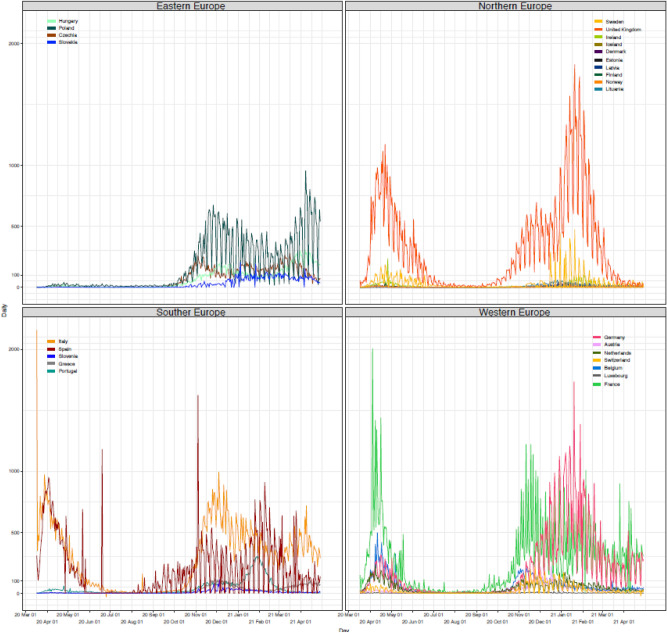
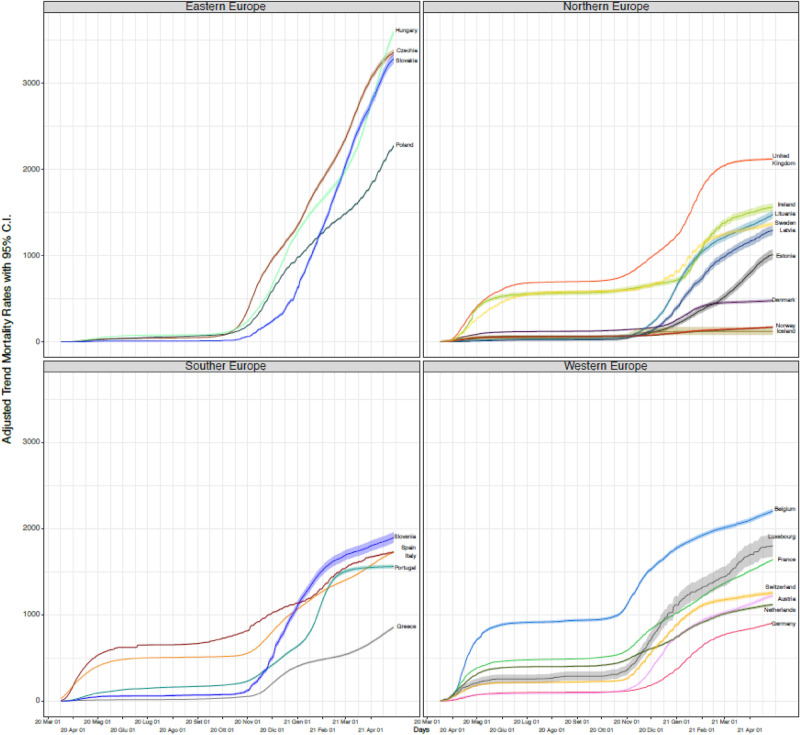
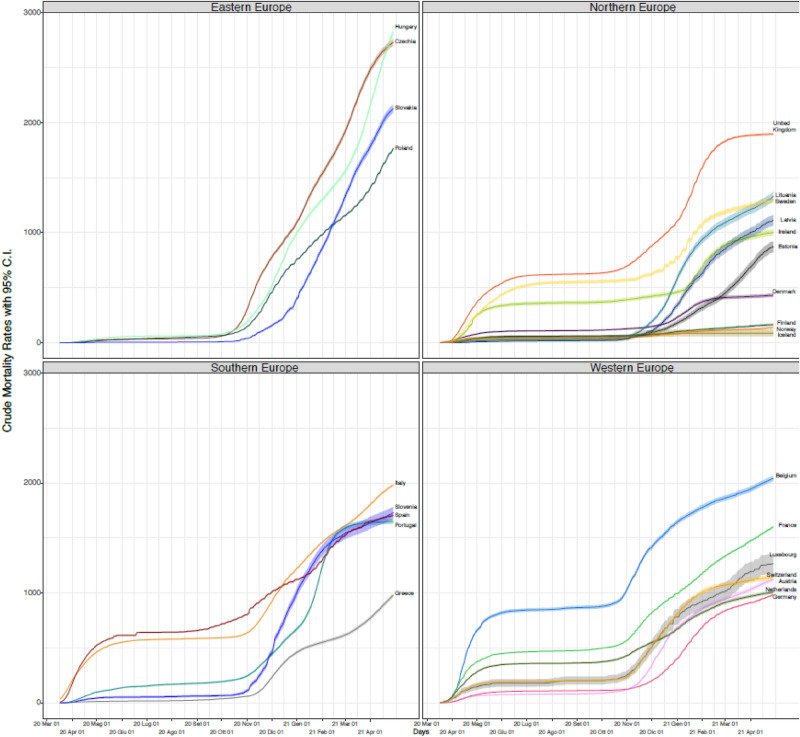
Comparison of COVID-19 trends in space and over time is essential to monitor the pandemic and to indirectly evaluate non-pharmacological policies aimed at reducing the burden of disease. Given the specific age- and sex- distribution of COVID-19 mortality, the underlying sex- and age-distribution of populations need to be accounted for. The aim of this paper is to present a method for monitoring trends of COVID-19 using adjusted mortality trend ratios (AMTRs). Age- and sex-mortality distribution of a reference European population (N = 14,086) was used to calculate age- and sex-specific mortality rates. These were applied to each country to calculate the expected deaths. Adjusted Mortality Trend Ratios (AMTRs) with 95% confidence intervals (C.I.) were calculated for selected European countries on a daily basis from 17th March 2020 to 29th April 2021 by dividing observed cumulative mortality, by expected mortality, times the crude mortality of the reference population. These estimated the sex- and age-adjusted mortality for COVID-19 per million population in each country. United Kingdom experienced the highest number of COVID-19 related death in Europe. Crude mortality rates were highest Hungary, Czech Republic, and Luxembourg. Accounting for the age-and sex-distribution of the underlying populations with AMTRs for each European country, four different patterns were identified: countries which experienced a two-wave pandemic, countries with almost undetectable first wave, but with either a fast or a slow increase of mortality during the second wave; countries with consistently low rates throughout the period. AMTRs were highest in Eastern European countries (Hungary, Czech Republic, Slovakia, and Poland). Our methods allow a fair comparison of mortality in space and over time. These might be of use to indirectly estimating the efficacy of non-pharmacological health policies. The authors urge the World Health Organisation, given the absence of age and sex-specific mortality data for direct standardisation, to adopt this method to estimate the comparative mortality from COVID-19 pandemic worldwide.
比较空间和时间上的 COVID-19 趋势对于监测大流行以及间接评估旨在减轻疾病负担的非药物政策至关重要。鉴于 COVID-19 死亡率的特定年龄和性别分布,需要考虑人口的潜在性别和年龄分布。本文的目的是提出一种使用调整后的死亡率趋势比 (AMTR) 监测 COVID-19 趋势的方法。使用参考欧洲人口(N=14086)的年龄和性别死亡率分布来计算年龄和性别特异性死亡率。将这些应用于每个国家以计算预期死亡人数。从 2020 年 3 月 17 日至 2021 年 4 月 29 日,每天在选定的欧洲国家计算调整后的死亡率趋势比(AMTR),方法是将观察到的累积死亡率除以预期死亡率,再乘以参考人群的粗死亡率。这估计了每个国家每百万人口的 COVID-19 相关死亡人数。英国是欧洲 COVID-19 相关死亡人数最多的国家。粗死亡率最高的国家是匈牙利、捷克共和国和卢森堡。通过使用 AMTR 为每个欧洲国家的人口分配年龄和性别,确定了四种不同的模式:经历了两波大流行的国家、第一波几乎无法检测到的国家,但在第二波期间死亡率迅速或缓慢增加的国家、整个期间死亡率一直较低的国家。东欧国家(匈牙利、捷克共和国、斯洛伐克和波兰)的 AMTR 最高。我们的方法允许对空间和时间上的死亡率进行公平比较。这些方法可能有助于间接估计非药物卫生政策的效果。作者敦促世界卫生组织,鉴于缺乏直接标准化的年龄和性别特异性死亡率数据,采用这种方法来估计全球 COVID-19 大流行的相对死亡率。