Nguyen Quyen N T, Le Toan, Huynh Quyen B T, Setty Arveity, Vo Toi V, Le Trung Q
Department of Medical Instrumentation, School of Biomedical Engineering, International University of Vietnam National University, Ho Chi Minh City, Vietnam.
Department of Biomedical Engineering, North Dakota State University, Fargo, ND 58108, USA.
Clocks Sleep. 2021 May 3;3(2):274-288. doi: 10.3390/clockssleep3020017.
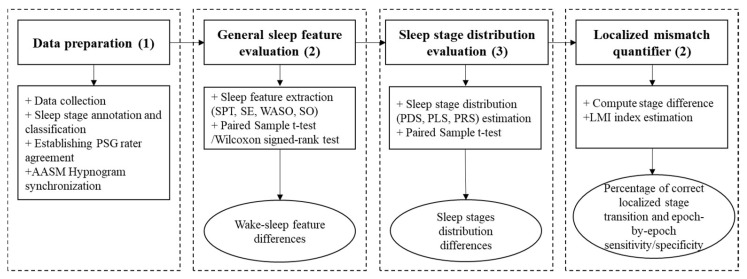
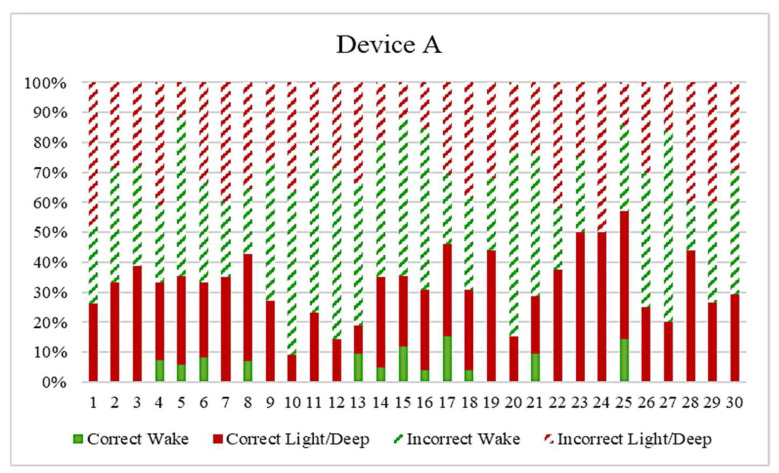
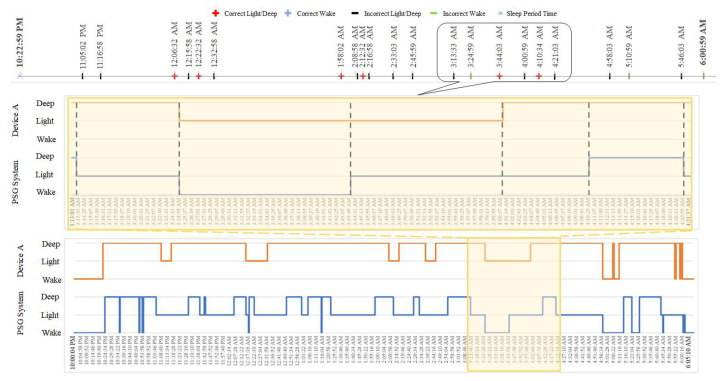
The rapid growth of point-of-care polysomnographic alternatives has necessitated standardized evaluation and validation frameworks. The current average across participant validation methods may overestimate the agreement between wearable sleep tracker devices and polysomnography (PSG) systems because of the high base rate of sleep during the night and the interindividual difference across the sampling population. This study proposes an evaluation framework to assess the aggregating differences of the sleep architecture features and the chronologically epoch-by-epoch mismatch of the wearable sleep tracker devices and the PSG ground truth. An AASM-based sleep stage categorizing method was proposed to standardize the sleep stages scored by different types of wearable trackers. Sleep features and sleep stage architecture were extracted from the PSG and the wearable device's hypnograms. Therefrom, a localized quantifier index was developed to characterize the local mismatch of sleep scoring. We evaluated different commonly used wearable sleep tracking devices with the data collected from 22 different subjects over 30 nights of 8-h sleeping. The proposed localization quantifiers can characterize the chronologically localized mismatches over the sleeping time. The outperformance of the proposed method over existing evaluation methods was reported. The proposed evaluation method can be utilized for the improvement of the sensor design and scoring algorithm.
即时多导睡眠图替代技术的快速发展使得标准化评估和验证框架成为必要。由于夜间睡眠的高发生率以及抽样人群中的个体差异,目前参与者验证方法的平均结果可能高估了可穿戴睡眠追踪设备与多导睡眠图(PSG)系统之间的一致性。本研究提出了一个评估框架,以评估睡眠结构特征的总体差异以及可穿戴睡眠追踪设备与PSG真实情况在逐时程上的逐时段不匹配情况。提出了一种基于美国睡眠医学学会(AASM)的睡眠阶段分类方法,以规范不同类型可穿戴追踪器所记录的睡眠阶段。从PSG和可穿戴设备的睡眠图中提取睡眠特征和睡眠阶段结构。据此,开发了一个局部量化指标来表征睡眠评分的局部不匹配情况。我们使用从22名不同受试者在30个夜晚的8小时睡眠中收集的数据,评估了不同的常用可穿戴睡眠追踪设备。所提出的局部量化指标能够表征睡眠期间逐时程的局部不匹配情况。报告了所提出方法相对于现有评估方法的优越性。所提出的评估方法可用于改进传感器设计和评分算法。