Division of Hematology/Oncology, Department of Internal Medicine, University of Texas Southwestern Medical Center, Dallas, TX 75390, USA.
Harold C. Simmons Comprehensive Cancer Center, University of Texas Southwestern Medical Center, Dallas, TX 75390, USA.
Cells. 2021 May 21;10(6):1270. doi: 10.3390/cells10061270.
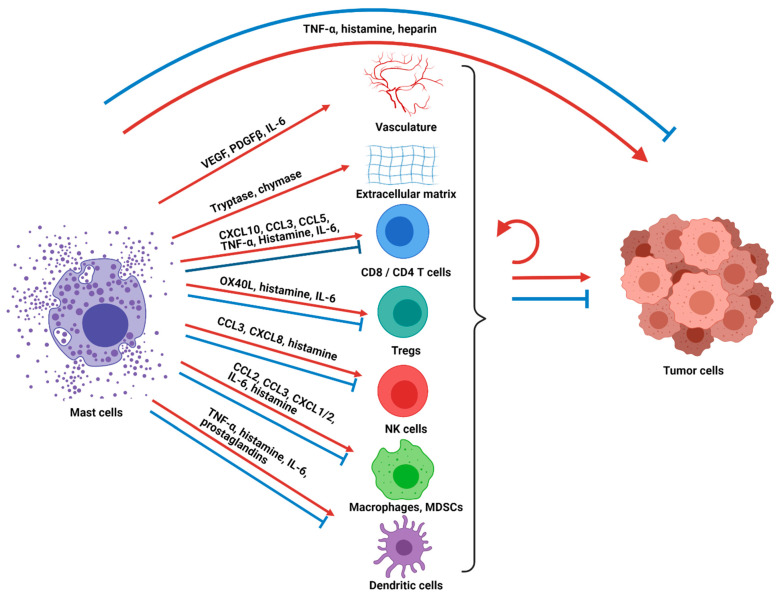
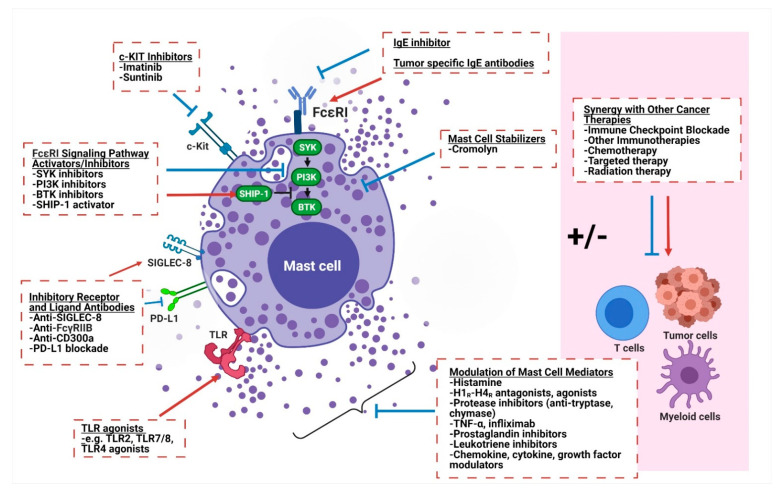
Mast cells are unique tissue-resident immune cells of the myeloid lineage that have long been implicated in the pathogenesis of allergic and autoimmune disorders. More recently, mast cells have been recognized as key orchestrators of anti-tumor immunity, modulators of the cancer stroma, and have also been implicated in cancer cell intrinsic properties. As such, mast cells are an underrecognized but very promising target for cancer immunotherapy. In this review, we discuss the role of mast cells in shaping cancer and its microenvironment, the interaction between mast cells and cancer therapies, and strategies to target mast cells to improve cancer outcomes. Specifically, we address (1) decreasing cell numbers through c-KIT inhibition, (2) modulating mast cell activation and phenotype (through mast cell stabilizers, FcεR1 signaling pathway activators/inhibitors, antibodies targeting inhibitory receptors and ligands, toll like receptor agonists), and (3) altering secreted mast cell mediators and their downstream effects. Finally, we discuss the importance of translational research using patient samples to advance the field of mast cell targeting to optimally improve patient outcomes. As we aim to expand the successes of existing cancer immunotherapies, focused clinical and translational studies targeting mast cells in different cancer contexts are now warranted.
肥大细胞是髓系来源的独特组织驻留免疫细胞,长期以来一直被认为与过敏和自身免疫性疾病的发病机制有关。最近,肥大细胞被认为是抗肿瘤免疫的关键协调者,是肿瘤基质的调节剂,并且与癌细胞内在特性有关。因此,肥大细胞是癌症免疫治疗中一个尚未被充分认识但非常有前途的靶点。在这篇综述中,我们讨论了肥大细胞在塑造癌症及其微环境中的作用、肥大细胞与癌症治疗的相互作用,以及靶向肥大细胞以改善癌症结局的策略。具体而言,我们讨论了以下三种方法:(1)通过 c-KIT 抑制减少细胞数量,(2)调节肥大细胞的激活和表型(通过肥大细胞稳定剂、FcεR1 信号通路激活剂/抑制剂、靶向抑制性受体和配体的抗体、 Toll 样受体激动剂),以及(3)改变分泌的肥大细胞介质及其下游效应。最后,我们讨论了使用患者样本进行转化研究的重要性,以推进肥大细胞靶向领域的发展,从而优化患者的治疗效果。随着我们旨在扩大现有癌症免疫疗法的成功,针对不同癌症环境中的肥大细胞进行有针对性的临床和转化研究现在是必要的。