Lorent Dagny, Nowak Rafal, Roxo Carolina, Lenartowicz Elzbieta, Makarewicz Aleksandra, Zaremba Bartosz, Nowak Szymon, Kuszel Lukasz, Stefaniak Jerzy, Kierzek Ryszard, Zmora Pawel
Institute of Bioorganic Chemistry Polish Academy of Sciences, 61-704 Poznan, Poland.
Department and Clinic of Tropical and Parasitic Diseases, Poznan University of Medical Sciences, 60-355 Poznan, Poland.
Vaccines (Basel). 2021 May 21;9(6):541. doi: 10.3390/vaccines9060541.
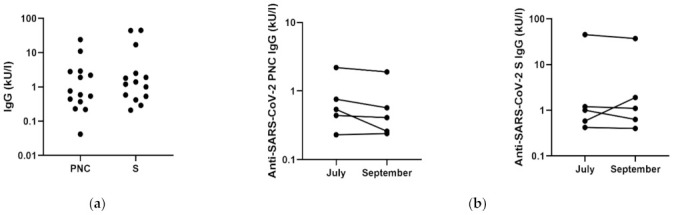
In comparison to other European countries, during the first months of the COVID-19 pandemic, Poland reported a relatively low number of confirmed cases of severe acute respiratory syndrome coronavirus 2 (SARS-CoV-2) infections. To estimate the scale of the pandemic in Poland, a serosurvey of antibodies against SARS-CoV-2 was performed after the first wave of COVID-19 in Europe (March-May 2020). Within this study, we collected samples from 28 July to 24 September 2020 and, based on the ELISA results, we found that 1.67% (25/1500, 95% CI 1.13-2.45) of the Poznan (Poland) metropolitan area's population had antibodies against SARS-CoV-2 after the first wave of COVID-19. However, the presence of anti-SARS-CoV-2 IgG antibodies was confirmed with immunoblotting in 56% (14/25) samples, which finally resulted in a decrease in seroprevalence, i.e., 0.93% (14/1500, 95% CI 0.56-1.56). The positive anti-SARS-CoV-2 IgG results were associated with age, occupation involving constant contact with people, travelling abroad, non-compliance with epidemiological recommendations and direct contact with the novel coronavirus. Our findings confirm the low SARS-CoV-2 incidence in Poland and imply that the population had little herd immunity heading into the second and third wave of the pandemic, and therefore, that herd immunity contributed little to preventing the high numbers of SARS-CoV-2 infections and COVID-19-related deaths in Poland during these subsequent waves.
与其他欧洲国家相比,在新冠疫情的最初几个月里,波兰报告的严重急性呼吸综合征冠状病毒2(SARS-CoV-2)感染确诊病例数相对较低。为了评估波兰的疫情规模,在欧洲第一波新冠疫情(2020年3月至5月)之后进行了一项针对SARS-CoV-2抗体的血清学调查。在本研究中,我们于2020年7月28日至9月24日收集样本,并根据酶联免疫吸附测定(ELISA)结果发现,在第一波新冠疫情之后,波兰波兹南都会区1.67%(25/1500,95%置信区间1.13 - 2.45)的人口拥有SARS-CoV-2抗体。然而,通过免疫印迹法在56%(14/25)的样本中确认了抗SARS-CoV-2 IgG抗体的存在,这最终导致血清阳性率下降,即0.93%(14/1500,95%置信区间0.56 - 1.56)。抗SARS-CoV-2 IgG阳性结果与年龄、涉及与人持续接触的职业、出国旅行、不遵守流行病学建议以及与新型冠状病毒直接接触有关。我们的研究结果证实了波兰SARS-CoV-2的低发病率,并表明在进入第二波和第三波疫情时,该人群几乎没有群体免疫力,因此,群体免疫力对在随后这些疫情波次中预防波兰大量的SARS-CoV-2感染和新冠相关死亡贡献不大。