Department of Pharmaceutical Microbiology, Medical University of Lublin, 20-093 Lublin, Poland.
Department of Hematooncology and Bone Marrow Transplantation, Medical University of Lublin, 20-081 Lublin, Poland.
Int J Environ Res Public Health. 2022 Feb 17;19(4):2319. doi: 10.3390/ijerph19042319.
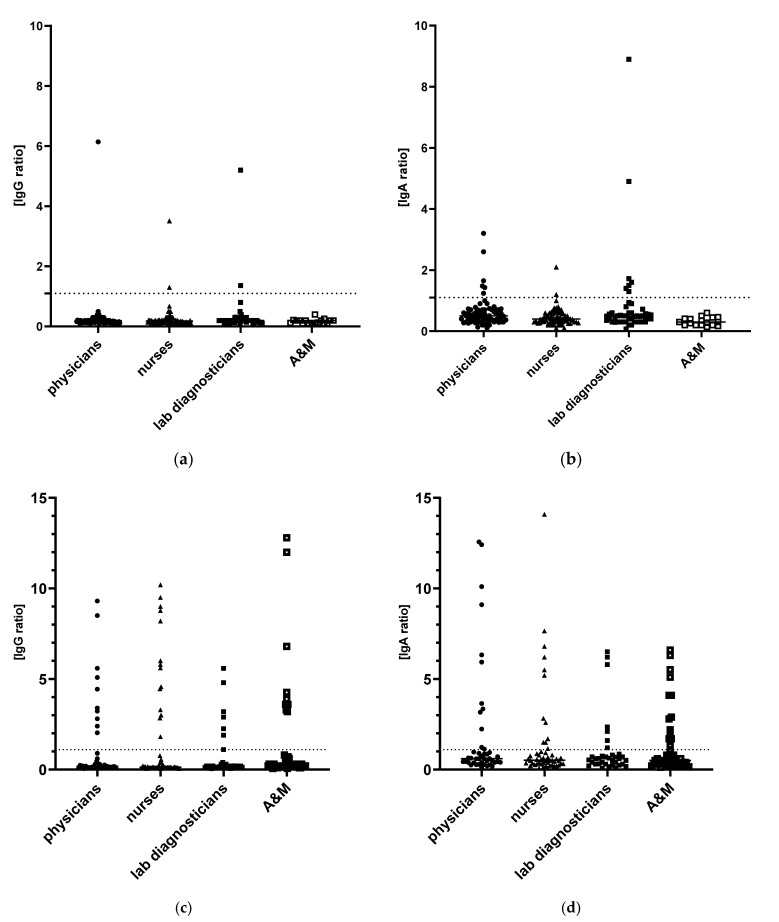
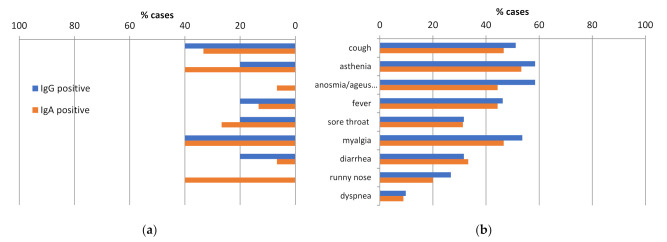
Healthcare workers (HCWs) are on the frontline, struggling with the pandemic caused by severe acute respiratory syndrome coronavirus 2 (SARS-CoV-2). To describe recent or past infections, the serological assays enabled the assessment of the immune response developed in coronavirus disease (COVID-19) in the period when testing was hardly available. In this study, we investigated SARS-CoV-2 seroprevalence in HCWs in a Polish teaching hospital and the Regional Occupational Medicine Center after both the first and the second waves. ELISA-based tests for anti-SARS-CoV-2 IgA and IgG were used to determine immune response to SARS-CoV-2 in volunteer HCWs who worked in those institutions in May 2020 (208 participants aged 47.1 ± 12.5, 88% women) and in December 2020 (179 participants aged 45.2 ± 12.4, 86% woman). Risk factors for seropositivity were also assessed using a questionnaire filled out by all participants. We reported a significant increase in seroprevalence after the second wave (22.9%) compared with the first outbreak (2.4%) (OR 12.1; 95%CI 4.6-31.3; < 0.0001). An association between IgG seroprevalence and severity of infections was noted. Furthermore, we demonstrated that amongst medical personnel, nurses exhibited a proportionally higher SARS-CoV-2 seroprevalence. Moreover, given the high seroprevalence in non-clinical group of HCWs, we suggest that community transmission can play a superior role to workplace exposure.
医护人员(HCWs)奋战在抗击由严重急性呼吸综合征冠状病毒 2(SARS-CoV-2)引起的大流行的前线。为了描述近期或过去的感染情况,血清学检测使人们能够评估在检测几乎不可用时发生的冠状病毒病(COVID-19)中的免疫反应。在这项研究中,我们调查了波兰一所教学医院和地区职业医学中心的 HCWs 在第一波和第二波之后 SARS-CoV-2 的血清流行率。使用基于 ELISA 的抗 SARS-CoV-2 IgA 和 IgG 检测来确定在这些机构工作的志愿者 HCWs 对 SARS-CoV-2 的免疫反应,这些 HCWs 于 2020 年 5 月(208 名参与者,年龄 47.1 ± 12.5,88%为女性)和 2020 年 12 月(179 名参与者,年龄 45.2 ± 12.4,86%为女性)参加了研究。还使用所有参与者填写的问卷评估了血清阳性的危险因素。与第一波疫情(2.4%)相比,我们报告第二波疫情后血清阳性率显著增加(22.9%)(OR 12.1;95%CI 4.6-31.3;<0.0001)。我们注意到 IgG 血清阳性率与感染严重程度之间存在关联。此外,我们证明在医务人员中,护士的 SARS-CoV-2 血清阳性率比例较高。此外,鉴于非临床 HCWs 群体中的高血清阳性率,我们认为社区传播可能比工作场所暴露发挥更重要的作用。