Schreiber Karl J, Chau-Ly Ilea J, Lewis Jennifer D
Department of Plant and Microbial Biology, University of California, Berkeley, CA 94710, USA.
Plant Gene Expression Center, United States Department of Agriculture, University of California, Berkeley, CA 94710, USA.
Microorganisms. 2021 May 11;9(5):1029. doi: 10.3390/microorganisms9051029.
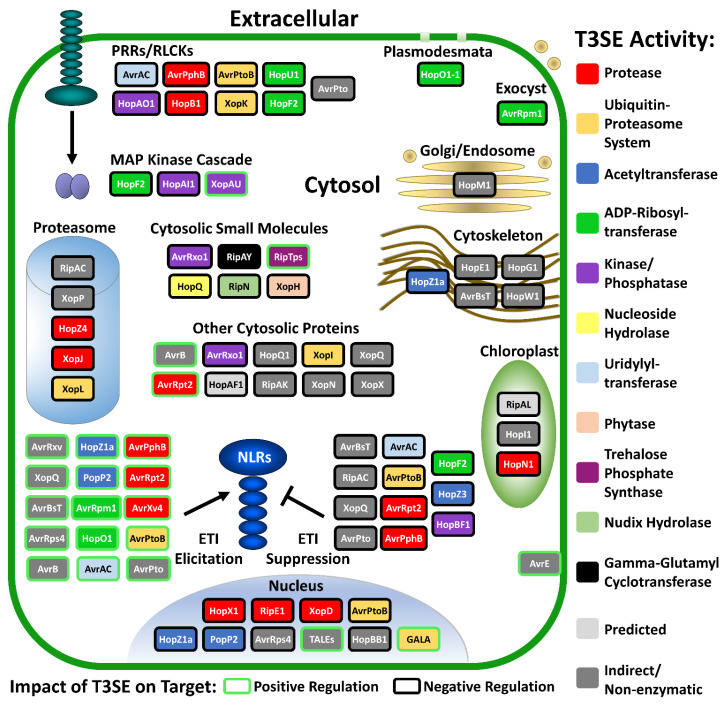
Phytopathogenic bacteria possess an arsenal of effector proteins that enable them to subvert host recognition and manipulate the host to promote pathogen fitness. The type III secretion system (T3SS) delivers type III-secreted effector proteins (T3SEs) from bacterial pathogens such as , , and various species. These T3SEs interact with and modify a range of intracellular host targets to alter their activity and thereby attenuate host immune signaling. Pathogens have evolved T3SEs with diverse biochemical activities, which can be difficult to predict in the absence of structural data. Interestingly, several T3SEs are activated following injection into the host cell. Here, we review T3SEs with documented enzymatic activities, as well as T3SEs that facilitate virulence-promoting processes either indirectly or through non-enzymatic mechanisms. We discuss the mechanisms by which T3SEs are activated in the cell, as well as how T3SEs modify host targets to promote virulence or trigger immunity. These mechanisms may suggest common enzymatic activities and convergent targets that could be manipulated to protect crop plants from infection.
植物致病细菌拥有一系列效应蛋白,使它们能够颠覆宿主识别并操控宿主以提高病原体适应性。III型分泌系统(T3SS)从诸如 、 和各种 物种等细菌病原体中递送III型分泌效应蛋白(T3SEs)。这些T3SEs与一系列细胞内宿主靶点相互作用并对其进行修饰,以改变它们的活性,从而减弱宿主免疫信号传导。病原体已经进化出具有多种生化活性的T3SEs,在缺乏结构数据的情况下,这些活性可能难以预测。有趣的是,一些T3SEs在注入宿主细胞后被激活。在这里,我们综述了具有已记录酶活性的T3SEs,以及通过间接或非酶机制促进毒力增强过程的T3SEs。我们讨论了T3SEs在细胞中被激活的机制,以及T3SEs如何修饰宿主靶点以促进毒力或触发免疫。这些机制可能提示了共同的酶活性和趋同靶点,可对其进行操控以保护作物免受感染。