Beijing Advanced Innovation Center for Food Nutrition and Human Health, College of Food Science and Nutritional Engineering, China Agricultural University, Beijing 100083, China.
Department of Food Engineering, Mokpo National University, Muangun 58554, Korea.
Nutrients. 2021 May 16;13(5):1691. doi: 10.3390/nu13051691.
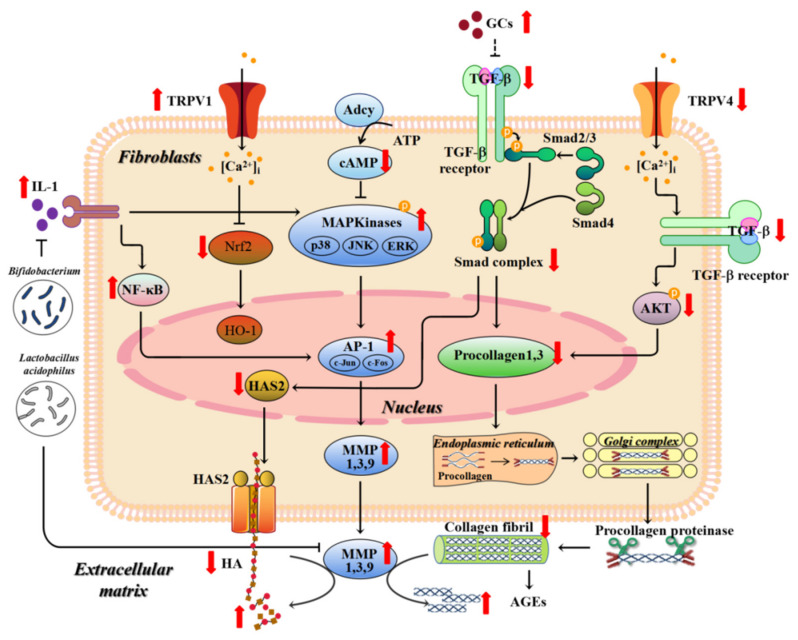
Skin photoaging is mainly induced by ultraviolet (UV) irradiation and its manifestations include dry skin, coarse wrinkle, irregular pigmentation, and loss of skin elasticity. Dietary supplementation of nutraceuticals with therapeutic and preventive effects against skin photoaging has recently received increasing attention. This article aims to review the research progress in the cellular and molecular mechanisms of UV-induced skin photoaging. Subsequently, the beneficial effects of dietary components on skin photoaging are discussed. The photoaging process and the underlying mechanisms are complex. Matrix metalloproteinases, transforming growth factors, skin adipose tissue, inflammation, oxidative stress, nuclear and mitochondrial DNA, telomeres, microRNA, advanced glycation end products, the hypothalamic-pituitary-adrenal axis, and transient receptor potential cation channel V are key regulators that drive the photoaging-associated changes in skin. Meanwhile, mounting evidence from animal models and clinical trials suggests that various food-derived components attenuate the development and symptoms of skin photoaging. The major mechanisms of these dietary components to alleviate skin photoaging include the maintenance of skin moisture and extracellular matrix content, regulation of specific signaling pathways involved in the synthesis and degradation of the extracellular matrix, and antioxidant capacity. Taken together, the ingestion of food-derived functional components could be an attractive strategy to prevent skin photoaging damage.
皮肤光老化主要由紫外线(UV)辐射引起,其表现包括皮肤干燥、粗糙皱纹、色素不均匀和皮肤弹性丧失。具有治疗和预防皮肤光老化作用的营养保健品的饮食补充近来受到越来越多的关注。本文旨在综述 UV 诱导皮肤光老化的细胞和分子机制的研究进展。随后,讨论了饮食成分对皮肤光老化的有益作用。光老化过程和潜在机制复杂。基质金属蛋白酶、转化生长因子、皮肤脂肪组织、炎症、氧化应激、核和线粒体 DNA、端粒、microRNA、糖基化终产物、下丘脑-垂体-肾上腺轴和瞬时受体电位阳离子通道 V 是驱动皮肤光老化相关变化的关键调节因子。同时,来自动物模型和临床试验的越来越多的证据表明,各种源自食物的成分可减轻皮肤光老化的发生和症状。这些饮食成分缓解皮肤光老化的主要机制包括维持皮肤水分和细胞外基质含量、调节细胞外基质合成和降解涉及的特定信号通路,以及抗氧化能力。总的来说,摄入源自食物的功能性成分可能是预防皮肤光老化损伤的一种有吸引力的策略。