Department of Microbiology, Biochemistry, and Immunology, Morehouse School of Medicine, Atlanta, GA 30310, USA.
Department of Community Health and Preventive Medicine, Morehouse School of Medicine, Atlanta, GA 30310, USA.
Int J Environ Res Public Health. 2021 May 13;18(10):5163. doi: 10.3390/ijerph18105163.
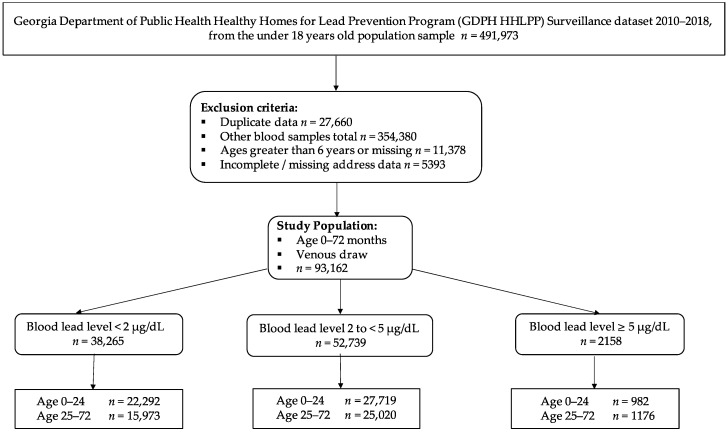
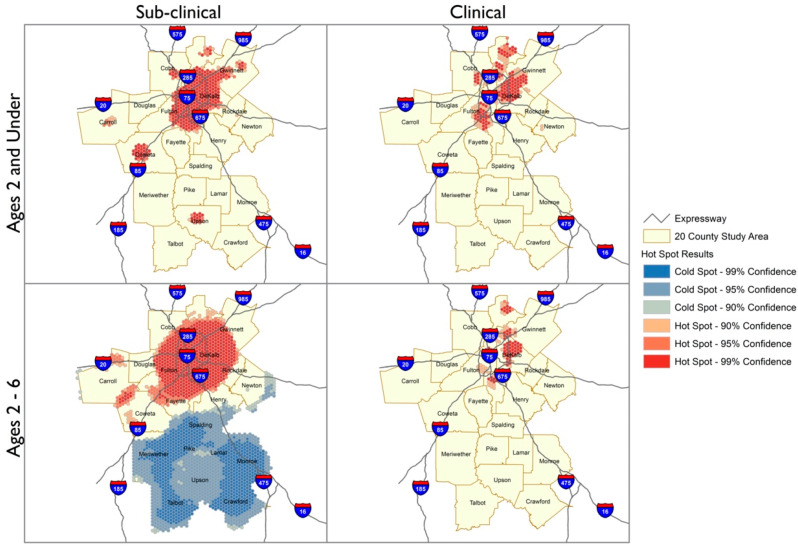
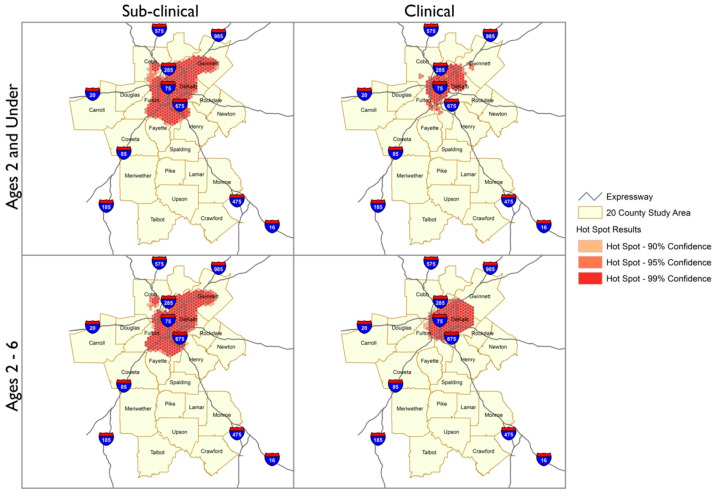
Lead (Pb) is a naturally occurring, highly toxic metal that has adverse effects on children across a range of exposure levels. Limited screening programs leave many children at risk for chronic low-level lead exposure and there is little understanding of what factors may be used to identify children at risk. We characterize the distribution of blood lead levels (BLLs) in children aged 0-72 months and their associations with sociodemographic and area-level variables. Data from the Georgia Department of Public Health's Healthy Homes for Lead Prevention Program surveillance database was used to describe the distribution of BLLs in children living in the metro Atlanta area from 2010 to 2018. Residential addresses were geocoded, and "Hotspot" analyses were performed to determine if BLLs were spatially clustered. Multilevel regression models were used to identify factors associated with clinical BBLs (≥5 µg/dL) and sub-clinical BLLs (2 to <5 µg/dL). From 2010 to 2018, geographically defined hotspots for both clinical and sub-clinical BLLs diffused from the city-central area of Atlanta into suburban areas. Multilevel regression analysis revealed non-Medicaid insurance, the proportion of renters in a given geographical area, and proportion of individuals with a GED/high school diploma as predictors that distinguish children with BLLs 2 to <5 µg/dL from those with lower (<2 µg/dL) or higher (≥5 µg/dL) BLLs. Over half of the study children had BLLs between 2 and 5 µg/dL, a range that does not currently trigger public health measures but that could result in adverse developmental outcomes if ignored.
铅(Pb)是一种天然存在的、毒性很高的金属,在一定的暴露水平范围内,对儿童会产生不良影响。有限的筛查项目使许多儿童面临慢性低水平铅暴露的风险,而且对于哪些因素可能用于识别处于风险之中的儿童,人们了解甚少。我们描述了 0-72 个月儿童的血铅水平(BLL)分布情况及其与社会人口学和地区水平变量的关联。我们使用了来自佐治亚州公共卫生部的健康家园铅预防计划监测数据库的数据,来描述 2010 年至 2018 年间居住在亚特兰大市区的儿童的 BLL 分布情况。对居住地址进行了地理编码,并进行了“热点”分析,以确定 BLL 是否存在空间聚类。使用多水平回归模型确定与临床 BBL(≥5 µg/dL)和亚临床 BLL(2 至 <5 µg/dL)相关的因素。2010 年至 2018 年,临床和亚临床 BLL 的地理定义热点从亚特兰市中心区扩散到了郊区。多水平回归分析显示,非医疗补助保险、特定地理区域内租客的比例以及具有普通教育发展证书/高中文凭的个人比例是区分 BLL 在 2 至 <5 µg/dL 之间的儿童与 BLL 较低(<2 µg/dL)或较高(≥5 µg/dL)的儿童的预测因素。超过一半的研究儿童的 BLL 处于 2 至 5 µg/dL 之间,这个范围目前不会触发公共卫生措施,但如果被忽视,可能会导致不良的发育结果。