Department of Epidemiology and Environmental Health, School of Public Health and Health Professions, University at Buffalo, Buffalo, NY 14260, USA.
Department of Community Health and Preventive Medicine, Morehouse School of Medicine, Atlanta, GA 30310, USA.
Int J Environ Res Public Health. 2023 Mar 2;20(5):4477. doi: 10.3390/ijerph20054477.
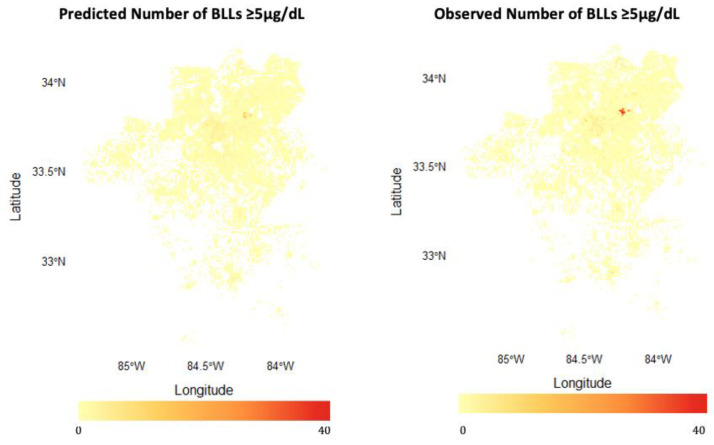
Low-level lead exposure in children is a major public health issue. Higher-resolution spatial targeting would significantly improve county and state-wide policies and programs for lead exposure prevention that generally intervene across large geographic areas. We use stack-ensemble machine learning, including an elastic net generalized linear model, gradient-boosted machine, and deep neural network, to predict the number of children with venous blood lead levels (BLLs) ≥2 to <5 µg/dL and ≥5 µg/dL in ~1 km raster cells in the metro Atlanta region using a sample of 92,792 children ≤5 years old screened between 2010 and 2018. Permutation-based predictor importance and partial dependence plots were used for interpretation. Maps of predicted vs. observed values were generated to compare model performance. According to the EPA Toxic Release Inventory for air-based toxic release facility density, the percentage of the population below the poverty threshold, crime, and road network density was positively associated with the number of children with low-level lead exposure, whereas the percentage of the white population was inversely associated. While predictions generally matched observed values, cells with high counts of lead exposure were underestimated. High-resolution geographic prediction of lead-exposed children using ensemble machine learning is a promising approach to enhance lead prevention efforts.
儿童低水平铅暴露是一个主要的公共卫生问题。更高分辨率的空间靶向将显著改善针对铅暴露预防的县和全州政策和计划,这些政策和计划通常在较大的地理区域内进行干预。我们使用堆叠集成机器学习,包括弹性网络广义线性模型、梯度提升机和深度神经网络,根据 2010 年至 2018 年间筛查的 92792 名 5 岁以下儿童的样本,预测在亚特兰大都会区约 1 公里的栅格单元中静脉血铅水平(BLL)≥2 至<5μg/dL 和≥5μg/dL 的儿童数量。使用排列预测器重要性和部分依赖关系图进行解释。生成预测值与观测值的地图以比较模型性能。根据 EPA 有毒物质释放清单中基于空气的有毒释放设施密度、贫困线以下人口比例、犯罪和道路网络密度,与低水平铅暴露儿童数量呈正相关,而白人人口比例则呈负相关。虽然预测值通常与观测值匹配,但铅暴露高的细胞被低估了。使用集成机器学习进行高分辨率地理预测铅暴露儿童是一种有前途的方法,可以加强铅预防工作。