Kim Sangwook, Lim Byeonghwi, Cho Joohyeon, Lee Seokhyun, Dang Chang-Gwon, Jeon Jung-Hwan, Kim Jun-Mo, Lee Jungjae
Department of Animal Science and Technology, Chung-Ang University, Anseong 17546, Gyeonggi-do, Korea.
Dairy Cattle Genetic Improvement Center, Nonghyup, Goyang 10292, Gyeonggi-do, Korea.
Animals (Basel). 2021 May 13;11(5):1392. doi: 10.3390/ani11051392.
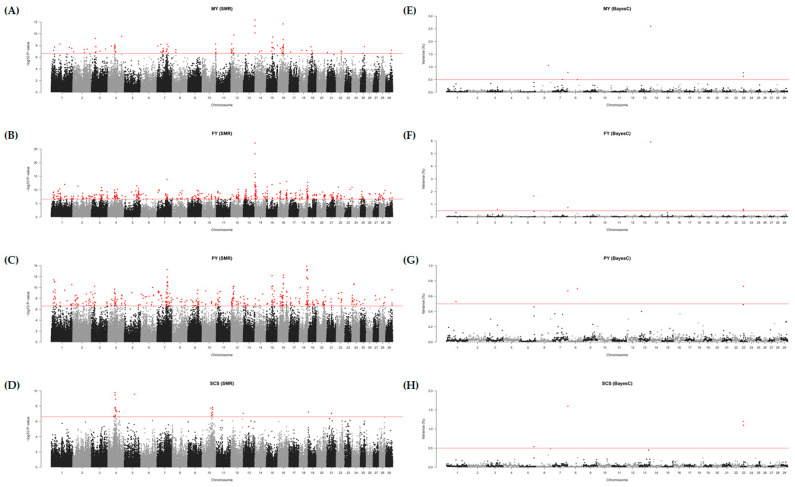
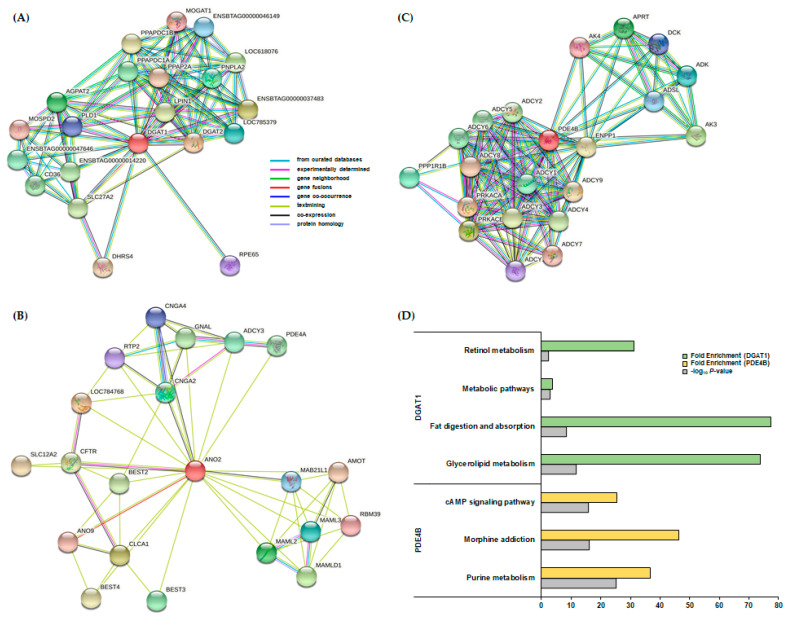
We performed a genome-wide association study and fine mapping using two methods (single marker regression: frequentist approach and Bayesian C (BayesC): fitting selected single nucleotide polymorphisms (SNPs) in a Bayesian framework) through three high-density SNP chip platforms to analyze milk production phenotypes in Korean Holstein cattle ( = 2780). We identified four significant SNPs for each phenotype in the single marker regression model: AX-311625843 and AX-115099068 on autosome (BTA) 14 for milk yield (MY) and adjusted 305-d fat yield (FY), respectively, AX-428357234 on BTA 18 for adjusted 305-d protein yield (PY), and AX-185120896 on BTA 5 for somatic cell score (SCS). Using the BayesC model, we discovered significant 1-Mb window regions that harbored over 0.5% of the additive genetic variance effects for four milk production phenotypes. The concordant significant SNPs and 1-Mb window regions were characterized into quantitative trait loci (QTL). Among the QTL regions, we focused on a well-known gene (diacylglycerol O-acyltransferase 1 ()) and newly identified genes (phosphodiesterase 4B (), and anoctamin 2 ()) for MY and FY, and observed that is involved in glycerolipid metabolism, fat digestion and absorption, metabolic pathways, and retinol metabolism, and is involved in cAMP signaling. Our findings suggest that the candidate genes in QTL are strongly related to physiological mechanisms related to the fat production and consequent total MY in Korean Holstein cattle.
我们通过三个高密度单核苷酸多态性(SNP)芯片平台,使用两种方法(单标记回归:频率论方法和贝叶斯C(BayesC):在贝叶斯框架中拟合选定的单核苷酸多态性)进行全基因组关联研究和精细定位,以分析韩国荷斯坦奶牛(n = 2780)的产奶表型。在单标记回归模型中,我们为每种表型鉴定出四个显著的SNP:分别位于常染色体(BTA)14上的AX-311625843和AX-115099068,用于产奶量(MY)和校正的305天脂肪产量(FY);位于BTA 18上的AX-428357234,用于校正的305天蛋白质产量(PY);位于BTA 5上的AX-185120896,用于体细胞评分(SCS)。使用BayesC模型,我们发现了显著的1兆碱基窗口区域,这些区域包含了四种产奶表型超过0.5%的加性遗传方差效应。将一致的显著SNP和1兆碱基窗口区域鉴定为数量性状位点(QTL)。在这些QTL区域中,我们重点关注了一个著名基因(二酰基甘油O-酰基转移酶1(DGAT1))以及新鉴定出的与MY和FY相关的基因(磷酸二酯酶4B(PDE4B)和八聚体通道蛋白2(ANO2)),并观察到DGAT1参与甘油脂质代谢、脂肪消化和吸收、代谢途径以及视黄醇代谢,PDE4B参与cAMP信号传导。我们的研究结果表明,QTL中的候选基因与韩国荷斯坦奶牛脂肪生成及随之而来的总产奶量相关的生理机制密切相关。