Olszańska Joanna, Pietraszek-Gremplewicz Katarzyna, Nowak Dorota
Department of Cell Pathology, Faculty of Biotechnology, University of Wroclaw, Joliot-Curie 14a, 50-383 Wroclaw, Poland.
Cancers (Basel). 2021 May 10;13(9):2281. doi: 10.3390/cancers13092281.
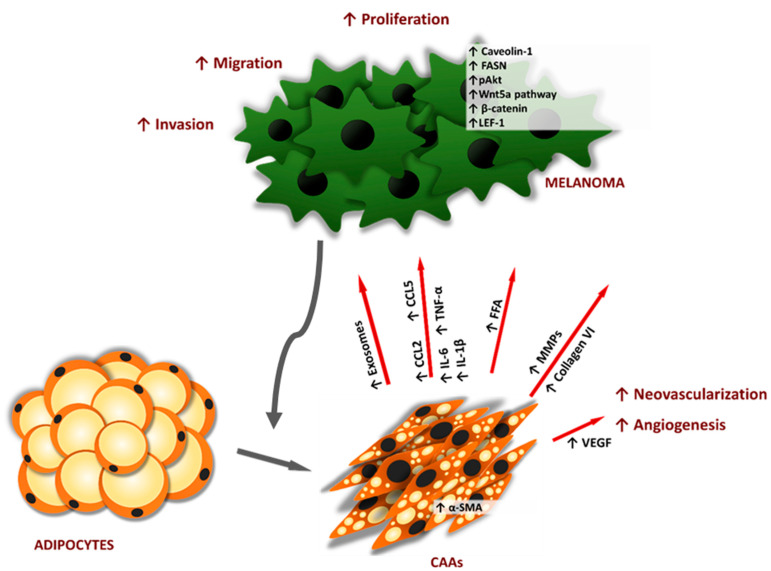
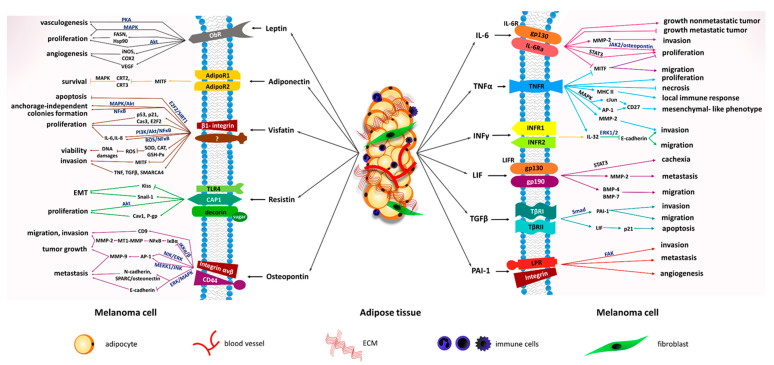
Obesity is a growing problem in the world and is one of the risk factors of various cancers. Among these cancers is melanoma, which accounts for the majority of skin tumor deaths. Current studies are looking for a correlation between obesity and melanoma. They suspect that a potential cause of its development is connected to the biology of adipokines, active molecules secreted by adipose tissue. Under physiological conditions, adipokines control many processes, including lipid and glucose homeostasis, insulin sensitivity, angiogenesis, and inflammations. However, when there is an increased amount of fat in the body, their secretion is dysregulated. This article reviews the current knowledge of the effect of adipokines on melanoma growth. This work focuses on the molecular pathways by which adipose tissue secreted molecules modify the angiogenesis, migration, invasion, proliferation, and death of melanoma cells. We also discuss the role of these factors as markers of incidence, metastasis, and melanoma patient survival. Understanding the functions of adipokines will lead to knowledge of whether and how obesity promotes melanoma growth. Further studies may contribute to the innovations of therapies and the use of adipokines as predictive and/or prognostic biomarkers.
肥胖是全球日益严重的问题,也是多种癌症的风险因素之一。黑色素瘤就是其中一种癌症,它导致了大多数皮肤肿瘤死亡。目前的研究正在探寻肥胖与黑色素瘤之间的关联。他们怀疑黑色素瘤发展的一个潜在原因与脂肪因子生物学有关,脂肪因子是脂肪组织分泌的活性分子。在生理条件下,脂肪因子控制许多过程,包括脂质和葡萄糖稳态、胰岛素敏感性、血管生成和炎症。然而,当体内脂肪量增加时,它们的分泌就会失调。本文综述了目前关于脂肪因子对黑色素瘤生长影响的知识。这项工作聚焦于脂肪组织分泌分子改变黑色素瘤细胞血管生成、迁移、侵袭、增殖和死亡的分子途径。我们还讨论了这些因子作为黑色素瘤发病率、转移和患者生存标志物的作用。了解脂肪因子的功能将有助于知晓肥胖是否以及如何促进黑色素瘤生长。进一步的研究可能有助于治疗方法的创新以及将脂肪因子用作预测和/或预后生物标志物。