Zarza Sandra Madariaga, Mezouar Soraya, Mege Jean-Louis
Aix-Marseille University, MEPHI, IRD, APHM, 13005 Marseille, France.
Institute Hospitalo-Universitaire-Méditerranée Infection, 13005 Marseille, France.
Pathogens. 2021 May 19;10(5):627. doi: 10.3390/pathogens10050627.
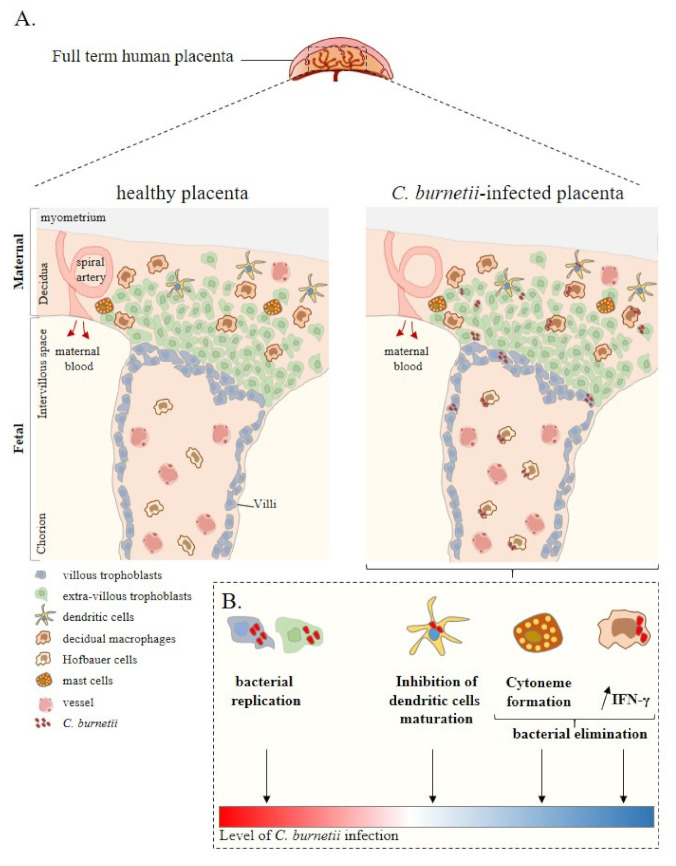
The infection of pregnant animals and women by , an intracellular bacterium, compromises both maternal health and foetal development. The placenta is targeted by as demonstrated by bacteriological and histological evidence. It now appears that placental strains of are highly virulent compared to reference strains and that placental injury involves different types of placental cells. Trophoblasts, the major placental cells, are largely infected by C. and may represent a replicating niche for the bacteria. The placenta also contains numerous immune cells, including macrophages, dendritic cells, and mast cells. Placental macrophages are infected and activated by in an unusual way of M1 polarisation associated with bacterial elimination. Placental mast cells eliminate bacteria through a mechanism including the release of extracellular actin filaments and antimicrobial peptides. In contrast, impairs the maturation of decidual dendritic cells, favouring bacterial pathogenicity. Our aim is to review infections of human placentas, paying special attention to both the action and function of the different cell types, immune cells, and trophoblasts targeted by in relation to foetal injury.
一种细胞内细菌感染怀孕动物和女性,会损害母体健康和胎儿发育。细菌学和组织学证据表明,胎盘是该细菌的攻击目标。现在看来,与参考菌株相比,胎盘菌株的毒性很强,而且胎盘损伤涉及不同类型的胎盘细胞。滋养层细胞是胎盘的主要细胞,大量被该细菌感染,可能是细菌的复制场所。胎盘还含有大量免疫细胞,包括巨噬细胞、树突状细胞和肥大细胞。胎盘巨噬细胞以与细菌清除相关的M1极化的异常方式被该细菌感染并激活。胎盘肥大细胞通过包括释放细胞外肌动蛋白丝和抗菌肽的机制清除细菌。相比之下,该细菌会损害蜕膜树突状细胞的成熟,从而有利于细菌致病性。我们的目的是综述人类胎盘的该细菌感染情况,特别关注该细菌针对的不同细胞类型、免疫细胞和滋养层细胞与胎儿损伤相关的作用和功能。