Department of Paediatrics and Adolescent Medicine, The University of Hong Kong, Hong Kong, China.
Department of Paediatrics, The Chinese University of Hong Kong, Hong Kong, China.
Genes (Basel). 2021 May 18;12(5):766. doi: 10.3390/genes12050766.
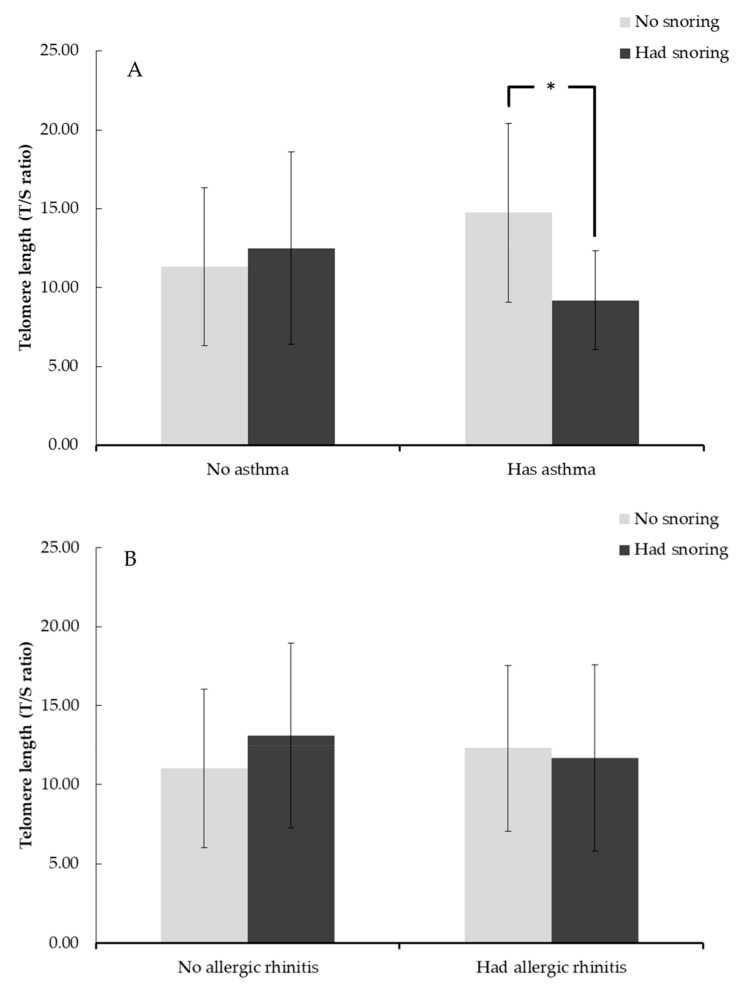
Atopic diseases can impose a significant burden on children and adolescents. Telomere length is a cellular marker of aging reflecting the impact of cumulative stress exposure on individual health. Since elevated oxidative stress and inflammation burden induced by chronic atopy and snoring may impact telomere length, this study aimed to investigate whether snoring would moderate the relationship between atopic diseases and telomere length in early adolescence. We surveyed 354 adolescents and their parents. Parents reported the adolescents' history of atopic diseases, recent snoring history as well as other family sociodemographic characteristics. Buccal swab samples were also collected from the adolescents for telomere length determination. Independent and combined effects of atopic diseases and snoring on telomere length were examined. Among the surveyed adolescents, 174 were reported by parents to have atopic diseases (20 had asthma, 145 had allergic rhinitis, 53 had eczema, and 25 had food allergy). Shorter TL was found in participants with a history of snoring and atopic diseases (β = -0.34, = 0.002) particularly for asthma (β = -0.21, = 0.007) and allergic rhinitis (β = -0.22, = 0.023). Our findings suggest that snoring in atopic patients has important implications for accelerated telomere shortening. Proper management of atopic symptoms at an early age is important for the alleviation of long-term health consequences at the cellular level.
特应性疾病会给儿童和青少年带来沉重负担。端粒长度是细胞衰老的标志物,反映了累积应激暴露对个体健康的影响。由于慢性特应性和打鼾引起的氧化应激和炎症负担增加可能会影响端粒长度,因此本研究旨在探讨打鼾是否会调节特应性疾病与青少年早期端粒长度之间的关系。我们调查了 354 名青少年及其家长。家长报告了青少年的特应性疾病史、近期打鼾史以及其他家庭社会人口统计学特征。还从青少年中采集口腔拭子样本以确定端粒长度。检查了特应性疾病和打鼾对端粒长度的独立和综合影响。在所调查的青少年中,有 174 名家长报告他们患有特应性疾病(20 名患有哮喘,145 名患有过敏性鼻炎,53 名患有湿疹,25 名患有食物过敏)。有打鼾和特应性疾病史的参与者的 TL 较短(β=-0.34,p=0.002),尤其是患有哮喘(β=-0.21,p=0.007)和过敏性鼻炎(β=-0.22,p=0.023)的参与者。我们的研究结果表明,特应性患者打鼾会导致端粒加速缩短。在早期对特应性症状进行适当管理对于减轻长期的细胞水平健康后果非常重要。