Heins Pascale, Boots Lizzy M M, Koh Wei Qi, Neven An, Verhey Frans R J, de Vugt Marjolein E
Alzheimer Centrum Limburg, Department of Psychiatry and Neuropsychology, School for Mental Health and Neuroscience, Maastricht University, 6200 MD Maastricht, The Netherlands.
School of Nursing and Midwifery, National University of Ireland Galway, H91 TK33 Galway, Ireland.
J Clin Med. 2021 May 25;10(11):2308. doi: 10.3390/jcm10112308.
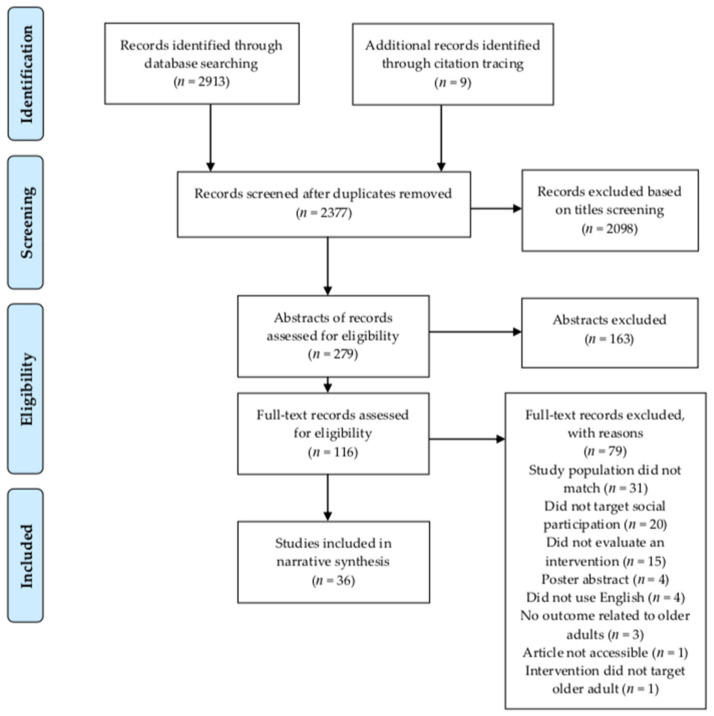
Social isolation in community-dwelling older adults with dementia is a growing health issue that can negatively affect health and well-being. To date, little attention has been paid to the role of technology in improving their social participation. This systematic review aims to provide a systematic overview of the effects of technological interventions that target social participation in community-dwelling older adults with and without dementia. The scientific databases Medline (PubMed), PsycINFO, CINAHL, Web of Science, and the Cochrane Library were systematically searched and independently screened by two reviewers. Results were synthesized narratively. The methodological quality of included studies was independently assessed by two reviewers. In total, 36 studies of varying methodological quality were identified. Most studies evaluated social networking technology and ICT training programs. Three studies focused on people with dementia. Quantitative findings showed limited effects on loneliness, social isolation, and social support. Nevertheless, several benefits related to social participation were reported qualitatively. Social interaction, face-to-face contact, and intergenerational engagement were suggested to be successful elements of technological interventions in improving the social participation of community-dwelling older adults. Rigorous studies with larger sample sizes are highly needed to evaluate the long-term effects of technology on the multidimensional concept of social participation.
社区中患有痴呆症的老年人的社会隔离是一个日益严重的健康问题,会对健康和幸福产生负面影响。迄今为止,技术在改善他们的社会参与方面所起的作用很少受到关注。本系统综述旨在系统概述针对有或没有痴呆症的社区居住老年人的社会参与的技术干预措施的效果。对科学数据库Medline(PubMed)、PsycINFO、CINAHL、科学网和考科蓝图书馆进行了系统检索,并由两名评审员独立筛选。结果进行了叙述性综合。纳入研究的方法学质量由两名评审员独立评估。总共确定了36项方法学质量各异的研究。大多数研究评估了社交网络技术和信息通信技术培训项目。三项研究聚焦于痴呆症患者。定量研究结果显示,对孤独感、社会隔离和社会支持的影响有限。然而,定性研究报告了一些与社会参与相关的益处。社会互动、面对面接触和代际参与被认为是技术干预措施改善社区居住老年人社会参与的成功要素。非常需要进行样本量更大的严谨研究,以评估技术对社会参与这一多维概念的长期影响。