Department of Industrial Engineering, Jazan University, Jazan 45142, Saudi Arabia.
Department of Industrial Engineering and Management Systems, University of Central Florida, Orlando, FL 162993, USA.
Int J Environ Res Public Health. 2021 May 23;18(11):5566. doi: 10.3390/ijerph18115566.
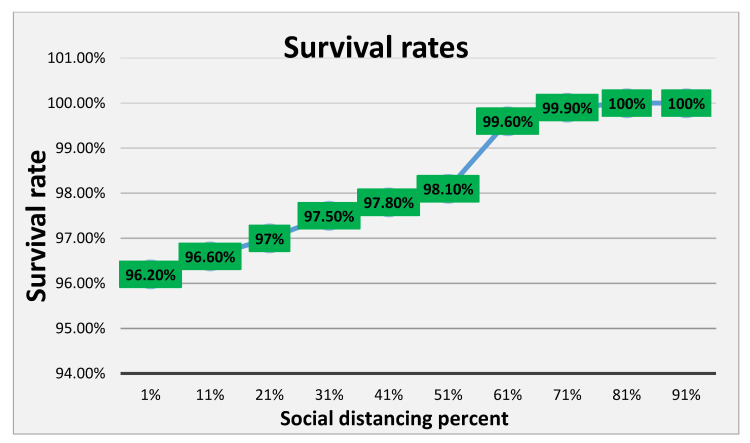
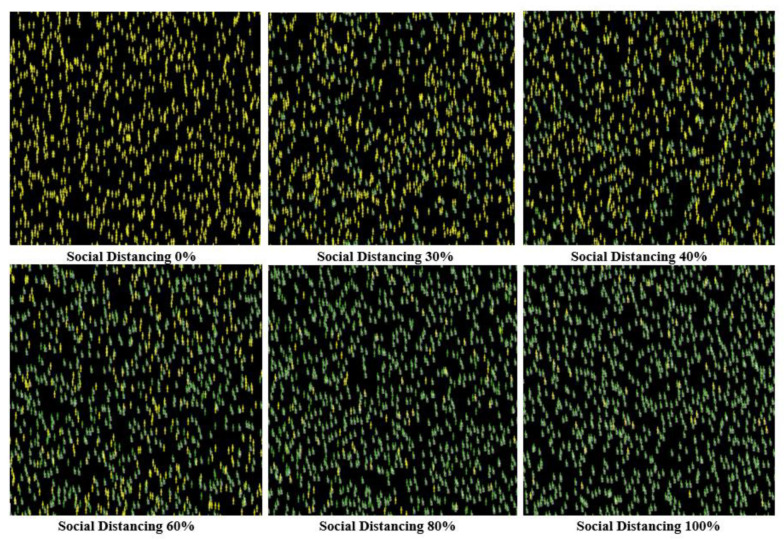
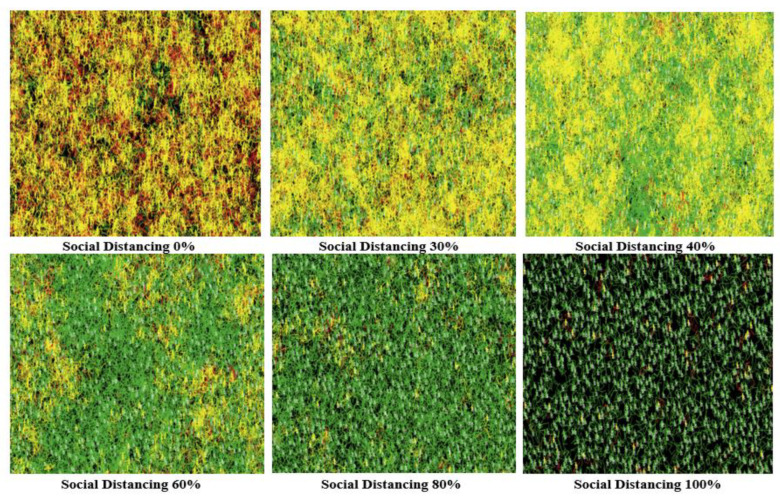
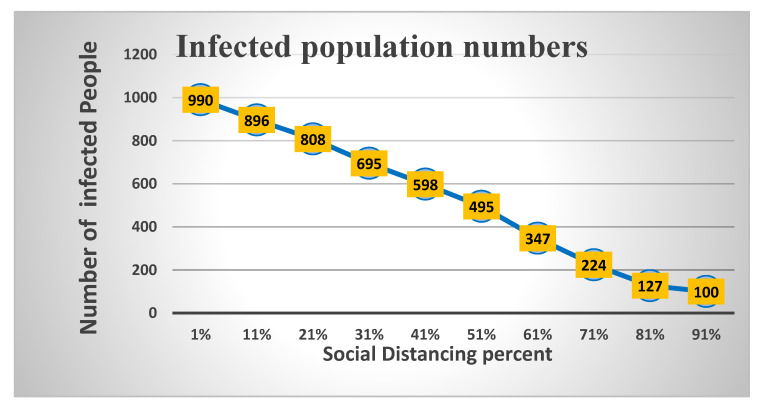
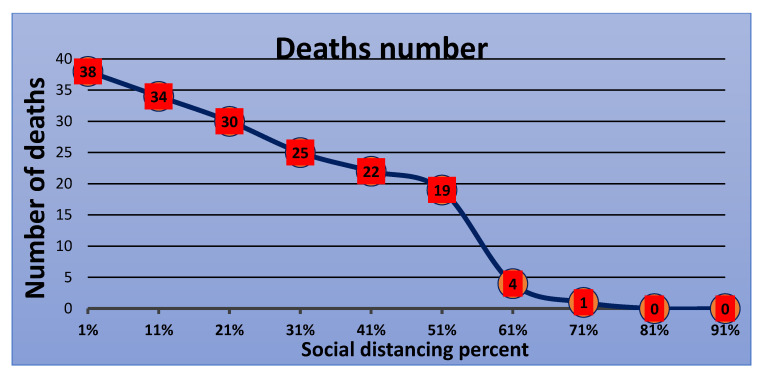
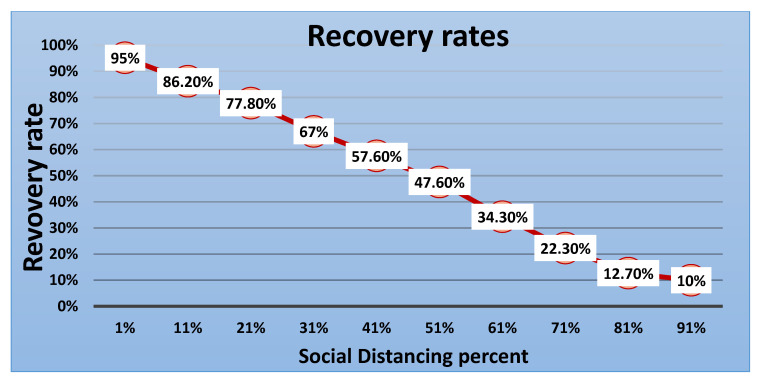
This paper studies the interplay between social distancing and the spread of the COVID-19 disease-a global pandemic that has affected most of the world's population. Our goals are to (1) to observe the correlation between the strictness of social distancing policies and the spread of disease and (2) to determine the optimal adoption level of social distancing policies. The earliest instances of the virus were found in China, and the virus has reached the United States with devastating consequences. Other countries severely affected by the pandemic are Brazil, Russia, the United Kingdom, Spain, India, Italy, and France. Although it is impossible to stop it, it is possible to slow down its spread to reduce its impact on the society and economy. Governments around the world have deployed various policies to reduce the virus spread in response to the pandemic. To assess the effectiveness of these policies, the system's dynamics of the society needs to be analyzed, which is generally not possible with mathematical linear equations or Monte Carlo methods because human society is a complex adaptive system with continuous feedback loops. Because of the challenges with the other methods, we chose agent-based methods to conduct our study. Moreover, recent agent-based modeling studies for the COVID-19 pandemic show significant promise in assisting decision-makers in managing the crisis by applying policies such as social distancing, disease testing, contact tracing, home isolation, emergency hospitalization, and travel prevention to reduce infection rates. Based on modeling studies conducted in Imperial College, increasing levels of interventions could slow the spread of disease and infection. We ran the model with six different percentages of social distancing while keeping the other parameters constant. The results show that social distancing affects the spread of COVID-19 significantly, in turn decreasing the spread of disease and infection rates when implemented at higher levels. We also validated these results by using the behavior space tool with ten experiments with varying social distancing levels. We conclude that applying and increasing social distancing policy levels leads to a significant reduction in infection spread and the number of deaths. Both experiments show that infection rates are reduced drastically when social distancing intervention is implemented between 80% to 100%.
本文研究了社交距离措施和 COVID-19 疾病传播之间的相互作用——这是一种全球性大流行病,已影响到世界上大多数人口。我们的目标是:(1)观察社交距离措施的严格程度与疾病传播之间的相关性;(2)确定社交距离措施的最佳采用水平。该病毒最早在中国发现,随后传播到美国,并造成了毁灭性的后果。其他受大流行病严重影响的国家是巴西、俄罗斯、英国、西班牙、印度、意大利和法国。虽然无法阻止它,但可以减缓其传播速度,以减少其对社会和经济的影响。世界各地的政府都采取了各种政策来减少病毒传播,以应对这一大流行病。为了评估这些政策的有效性,需要分析该系统的社会动态,而这通常无法使用数学线性方程或蒙特卡罗方法来实现,因为人类社会是一个具有连续反馈循环的复杂自适应系统。由于其他方法存在挑战,我们选择基于代理的方法来进行研究。此外,最近针对 COVID-19 大流行病的基于代理的建模研究表明,通过应用社交距离、疾病检测、接触者追踪、家庭隔离、紧急住院和旅行预防等政策,具有很大的潜力来帮助决策者管理危机,从而降低感染率。根据帝国理工学院进行的建模研究,增加干预水平可以减缓疾病的传播和感染。我们在保持其他参数不变的情况下,用六种不同的社交距离水平运行了该模型。结果表明,社交距离措施显著影响 COVID-19 的传播,在较高水平实施时,可相应降低疾病的传播和感染率。我们还通过使用具有十种不同社交距离水平的行为空间工具验证了这些结果。我们得出结论,实施和提高社交距离政策水平可显著减少感染传播和死亡人数。两个实验都表明,当实施 80%至 100%的社交距离干预时,感染率会大幅降低。