Prakash Navendu, Srivastava Bhavya, Singh Shveta, Sharma Seema, Jain Sonali
Department of Management Studies, Indian Institute of Technology Delhi, Vishwakarma Bhawan, Hauz Khas, New Delhi 110016, India.
Econ Hum Biol. 2022 Jan;44:101091. doi: 10.1016/j.ehb.2021.101091. Epub 2021 Dec 2.
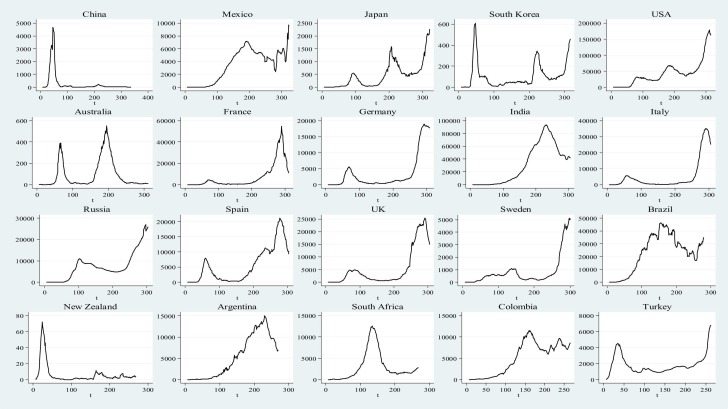
The epidemiological literature has widely documented the importance of social distancing interventions in containing the spread of the COVID-19 pandemic. However, the epidemiological measure of virus reproduction, R, provides a myopic view of containment, especially when the absolute number of cases is still high. The paper investigates cross-country variations concerning the impact of social distancing interventions on COVID-19 incidence by employing a statistical measure of containment, which models the daily number of cases as a structural time-series, state-space vector. Countries that adopt strict lockdown policies and provide economic support in the form of income augmentations and debt relief improve the response towards the pandemic. Countries like China and South Korea have been most influential in containing the spread of infections. European nations of France, Italy, Spain and the UK are witnessing a second wave of the virus, indicating that re-opening the European economy perhaps has instigated an exponential spread.
流行病学文献广泛记录了社会 distancing 干预措施在遏制 COVID-19 大流行传播方面的重要性。然而,病毒繁殖数 R 这一流行病学指标对遏制情况的看法较为短视,尤其是当病例绝对数量仍然很高时。本文通过采用一种遏制统计指标来研究各国在社会 distancing 干预措施对 COVID-19 发病率影响方面的差异,该指标将每日病例数建模为一个结构时间序列、状态空间向量。采取严格封锁政策并以增加收入和债务减免形式提供经济支持的国家,对疫情的应对效果更好。中国和韩国等国家在遏制感染传播方面最具影响力。法国、意大利、西班牙和英国等欧洲国家正经历病毒的第二波传播,这表明重新开放欧洲经济可能引发了指数级传播。