State Key Laboratory for Conservation and Utilization of Subtropical Agro-Bioresources, Guangdong Province Key Laboratory of Microbial Signals and Disease Control, Integrative Microbiology Research Centre, South China Agricultural University, Guangzhou 510642, China.
Guangdong Laboratory for Lingnan Modern Agriculture, Guangzhou 510642, China.
Int J Environ Res Public Health. 2021 May 28;18(11):5789. doi: 10.3390/ijerph18115789.
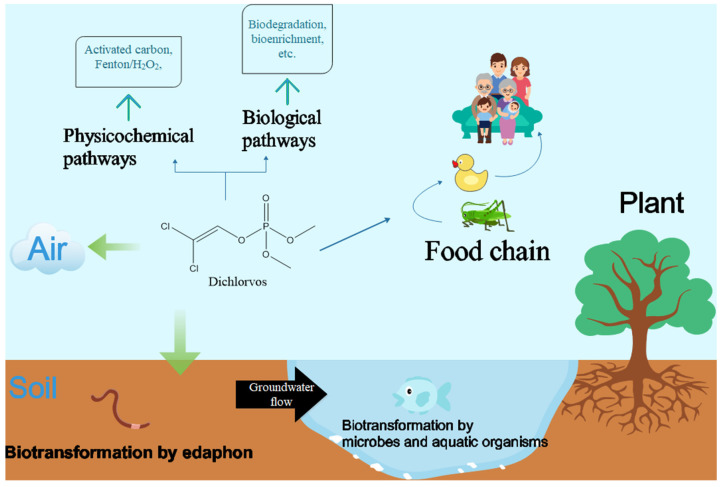
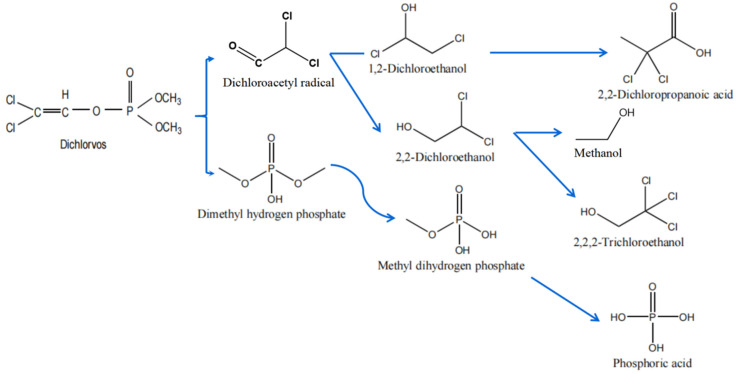
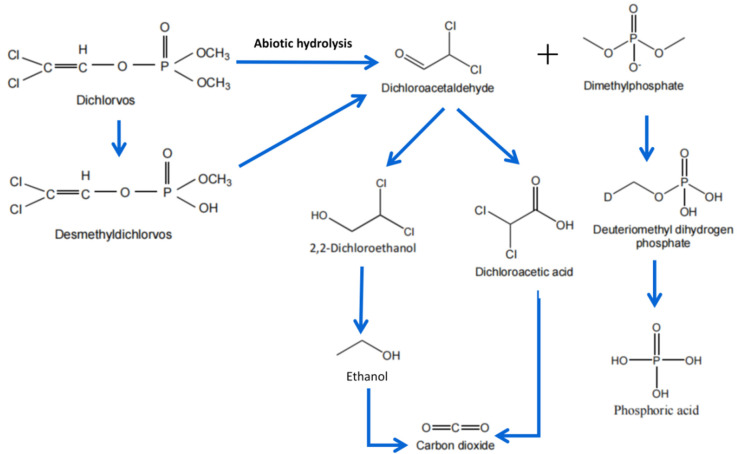
Dichlorvos (,-dimethyl -(2,2-dichlorovinyl)phosphate, DDVP) is a widely acknowledged broad-spectrum organophosphorus insecticide and acaracide. This pesticide has been used for more than four decades and is still in strong demand in many developing countries. Extensive application of DDVP in agriculture has caused severe hazardous impacts on living systems. The International Agency for Research on Cancer of the World Health Organization considered DDVP among the list of 2B carcinogens, which means a certain extent of cancer risk. Hence, removing DDVP from the environment has attracted worldwide attention. Many studies have tested the removal of DDVP using different kinds of physicochemical methods including gas phase surface discharge plasma, physical adsorption, hydrodynamic cavitation, and nanoparticles. Compared to physicochemical methods, microbial degradation is regarded as an environmentally friendly approach to solve several environmental issues caused by pesticides. Till now, several DDVP-degrading microbes have been isolated and reported, including but not limited to , , , , , , , , and . Moreover, the possible degradation pathways of DDVP and the transformation of several metabolites have been fully explored. In addition, there are a few studies on DDVP-degrading enzymes and the corresponding genes in microorganisms. However, further research relevant to molecular biology and genetics are still needed to explore the bioremediation of DDVP. This review summarizes the latest development in DDVP degradation and provides reasonable and scientific advice for pesticide removal in contaminated environments.
敌敌畏(-二甲基-(2,2-二氯乙烯基)磷酸酯,DDVP)是一种广泛认可的广谱有机磷杀虫剂和杀螨剂。这种农药已经使用了四十多年,在许多发展中国家仍然有很大的需求。DDVP 在农业中的广泛应用对生命系统造成了严重的危害。世界卫生组织国际癌症研究机构将 DDVP 列入 2B 类致癌物名单,这意味着存在一定程度的致癌风险。因此,从环境中去除 DDVP 引起了全世界的关注。许多研究已经测试了使用不同的物理化学方法去除 DDVP,包括气相表面放电等离子体、物理吸附、空化水力学和纳米颗粒。与物理化学方法相比,微生物降解被认为是一种环保的方法,可以解决由农药引起的许多环境问题。到目前为止,已经分离和报道了几种能够降解 DDVP 的微生物,包括但不限于 、 、 、 、 、 、 、 。此外,还充分探索了 DDVP 的可能降解途径和几种代谢物的转化。此外,在微生物中还存在一些关于 DDVP 降解酶和相应基因的研究。然而,仍需要进一步的分子生物学和遗传学研究来探索 DDVP 的生物修复。本文综述了 DDVP 降解的最新进展,为受污染环境中农药的去除提供了合理、科学的建议。