
法国谷物升降机工人的霉菌毒素暴露:生物监测与空气监测
Mycotoxins Exposure of French Grain Elevator Workers: Biomonitoring and Airborne Measurements.
作者信息
Ndaw Sophie, Remy Aurélie, Jargot Danièle, Antoine Guillaume, Denis Flavien, Robert Alain
机构信息
Toxicology and Biomonitoring Department, INRS-French National Research and Safety Institute for the Prevention of Occupational Accidents and Diseases, 54500 Vandoeuvre-Lés-Nancy, France.
Pollutant Metrology Department, INRS-French National Research and Safety Institute for the Prevention of Occupational Accidents and Diseases, 54500 Vandoeuvre-Lés-Nancy, France.
出版信息
Toxins (Basel). 2021 May 27;13(6):382. doi: 10.3390/toxins13060382.
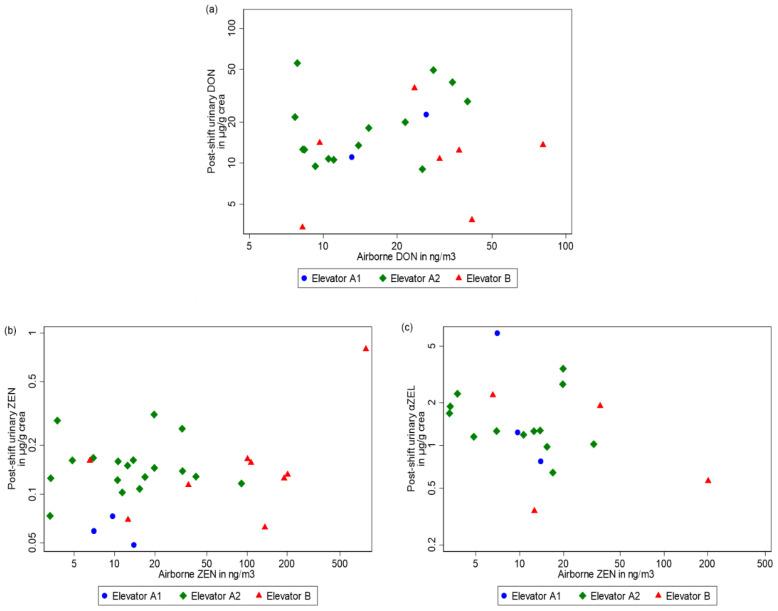
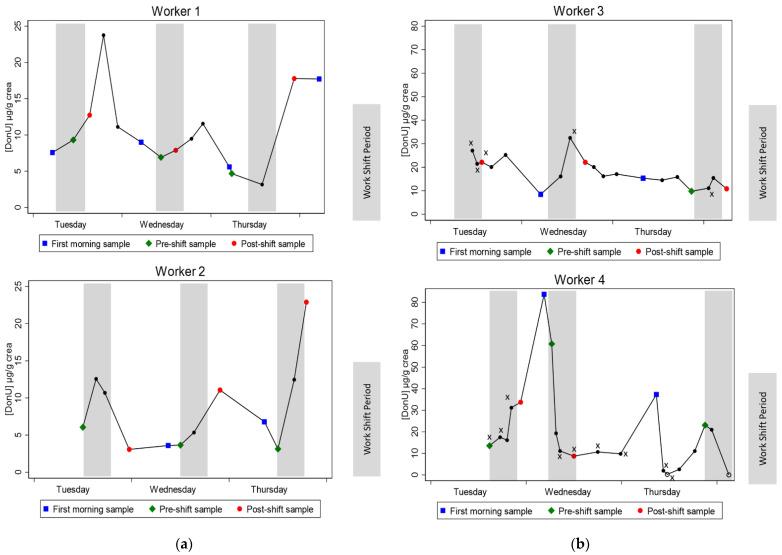
It is now recognized that additional exposure to mycotoxins may occur through inhalation of contaminated dust at a workplace. The aim of this study was to characterize the multi-mycotoxin exposure of French grain elevator workers using biomonitoring and airborne measurements. Eighteen workers participated in the study. Personal airborne dust samples were analyzed for their mycotoxin concentrations. Workers provided multiple urine samples including pre-shift, post-shift and first morning urine samples or 24 h urine samples. Mycotoxin urinary biomarkers (aflatoxin B1, aflatoxin M1, ochratoxin A, ochratoxin α, deoxynivalenol, zearalenone, α-zearalenol, β-zearalenol, fumonisin B1, HT-2 toxin and T-2 toxin) were measured using a liquid chromatography-high-resolution mass spectrometry method. Grain elevator workers were highly exposed to organic airborne dust (median 4.92 mg.m). DON, ZEN and FB1 were frequent contaminants in 54, 76 and 72% of air samples, respectively. The mycotoxin biomarkers quantified were DON (98%), ZEN (99%), α-ZEL (52%), β-ZEL (33%), OTA (76%), T-2 (4%) and HT-2 (4%). DON elimination profiles showed highest concentrations in samples collected after the end of the work shift and the urinary DON concentrations were significantly higher in post-shift than in pre-shift-samples (9.9 and 22.1 µg/L, respectively). ZEN and its metabolites concentrations did not vary according to the sampling time. However, the levels of α-/β-ZEL were consistent with an additional occupational exposure. These data provide valuable information on grain worker exposure to mycotoxins. They also highlight the usefulness of multi-mycotoxin methods in assessing external and internal exposures, which shed light on the extent and pathways of exposure occurring in occupational settings.
现在人们认识到,在工作场所吸入受污染的粉尘可能会导致额外接触霉菌毒素。本研究的目的是通过生物监测和空气传播测量来描述法国谷物升降机工人的多霉菌毒素暴露情况。18名工人参与了该研究。对个人空气传播粉尘样本进行霉菌毒素浓度分析。工人们提供了多个尿液样本,包括班前、班后和晨尿样本或24小时尿液样本。使用液相色谱-高分辨率质谱法测量霉菌毒素尿生物标志物(黄曲霉毒素B1、黄曲霉毒素M1、赭曲霉毒素A、赭曲霉毒素α、脱氧雪腐镰刀菌烯醇、玉米赤霉烯酮、α-玉米赤霉烯醇、β-玉米赤霉烯醇、伏马菌素B1、HT-2毒素和T-2毒素)。谷物升降机工人高度暴露于有机空气传播粉尘(中位数为4.92毫克/立方米)。脱氧雪腐镰刀菌烯醇(DON)、玉米赤霉烯酮(ZEN)和伏马菌素B1分别在54%、76%和72%的空气样本中为常见污染物。定量的霉菌毒素生物标志物为DON(98%)、ZEN(99%)、α-ZEL(52%)、β-ZEL(33%)、OTA(76%)、T-2(4%)和HT-2(4%)。DON消除曲线显示,在工作班次结束后采集的样本中浓度最高,班后尿液中DON浓度显著高于班前样本(分别为9.9和22. µg/L)。ZEN及其代谢物浓度不随采样时间变化。然而,α-/β-ZEL的水平与额外的职业暴露一致。这些数据提供了关于谷物工人接触霉菌毒素的宝贵信息。它们还突出了多霉菌毒素方法在评估外部和内部暴露方面的有用性,这有助于了解职业环境中暴露的程度和途径。
 Zotero 插件