Karanikas Evangelos, Daskalakis Nikolaos P, Agorastos Agorastos
Department of Psychiatry, 424 General Military Hospital, GR-56429 Thessaloniki, Greece.
II. Department of Psychiatry, Division of Neurosciences, School of Medicine, Aristotle University of Thessaloniki, GR-56430 Thessaloniki, Greece.
Brain Sci. 2021 May 29;11(6):723. doi: 10.3390/brainsci11060723.
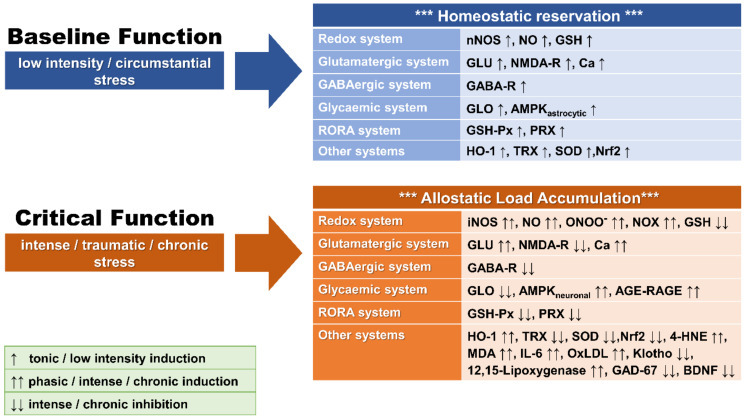
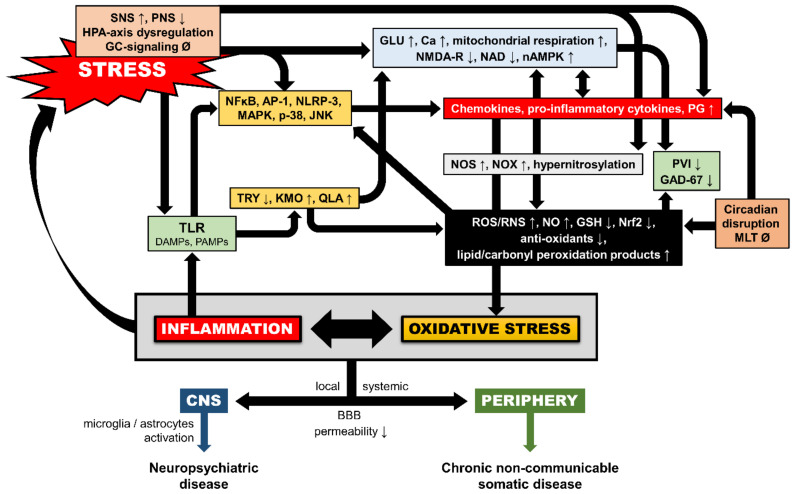
Traumatic stress may chronically affect master homeostatic systems at the crossroads of peripheral and central susceptibility pathways and lead to the biological embedment of trauma-related allostatic trajectories through neurobiological alterations even decades later. Lately, there has been an exponential knowledge growth concerning the effect of traumatic stress on oxidative components and redox-state homeostasis. This extensive review encompasses a detailed description of the oxidative cascade components along with their physiological and pathophysiological functions and a systematic presentation of both preclinical and clinical, genetic and epigenetic human findings on trauma-related oxidative stress (OXS), followed by a substantial synthesis of the involved oxidative cascades into specific and functional, trauma-related pathways. The bulk of the evidence suggests an imbalance of pro-/anti-oxidative mechanisms under conditions of traumatic stress, respectively leading to a systemic oxidative dysregulation accompanied by toxic oxidation byproducts. Yet, there is substantial heterogeneity in findings probably relative to confounding, trauma-related parameters, as well as to the equivocal directionality of not only the involved oxidative mechanisms but other homeostatic ones. Accordingly, we also discuss the trauma-related OXS findings within the broader spectrum of systemic interactions with other major influencing systems, such as inflammation, the hypothalamic-pituitary-adrenal axis, and the circadian system. We intend to demonstrate the inherent complexity of all the systems involved, but also put forth associated caveats in the implementation and interpretation of OXS findings in trauma-related research and promote their comprehension within a broader context.
创伤应激可能会长期影响外周和中枢易感性途径交叉处的主要稳态系统,并通过神经生物学改变导致创伤相关的异稳态轨迹的生物学嵌入,甚至在数十年后依然如此。最近,关于创伤应激对氧化成分和氧化还原状态稳态的影响,知识呈指数级增长。这篇全面的综述详细描述了氧化级联反应的组成部分及其生理和病理生理功能,并系统呈现了临床前和临床、遗传和表观遗传方面有关创伤相关氧化应激(OXS)的人体研究结果,随后将涉及的氧化级联反应大量整合为特定的、与创伤相关的功能性途径。大量证据表明,在创伤应激条件下,促氧化/抗氧化机制失衡,分别导致系统性氧化失调并伴有有毒氧化副产物。然而,研究结果存在很大的异质性,这可能与混杂因素、创伤相关参数有关,也与不仅涉及的氧化机制而且其他稳态机制的不明确方向性有关。因此,我们还在与其他主要影响系统(如炎症、下丘脑 - 垂体 - 肾上腺轴和昼夜节律系统)的更广泛系统相互作用范围内讨论创伤相关的氧化应激研究结果。我们旨在展示所有涉及系统的内在复杂性,同时也提出在创伤相关研究中实施和解释氧化应激研究结果时的相关注意事项,并促进在更广泛背景下对这些结果的理解。