Gu Gaoying, Meng Yichuan, Tan Ken, Dong Shihao, Nieh James C
CAS Key Laboratory of Tropical Forest Ecology, Xishuangbanna Tropical Botanical Garden, Chinese Academy of Sciences, Kunming 650000, China.
University of Chinese Academy of Sciences, Beijing 100049, China.
Biology (Basel). 2021 May 29;10(6):484. doi: 10.3390/biology10060484.
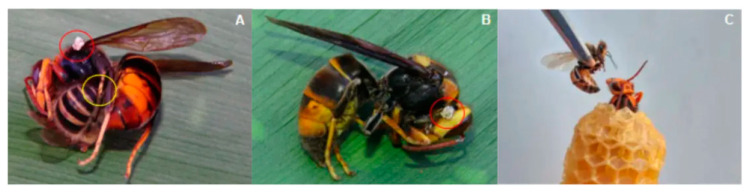
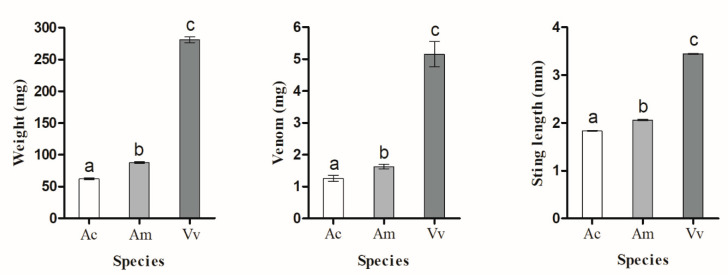
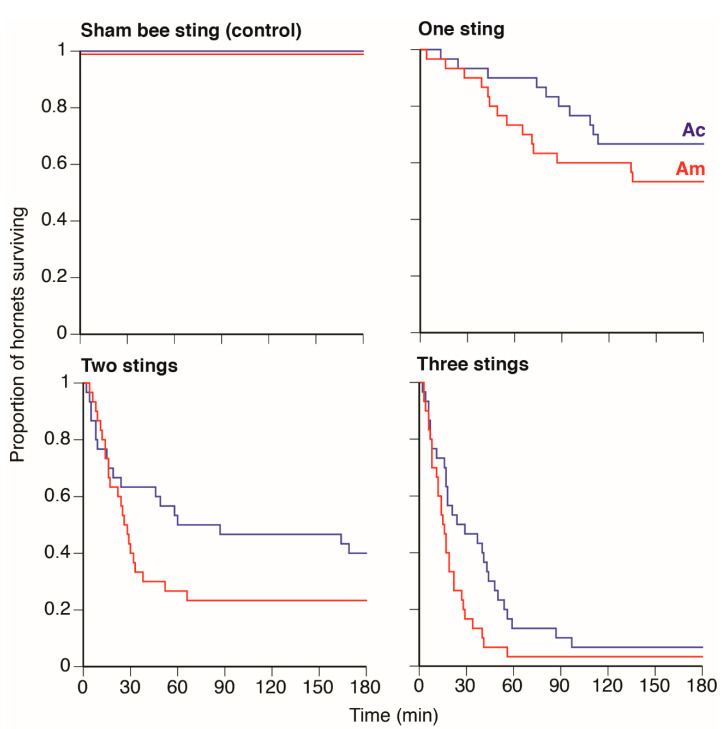
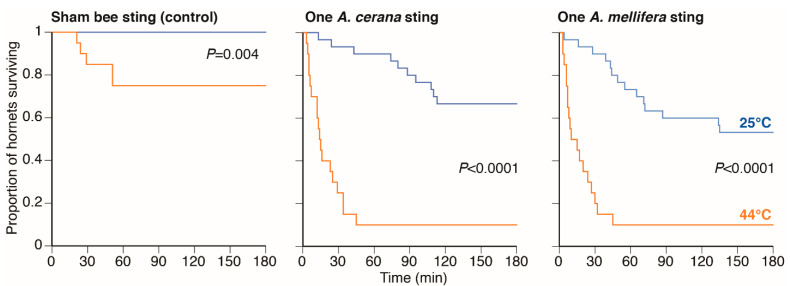
The heat ball defense of honey bees against their sympatric hornet predators is a classic and spectacular outcome of a co-evolutionary race. Hundreds of bees can encapsulate a hornet within a large ball that kills it with elevated heat. However, the role of stinging in this defense has been discounted, even though sting venom is an important weapon in bees. Surprisingly, no studies have tested the role of bee sting venom alone or in conjunction with elevated temperature on hornet survival. We surveyed dead hornets found near and inside colonies and found stings retained in hornet bodies, most often in an intersegmental neck-like region, the veracervix. Experimentally stinging hornets in this region with and guards significantly increased hornet mortality. The combination of sting venom and elevated heat ball temperature (44 °C) was the most lethal, although there was no synergistic interaction between sting venom and temperature. As expected, hornet mortality increased when they were stung more often. The average amount of venom per insect species and the length of stinger lancets correlated with insect mass. Sting venom thus remains important in the arms race between bees and their hornet predators.
蜜蜂针对同域黄蜂捕食者的热球防御是共同进化竞争的一个经典且引人注目的结果。数百只蜜蜂能将一只黄蜂包裹在一个大球中,通过升高的温度将其杀死。然而,尽管蜂毒是蜜蜂的一种重要武器,但蜇刺在这种防御中的作用却被忽视了。令人惊讶的是,尚无研究测试单独的蜂蜇毒液或其与升高温度共同作用对黄蜂生存的影响。我们调查了在蜂群附近和内部发现的死黄蜂,发现黄蜂体内留有蜇刺,大多位于节间类似颈部的区域,即真宫颈。用守卫蜂在该区域对黄蜂进行实验性蜇刺显著增加了黄蜂的死亡率。蜂蜇毒液与热球升高的温度(44摄氏度)相结合最为致命,尽管蜂蜇毒液与温度之间不存在协同相互作用。正如预期的那样,黄蜂被蜇刺的次数越多,死亡率越高。每种昆虫的平均毒液量和螫针长度与昆虫体重相关。因此,在蜜蜂与其黄蜂捕食者的军备竞赛中,蜂蜇毒液仍然很重要。