Nicolaus Copernicus Multidisciplinary Centre for Oncology and Traumatology, Department of Proliferative Diseases, 93-513 Lodz, Poland.
Department of Dermatology, Pediatric Dermatology and Dermatological Oncology, Medical University of Lodz, 91-347 Lodz, Poland.
Int J Mol Sci. 2021 May 31;22(11):5898. doi: 10.3390/ijms22115898.
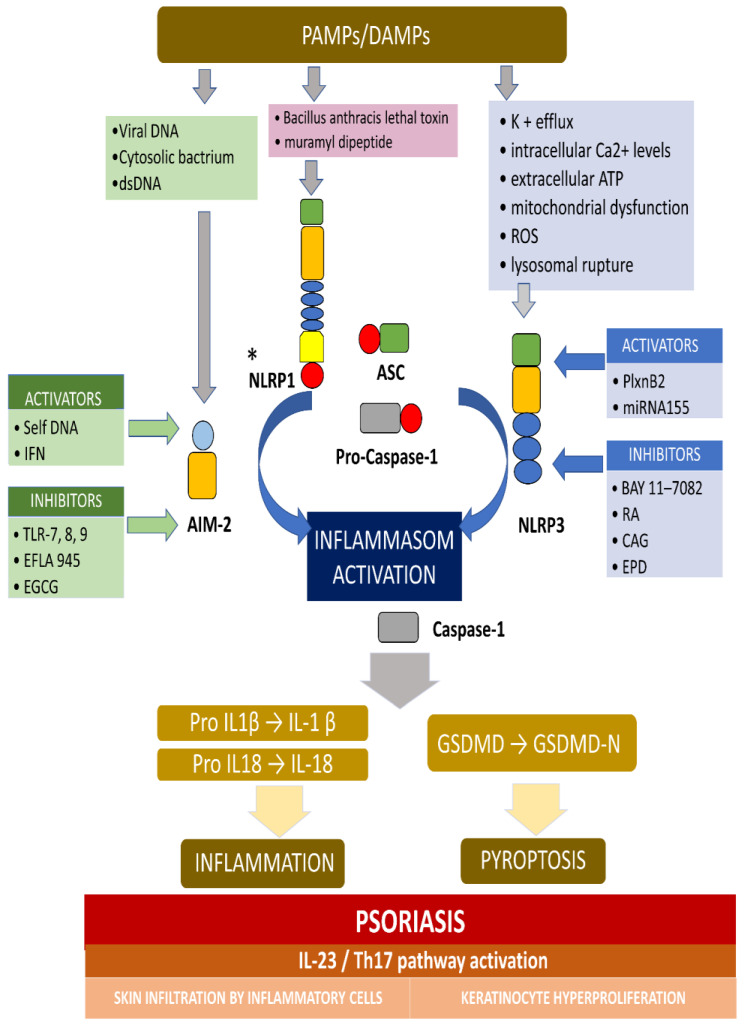
Inflammasomes are high-molecular-weight protein complexes that may cleave the two main proinflammatory cytokines, pro-interleukin-1β and pro-interleukin-18, into active forms, and contribute to psoriasis. Despite recent advances made in the pathogenesis of psoriasis, mainly studied as an autoimmune condition, activation of immune response triggers of psoriasis is still not completely understood. Recently, focus was placed on the role of inflammasomes in the pathogenesis of psoriasis. Multiple types of inhibitors and activators of various inflammasomes, inflammasome-related genes, and genetic susceptibility loci were recognized in psoriasis. In this systemic review, we collect recent and comprehensive evidence from the inflammasomes, NLRP1, NLRP3, and AIM2, in pathogenesis of psoriasis.
炎症小体是一种高分子量的蛋白质复合物,可将两种主要的前炎症细胞因子(白细胞介素-1β和白细胞介素-18)切割成活性形式,并导致银屑病。尽管银屑病的发病机制最近取得了进展,主要作为一种自身免疫性疾病进行研究,但银屑病免疫反应触发的激活仍不完全清楚。最近,人们关注炎症小体在银屑病发病机制中的作用。在银屑病中,已经识别出多种类型的各种炎症小体、炎症小体相关基因和遗传易感基因座的抑制剂和激活剂。在本系统综述中,我们从炎症小体、NLRP1、NLRP3 和 AIM2 中收集了银屑病发病机制的最新和综合证据。