Aleksandrov Vladimir, Kartseva Tania, Alqudah Ahmad M, Kocheva Konstantina, Tasheva Krasimira, Börner Andreas, Misheva Svetlana
Institute of Plant Physiology and Genetics, Bulgarian Academy of Sciences, Acad. G. Bonchev str., block 21, 1113 Sofia, Bulgaria.
Institute of Agricultural and Nutritional Sciences, Martin Luther University Halle-Wittenberg, Betty-Heimann-Straße 3, 06120 Halle (Saale), Germany.
Plants (Basel). 2021 May 31;10(6):1116. doi: 10.3390/plants10061116.
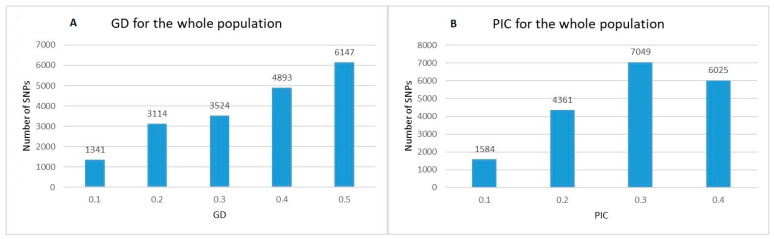
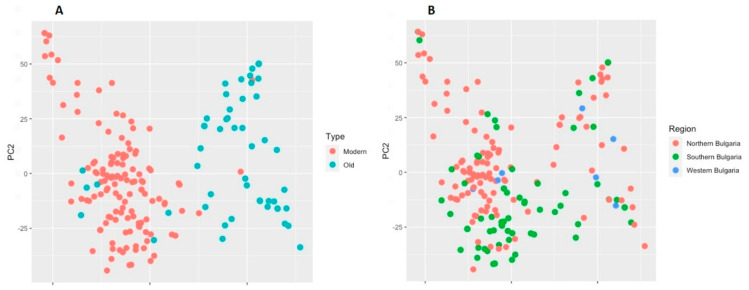
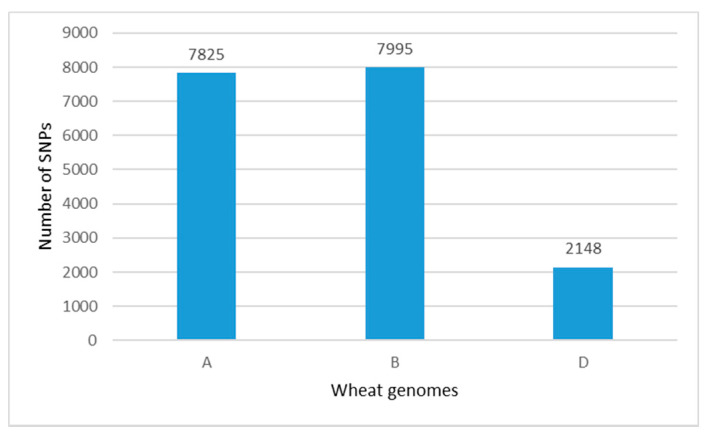
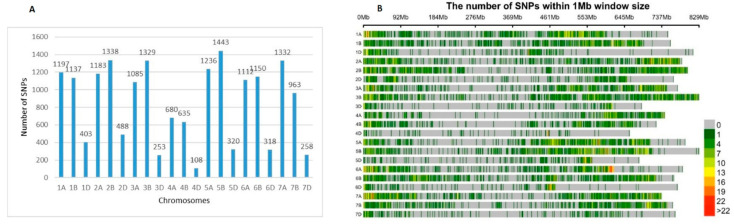
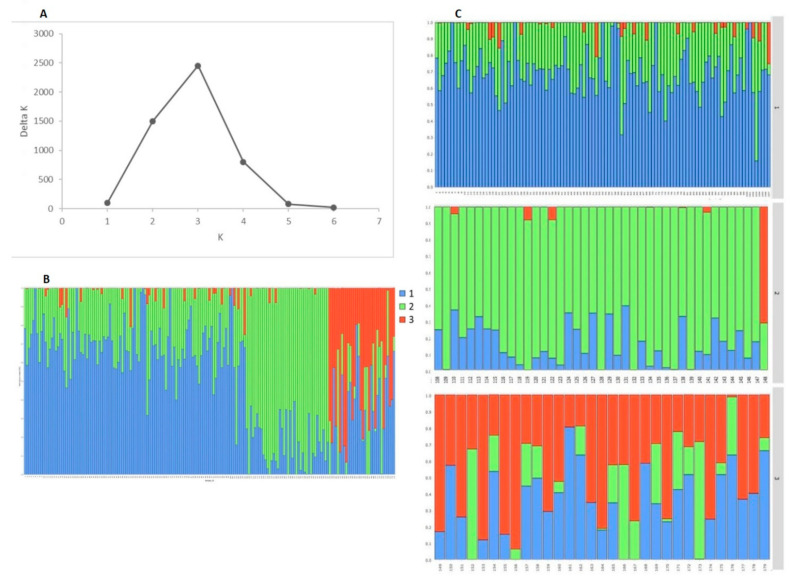
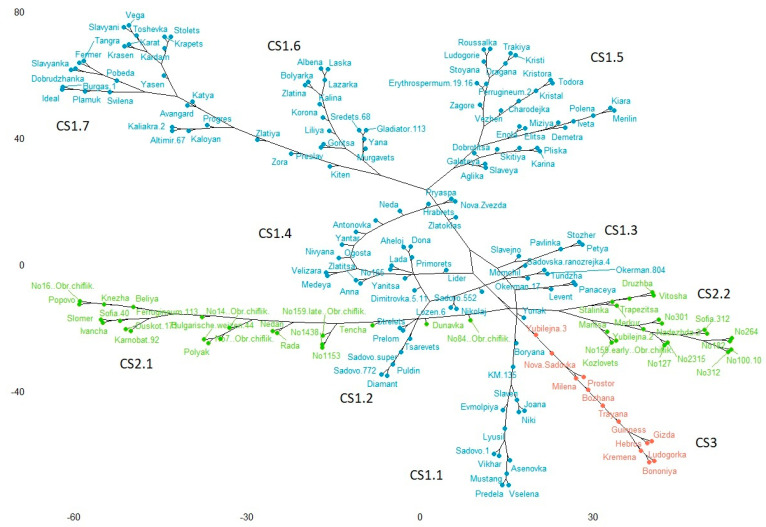
Genetic diversity and population structure are key resources for breeding purposes and genetic studies of important agronomic traits in crops. In this study, we described SNP-based genetic diversity, linkage disequilibrium and population structure in a panel of 179 bread wheat advanced cultivars and old accessions from Bulgaria, using an optimized wheat 25K Infinium iSelect array. Out of 19,019 polymorphic SNPs, 17,968 had а known chromosome position on the A (41%), B (42%) and D (11%) genome, and 6% were not assigned to any chromosome. Homoeologous group 4, in particular chromosome 4D, was the least polymorphic. In the total population, the Nei's gene diversity was within the range 0.1-0.5, and the polymorphism information content ranged from 0.1 to 0.4. Significant differences between the old and modern collections were revealed with respect to the linkage disequilibrium (LD): the average values for LD (), the percentage of the locus pairs in LD and the LD decay were 0.64, 16% and 3.3 for the old germplasm, and 0.43, 30% and 4.1 for the modern releases, respectively. Structure and k-means clustering algorithm divided the panel into three groups. The old accessions formed a distinct subpopulation. The cluster analysis further distinguished the modern releases according to the geographic region and genealogy. Gene exchange was evidenced mainly between the subpopulations of contemporary cultivars. The achieved understanding of the genetic diversity and structure of the Bulgarian wheat population and distinctiveness of the old germplasm could be of interest for breeders developing cultivars with improved characteristics. The obtained knowledge about SNP informativeness and the LD estimation are worthwhile for selecting markers and for considering the composition of a population in association mapping studies of traits of interest.
遗传多样性和群体结构是作物育种及重要农艺性状遗传研究的关键资源。在本研究中,我们使用优化的小麦25K Infinium iSelect芯片,描述了来自保加利亚的179个面包小麦先进品种和古老种质的基于单核苷酸多态性(SNP)的遗传多样性、连锁不平衡和群体结构。在19,019个多态性SNP中,17,968个在A(41%)、B(42%)和D(11%)基因组上有已知的染色体位置,6%未定位到任何染色体上。同源群4,特别是4D染色体,多态性最低。在整个群体中,Nei氏基因多样性在0.1 - 0.5范围内,多态性信息含量在0.1至0.4之间。古老种质和现代品种在连锁不平衡(LD)方面存在显著差异:古老种质的LD平均值(r)、处于LD状态的位点对百分比和LD衰减分别为0.64、16%和3.3,而现代品种分别为0.43、30%和4.1。Structure和k均值聚类算法将该群体分为三组。古老种质形成一个独特的亚群。聚类分析进一步根据地理区域和谱系区分了现代品种。基因交换主要发生在当代品种的亚群之间。对保加利亚小麦群体的遗传多样性和结构以及古老种质独特性的了解,可能会引起培育具有改良特性品种的育种者的兴趣。所获得的关于SNP信息性和LD估计的知识,对于选择标记以及在感兴趣性状的关联作图研究中考虑群体组成是有价值的。