Laboratory for Translational Cell Biology and Neurooncology, Department of Neurosurgery, University Hospital Erlangen-Nürnberg, Friedrich-Alexander University Erlangen-Nürnberg (FAU), 91054 Erlangen, Germany.
Institute of Physiology and Pathophysiology, Friedrich-Alexander University Erlangen-Nürnberg (FAU), 91054 Erlangen, Germany.
Int J Mol Sci. 2021 May 24;22(11):5518. doi: 10.3390/ijms22115518.
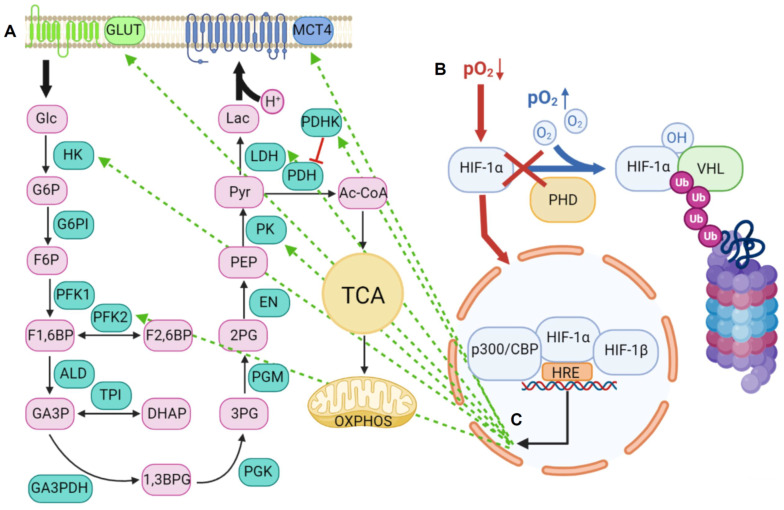
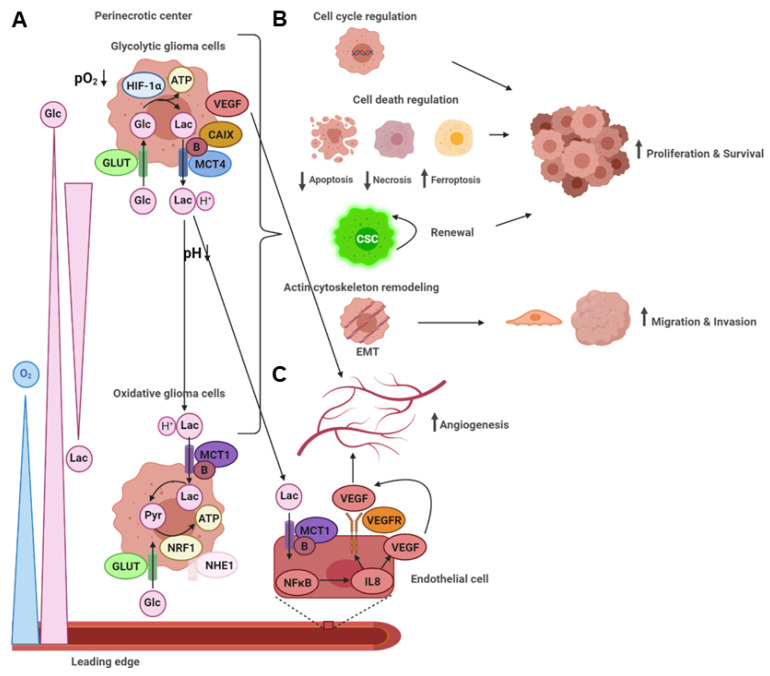
Malignant glioma represents a fatal disease with a poor prognosis and development of resistance mechanisms against conventional therapeutic approaches. The distinct tumor zones of this heterogeneous neoplasm develop their own microenvironment, in which subpopulations of cancer cells communicate. Adaptation to hypoxia in the center of the expanding tumor mass leads to the glycolytic and angiogenic switch, accompanied by upregulation of different glycolytic enzymes, transporters, and other metabolites. These processes render the tumor microenvironment more acidic, remodel the extracellular matrix, and create energy gradients for the metabolic communication between different cancer cells in distinct tumor zones. Escape mechanisms from hypoxia-induced cell death and energy deprivation are the result. The functional consequences are more aggressive and malignant behavior with enhanced proliferation and survival, migration and invasiveness, and the induction of angiogenesis. In this review, we go from the biochemical principles of aerobic and anaerobic glycolysis over the glycolytic switch, regulated by the key transcription factor hypoxia-inducible factor (HIF)-1α, to other important metabolic players like the monocarboxylate transporters (MCTs)1 and 4. We discuss the metabolic symbiosis model via lactate shuttling in the acidic tumor microenvironment and highlight the functional consequences of the glycolytic switch on glioma malignancy. Furthermore, we illustrate regulation by micro ribonucleic acids (miRNAs) and the connection between mutation status and glycolytic metabolism. Finally, we give an outlook about the diagnostic and therapeutic implications of the glycolytic switch and the relation to tumor immunity in malignant glioma.
恶性胶质瘤是一种预后不良的致命疾病,其对常规治疗方法产生耐药机制。这种异质性肿瘤的不同肿瘤区域形成了自己的微环境,其中癌细胞亚群相互交流。在不断扩大的肿瘤中心的缺氧适应导致糖酵解和血管生成开关,伴随着不同糖酵解酶、转运蛋白和其他代谢物的上调。这些过程使肿瘤微环境更加酸性,重塑细胞外基质,并为不同肿瘤区域中不同癌细胞之间的代谢通讯创造能量梯度。从而逃避缺氧诱导的细胞死亡和能量剥夺的机制。其功能后果是更具侵袭性和恶性的行为,表现为增强的增殖和存活、迁移和侵袭,以及血管生成的诱导。在这篇综述中,我们从有氧和无氧糖酵解的生化原理出发,探讨了糖酵解开关的调控机制,关键转录因子缺氧诱导因子(HIF)-1α,以及其他重要的代谢因子,如单羧酸转运蛋白(MCT)1 和 4。我们讨论了在酸性肿瘤微环境中通过乳酸穿梭实现的代谢共生模型,并强调了糖酵解开关对胶质瘤恶性的功能后果。此外,我们还说明了 micro ribonucleic acids (miRNAs) 的调节作用以及突变状态与糖酵解代谢之间的联系。最后,我们展望了糖酵解开关的诊断和治疗意义以及与恶性胶质瘤肿瘤免疫的关系。