Human Health Division, International Center of Insect Physiology and Ecology, P.O. Box 30772-00100, Nairobi, Kenya.
Complex Systems and Theoretical Biology Group, Laboratory of Research on Advanced Materials and Nonlinear Science (LaRAMaNS), Department of Physics, Faculty of Science, University of Buea, P.O. Box 63, Buea, Cameroon.
Int J Health Geogr. 2018 Jan 16;17(1):2. doi: 10.1186/s12942-018-0122-3.
Malaria is highly sensitive to climatic variables and is strongly influenced by the presence of vectors in a region that further contribute to parasite development and sustained disease transmission. Mathematical analysis of malaria transmission through the use and application of the value of the basic reproduction number (R) threshold is an important and useful tool for the understanding of disease patterns.
Temperature dependence aspect of R obtained from dynamical mathematical network model was used to derive the spatial distribution maps for malaria transmission under different climatic and intervention scenarios. Model validation was conducted using MARA map and the Annual Plasmodium falciparum Entomological Inoculation Rates for Africa.
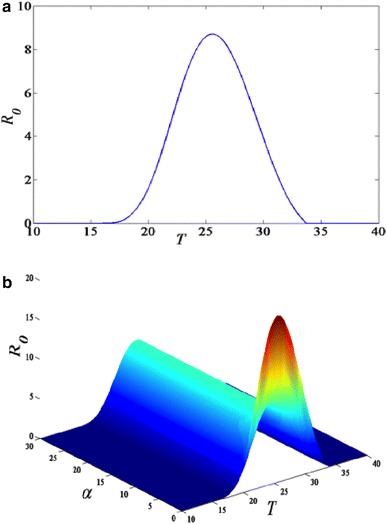
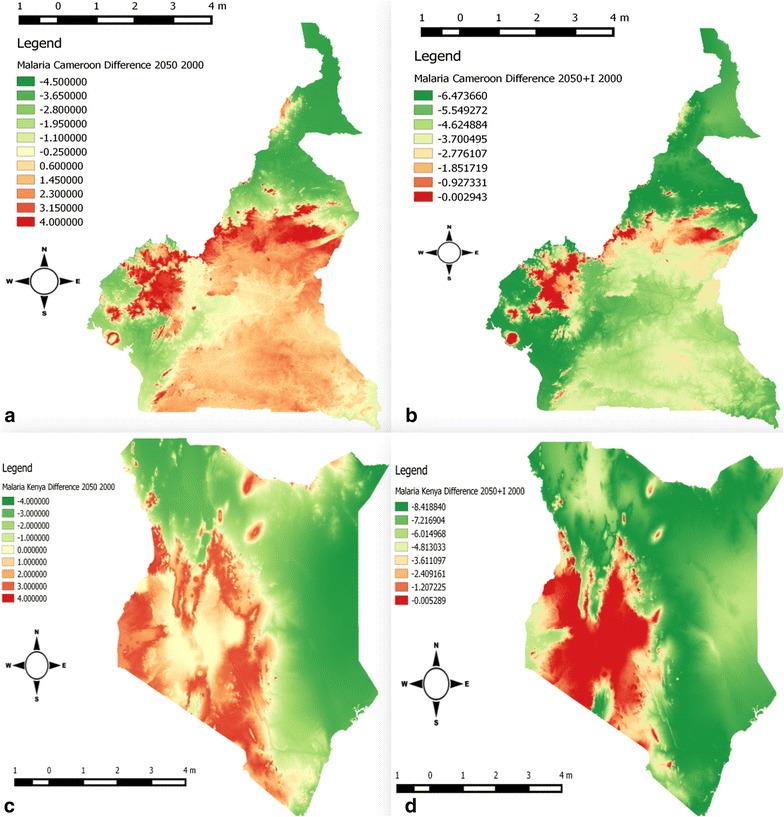
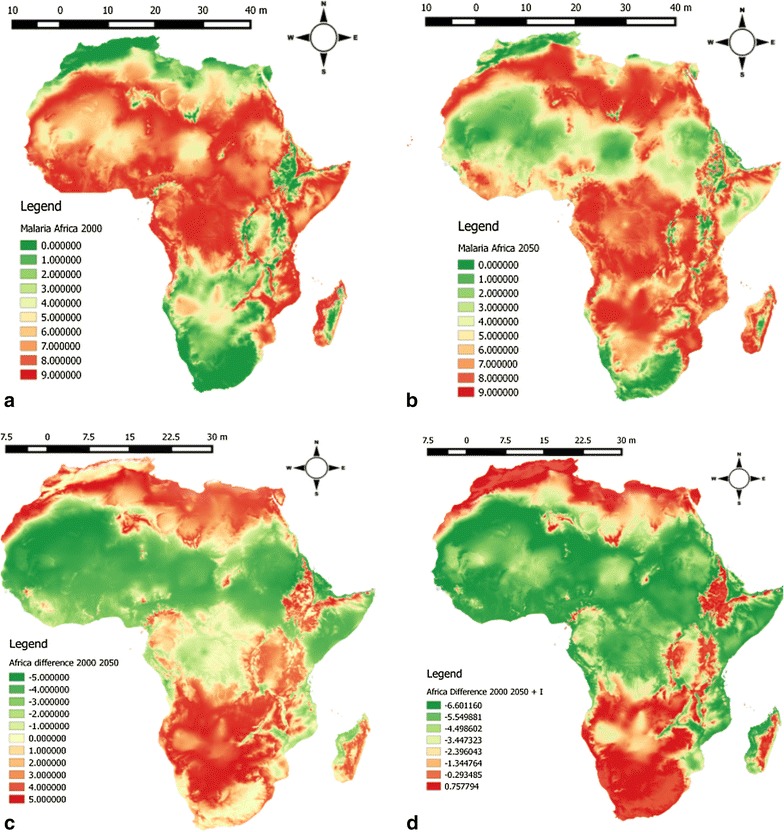
The inclusion of the coupling between patches in dynamical model seems to have no effects on the estimate of the optimal temperature (about 25 °C) for malaria transmission. In patches environment, we were able to establish a threshold value (about α = 5) representing the ratio between the migration rates from one patch to another that has no effect on the magnitude of R. Such findings allow us to limit the production of the spatial distribution map of R to a single patch model. Future projections using temperature changes indicated a shift in malaria transmission areas towards the southern and northern areas of Africa and the application of the interventions scenario yielded a considerable reduction in transmission within malaria endemic areas of the continent.
The approach employed here is a sole study that defined the limits of contemporary malaria transmission, using R derived from a dynamical mathematical model. It has offered a unique prospect for measuring the impacts of interventions through simple manipulation of model parameters. Projections at scale provide options to visualize and query the results, when linked to the human population could potentially deliver adequate highlight on the number of individuals at risk of malaria infection across Africa. The findings provide a reasonable basis for understanding the fundamental effects of malaria control and could contribute towards disease elimination, which is considered as a challenge especially in the context of climate change.
疟疾对气候变量高度敏感,并受到该地区病媒存在的强烈影响,这进一步促进了寄生虫的发展和持续的疾病传播。通过使用和应用基本繁殖数(R)阈值来分析疟疾传播的数学分析是理解疾病模式的重要和有用的工具。
从动态数学网络模型中获得的 R 的温度依赖性方面,用于在不同的气候和干预情景下得出疟疾传播的空间分布图。使用 MARA 地图和非洲每年疟原虫媒介接种率对模型进行验证。
动态模型中斑块之间的耦合的包含似乎对疟疾传播的最佳温度(约 25°C)的估计没有影响。在斑块环境中,我们能够建立一个阈值(约α=5),表示从一个斑块到另一个斑块的迁移率之间的比率,对 R 的幅度没有影响。这些发现使我们能够将 R 的空间分布图的制作限制在单个斑块模型上。使用温度变化进行的未来预测表明,疟疾传播区域将向非洲的南部和北部转移,并且干预情景的应用将导致该大陆疟疾流行地区的传播大大减少。
这里采用的方法是一项单独的研究,该研究使用从动态数学模型中得出的 R 来定义当代疟疾传播的极限。它通过简单地操纵模型参数,为衡量干预措施的影响提供了独特的前景。在大规模进行预测时,可以提供可视化和查询结果的选项,当与人口联系起来时,可能会在整个非洲潜在地突出显示有感染疟疾风险的个人数量。这些发现为理解疟疾控制的基本影响提供了合理的依据,并可能有助于消除疾病,这在气候变化的背景下被认为是一个挑战。