Killgore William D S, Cloonan Sara A, Taylor Emily C, Anlap Ian, Dailey Natalie S
University of Arizona College of Medicine, United States.
J Affect Disord Rep. 2021 Jul;5:100163. doi: 10.1016/j.jadr.2021.100163. Epub 2021 May 28.
To combat the spread of COVID-19, many communities implemented restrictions on personal movement, often referred to as "lockdowns." We hypothesized that continued lockdowns might be associated with increased feelings of aggression.
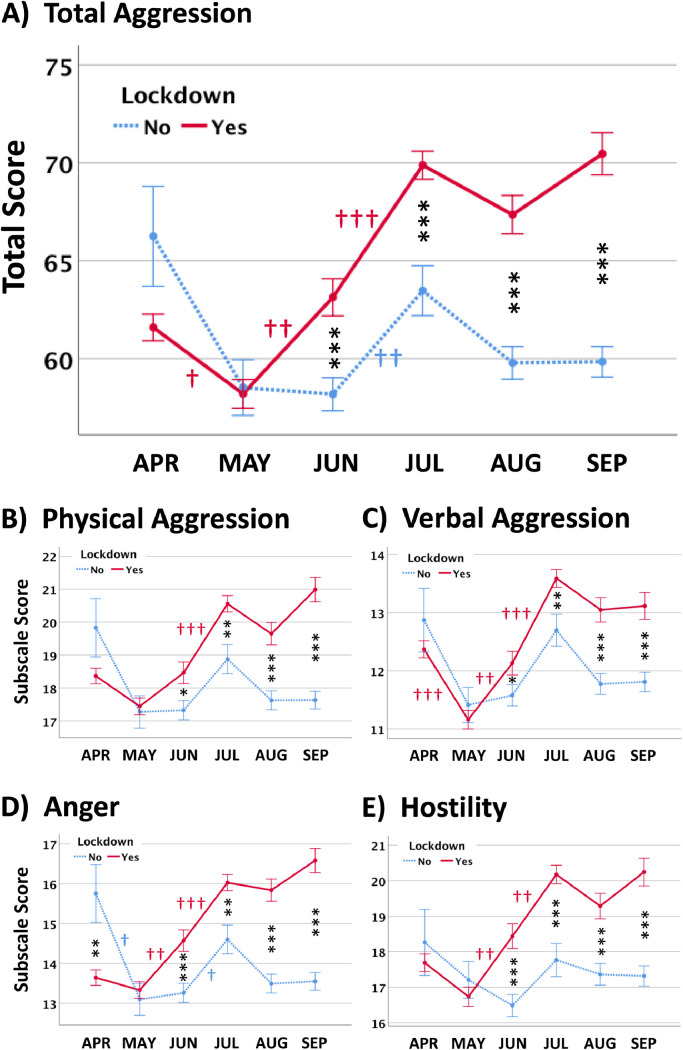
Over the first six months of the COVID-19 pandemic, the Buss-Perry Aggression Questionnaire (BPAQ) was administered to a total of 5,928 adults distributed proportionally from across the United States during independent online cross-sectional surveys collected each month. Data across the 6-month period were compared between those under lockdown versus those not under such restrictions.
BPAQ Total Aggression scores showed a significant main effect for both month and lockdown status as well as a significant interaction effect, with increasing scores evident for those reporting that they were under lockdown relative to those reporting no restrictions. This same pattern was evident for all four subscales of the BPAQ, including Physical Aggression, Verbal Aggression, Anger, and Hostility.
Random sampling of the entire population was not possible, so generalization of the results should be made with caution. Additionally, data were collected cross-sectionally and cannot be considered to reflect longitudinal change within individuals. Finally, the cross-sectional survey design means that it is impossible to infer that the lockdowns caused the increase in aggression.
Lockdowns were associated with elevated levels of aggression that were higher in later months of the national pandemic response.
为抗击新冠病毒病(COVID-19)的传播,许多社区实施了人员流动限制措施,通常称为“封锁”。我们推测持续的封锁可能与攻击情绪增加有关。
在COVID-19大流行的前六个月期间,每月通过独立的在线横断面调查,对总共5928名按比例从美国各地招募的成年人施测布斯-佩里攻击问卷(BPAQ)。比较了6个月期间处于封锁状态者与未受此类限制者的数据。
BPAQ攻击总分在月份和封锁状态方面均显示出显著的主效应以及显著的交互效应,报告处于封锁状态者相对于报告无限制者的得分呈上升趋势。BPAQ的所有四个子量表,包括身体攻击、言语攻击、愤怒和敌意,均呈现出相同的模式。
无法对整个人口进行随机抽样,因此结果的推广应谨慎。此外,数据是横断面收集的,不能认为反映了个体内部的纵向变化。最后,横断面调查设计意味着无法推断封锁导致了攻击行为的增加。
封锁与攻击水平升高有关,在国家大流行应对措施的后期月份中攻击水平更高。